Custom Search
Shoes mask weaknesses, barefoot highlights strengths
Showing posts with label barefoot laminitis. Show all posts

Friday, 7 September 2012

Should I shoe my laminitic?

Way way back I deshod a laminitic that was due to be PTS that week. Shod by an award winning farrier there was apparently nothing more that could be done. The horse was lame and fed up having suffered conventional therapy and been box rested for months. The owner was naturally distraught.

It wasn't long before he was sound and even with a few dietary hiccups he has been sound since and is currently in work.

I want to walk you through a few pictures - some are gross so finish your dinner before you read any further.

This first picture shows 'Henry', one of my freeze dried legs.  You can see the lamellar wedge, imminent solar penetration and how the poor thing is forced to bear weight on the tip of his pedal bone.
'Henry' NB wedge, angle of the pedal bone & heel height
 
 These photos tell their own story.  I understand that some HCP are taught to maintain the toe wall between 45 and 55 degrees. 
 
Initially this is done by rasping out the outer hoof wall, then when this option is exhausted (no outer wall left), the heel is raised. 
 
This of course will invert the hoof capsule so the horse has to bear progressively more weight on the tip of the pedal bone.  This is both painful and injurous to the horse.
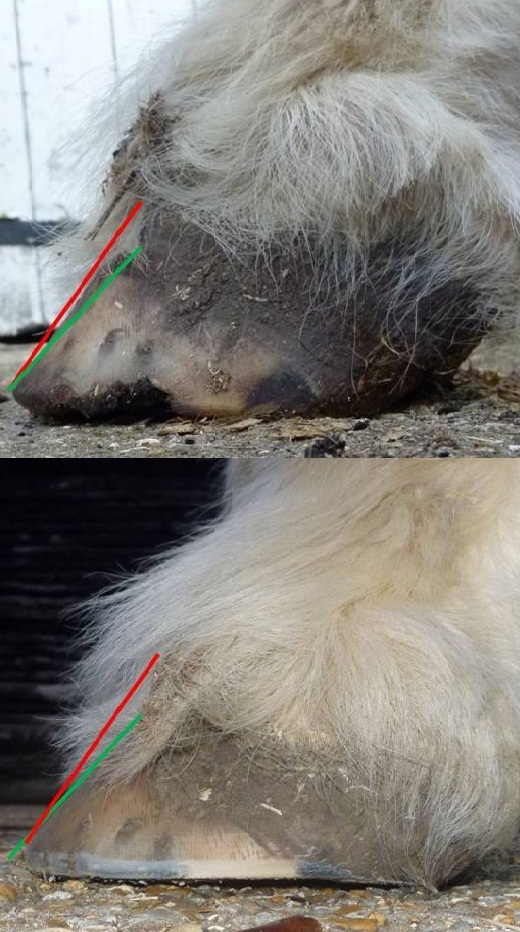

Red is pre trim angle, green post
NB heel height - pre trim, sole has been dechalked
With no more heel raising, but a complete diet change and lots of movement, the healing angle (HA) can grow down.
 
You can see the difference betwee the angle the horse was forced to maintain when he had shoes on, compared with the angle the hoof is meant to grow at. 
NB Wedge, red line denotes HA when fully grown in
You can see the history of trials and tribulations the horse went through during his rehab - dietary misadventures mostly.  But the last bit of wedge is nearly grown out.  Horse was sound throughout.
A few months later, not without hiccups and the wedge has
all but grown out.  Hoof in background has yet to be trimmed.

Thursday, 5 July 2012

What a difference five weeks makes

First I've been off sick for about 3.5 weeks so am now so far behind I almost don't know where to start and it's a bit daunting.  I never was that hot for the admin side of any job and now I have a ton of stuff to do.

Second - it brings to the fore another, hidden benefit of barefoot.  Most hooves can, if necessary, on occasion, go that extra week or two in between trims.  They may get considerably more tatty than their carers prefer, a few may get a little wonky, but the earth continues to turn and the hooves continue to be able to function.  It's only with the rehabs that I really start to worry.  And this is one of those.

Immediately post deshoe, just started to clean up

Five weeks later, to the day, note how toe wall
has grown in, the proportions have improved,
with a wider heel, buttresses coming back,
and frog bulking up


There is still a long way to go, but the horse was considerably more comfortable after the trim and is positively bouncing in boots and pads.  Not bad for five weeks.  And yes there have been some modest dietary modifications and an exercise programme put in place.  A few socks may have bitten the dirt too..........

A traditional viewpoint is that shoes 'protect' hooves. The hooves in these photos are actually stronger and more capable without metal nailed to them. It is going to take time to grow out the damage and in the interim boots and pads are invaluable.

Monday, 28 May 2012

Getting the whole picture

I often feel exceptionally blessed. I get to work every day with great people who are determined to put their horse's welfare first. 

The hoof below tells a familiar story, the owner was concerned that something wasn't quite right, but literally couldn't see the foot for the shoes.
Note: event lines upper hoof wall, rasped out lower hoof
wall, crumbling toe edge, dorsal wall is flat at 12 o'clock
from coronary band to floor


Note stretched white line and absence of hoof wall
at toe. Sole is flat and thin.  Hoof proportions are out
the foot has run forward.


This scenario is often seen in cases of undiagnosed laminitis in the shod horse, or perhaps where shoeing has been used to 'treat' a laminitic case, or where the horse has had laminitis in the past which had been treated and then gets it again, but the shoes mask the symptoms.

The owner of this horse couldn't see quite how extensive the damage was, because the shoes were doing a splendid job of covering it up.  So good on them for following their instincts and getting the shoes pulled.  And please send them your best wishes for a speedy recovery for this horse.

It is going to take a while to grow down a decent, healthy foot that has this much damage. In the meantime the horse can be kept comfortable with boots and pads which provide all the support and protection a damaged hoof needs, but which allow easy access for regular inspection and treatment. And when we know the foot is sufficiently comfortable the horse will be able to work in the boots and pads too.

Monday, 12 September 2011

Deadly white powder, often cut with other substances

Some will swear it is ok in moderation, many can eat a fair bit and be absolutely fine, for others even a small amount is not so good.

Yes folks, today's post is about sugar :-)

The chemical formula for almost all sugars is CnH2nOn (n is between 3 and 7).  The last time I checked this holds true for organic sugar too..........  and yes organic sugar has the same number of calories and the same potential to rot your teeth and in excess upset the balance of your horse's hind gut.

As you know, horses have evolved to eat lots of low sugar, high fibre forage.  They are so good at it that they can survive in areas too harsh for cows and sheep.  Yes, get that, horses are tougher than cows or sheep.

In future posts I may get into more of the biology of why too much sugar is bad for our horses, but for now can I urge you to read the small print of what you are feeding your treasured friends.

As an example; - a feed shop near me is selling grass seed advertised as 'Suitable for low sugar pony paddocks.'  Well I read the label, it is over 70% Rye grass (seed) and when I checked out the varieties of Rye included (yes I am a geek), they average over 18% sugar in the growing season.  Now bearing in mind we are aiming for less than 10% - how the ? is that low sugar?  It certainly isn't suitable for horses or ponies.

Ditto various products marketed as safe for laminitics or 'low sugar'.  Don't read the marketing guff on the side of the bag (in the UK) look for the white label that should be stitched on (it often falls off).  This will detail how much sugar is in the bag, as well as listing the ingredients. And don't be fooled; many molasses free products aren't, instead they contain a modified form of molasses which has had a tiny bit of the sugar taken out.  But it is still sweet and sugary!

Some will argue that a bit of sugar never did any harm.  Well the owners of the horses with behavioural problems; that on a low sugar diet have transformed into paragons of good behaviour, but when slipped the odd carrot or bit of grass and turn into 'monsters' will argue otherwise :-)  Guys you know who you are! :-)

And let's not forget the LGL's sound on well soaked hay, but footy when not.

Wednesday, 31 August 2011

Hoof reading

I'm giving you just one photo. Tell me what you see. There is a huge amount of background to this with more photos, but first I want your views. So if you want more photos of this case you need to work a little for it! :-)

Wednesday, 23 March 2011

Sound isn't always pretty

This horse had been lame for many months and was deteriorating when the carer decided to have the shoes removed and try barefoot.  X-rays showed an eroded 'ski tip' pedal bone.  Laminitis had obviously been a problem for a considerable time, disguised by the shoes.  Despite veterinary intervention, no one had offered dietary advice other than that the horse needed to lose weight.  This was true, but for a classic fatty the question was how?

It took a while for the carers to make the emotional adjustments required (it was hard for them to stop feeding sugary treats) - but they really applied themselves and 8 weeks 6 days later, on a diet consistently mostly of soaked hay the horse came sound. 

The horse is now in full work and has beautiful movement.  The hooves?  well they have deteriorated a little this past February (it's caught a lot of people out) so the grazing muzzle is going back on.  The horse though is still sound.

Note, although the feet aren't as good as they could be, they are a major improvement on the recently deshod version.

Just deshod

March 2010

Friday, 3 December 2010

Let there be light part two - laminitic cob hind foot


Left = Before/Right = After

Before trim

Partly cleaned

Wall height

Trimmed
Heel view post trim


This is the foot from 'Are you being kept in the dark?'  If you look at the Before picture you will see that it looks like 1'000s of other cob feet across the globe.  Only this one is attached to a horse that has been in a box for 9+ months with laminitis which has not resolved.  Advice has included PTS.  Upon shoe removal the owner was advised that the feet could not be trimmed because there was nothing to take off.

In the partly cleaned photo the chalk has been scraped (not cut) from the sole and the bars have been started.  Wall height shows just how high the walls have become.  That is a standard hoof pick for comparison purposes.  Walls should not be the sole weight bearing mechanism for a horse, it causes all sorts of problems.  You can see that prior to trimming this horse had no option but to largely walk on his walls.  With laminitis, that was probably quite painful and not at all helpful for the healing process.

The trimmed view (solar) shows a rather different foot.  Longer than wide, the stretched white line at the toe is now clearly visible.  The quarters which had looked flared, now look quite tight and much of the gunk in the walls and around the frog and on the sole has gone.

The final view across the back of the foot shows a frog which can now be properly engaged.  It is slightly prominant but it will flatten and toughen quite quickly.  The hoof is no longer peripheral loading and the true state of the sole can be seen.

This foot has been trimmed to the AANHCP guidelines, which seek to facilitate nature rather than work against it.

This horse now has limited turnout onto a nettle patch, which he loves and will shortly be going out onto a track.  Photos when we have them.

Sunday, 21 November 2010

Hind gut acidosis - learn to love your microbes

And you thought that all you had to worry about was your horse?

They might not be fluffy and cuddly and have super cute silvery moustaches, but the microbes in your horses gut deserve your love...... :-)  if only because keeping them healthy helps keep your horse healthy too.

You'd be forgiven for thinking I've given microbes quite enough attention in this earlier post.  I certainly did, but some recent conversations with various horsey peeps including experienced professionals made me realise just how little is known about hind gut acidosis (where the hind gut becomes too acidic).

The symptoms of hind gut acidosis can range from mild short term 'not quite right' to reduced appetite, mild colic symptoms, diarrhoea, development of repetative behaviours such as wood chewing, weaving, and box walking,weight loss, reduced performance and according to some sources eventually laminitis.  The first thing you may notice is sour smelling, loose droppings.

Techy Stuff

The equine digestive system alters ph along its length; the stomach is acidic, the cecum is relatively neutral and the colon is alkaline.

The beneficial fibre digesting bacteria in the cecum such as Ruminococcus albus and Fibrobacter succinogenes are sensitive to decreases in pH. For optimal performance, these bacteria prefer an environment with a pH between 6.5 and 7.0.  When pH drops below 6.0, which is often the case with subclinical acidosis, fibre digesting bacteria become less efficient and begin to die off.

In contrast, lactate-producing and lactate-utilizing bacteria thrive in an environment with a low pH.  Certain microorganisms such as Streptococcus bovis actually shift their metabolism and produce lactic acid rather than VFA (volatile fatty acids) when exposed to acidic conditions, serving only to compound the problem.

Some research uses ph testing of droppings to test for cecal acidosis, but this doesn't appear to be a widespread, general practice.  Certainly a number of vets I have spoken to were not that familiar with the practice, but I can't help but think I might try it, just to see what I get.

Hind gut acidosis is usually triggered by over ingestion of sugars/starches.  There is some anecdotal evidence that other factors, such as stress or over use of antibiotics may also be implicated.

If you suspect your horse has hind gut acidosis, and you know you are not over feeding sugars/starches, then please speak to your vet about potential causes and how to manage them.  Acidosis is not trivial and shouldn't be ignored.

Personal note
My own horse Grace arrived with sour smelling droppings and had them for ages, months even.  At first I just dismissed it as 'normal for her'.  Now I know it is not normal and I can help her by feeding a 'proper' good quality probiotic. (As well as watching her diet etc).

Grace also makes me think about causes, her diet could not practically be any lower in sugar/starch, but she still on occasion gets rancid droppings.  I pretty much have these incidents tied into stressful episodes.  So as I can not predict when Grace will stress out, I now feed probiotics routinely.  A little expensive, but better than her being ill.

Thursday, 18 November 2010

Mind your language - laminitis/LGL/Sub Clinical Laminitis

No pictures today.  Just a bit of a health warning.

You have probably realised that the words laminitis and navicular are used a lot. But unfortunately they mean very different things depending on who is using them.

For example there has been some research publicised this year which promotes the finding that fructans do not cause laminitis.  Now this might very well be the case.  But for this particular piece of research the definition of laminitis does not include all those horses which we barefooters observe going footy after X length time out on grass.  The definition for the research is quite limited and only includes (if I understand my source correctly) cases where there has been (their words not mine) rotation of the pedal bone.

My source tells me that for the purposes of the research (and in other areas too) laminitis is viewed in the same way as a heart attack; kind of on or off.  It is not viewed as something with a continum.  So the spectrum of symptoms/degrees of problem that many barefooters are so familiar with are not recognised by the veterinary community involved in the research.  Or if a back office technician wants to recognise it they are not allowed to because of the directives they are working under.

Second element of health warning.  The research also promotes the idea that obesity alone is the causal factor for laminitis.  This research seems to quietly ignore all the thin horses that get laminitis and the separate piece of research that shows that a high proportion of in work/fit racehorses also have sub clinicial laminitis.  I did raise this point and it is not that the researchers are unaware of these points, but they don't fit the story and are not allowed to discuss them. Which naturally makes me then question the research; because research shouldn't have an agenda and findings should not (in my opinion) be reported 'pick and mix' style.

So what does the research show?  Well to be grossly over simplistic; if you put a large and completely unnatural bolus of fructans by stomach tube into a horse then they won't get rotation of the pedal bone.  And that is about it - from a practical point of view.

How does it help the barefooter who knows that 30 mins on spring/summer grass will make their thin/fit horse lame?  Not at all. So it is back to bare paddocks and grazing muzzles for now.

Now onto 'navicular'.  Not everyone is aware that the diagnosis of 'navicular' is a rather loose one.  That changes to the navicular bone on x-ray can be pretty meaningless, that lots of horses have changes and are perfectly sound and lots don't have changes and are lame.  Equally 'navicular disease' is confused with 'navicular syndrome'.  Again unfortunately the latter tends to be the diagnosis when the horse has caudal heel pain (pain in the back of the foot) and the source of pain can not be identified.

What research does show is that soft tissue damage of the DDFT happens in advance of damage to the navicular bone.  What is starting to happen is that people (a very small minority) are realising that poor foot health is a key contributor and if the foot is brought back to health (yes you have guessed, good diet, appropriate exercise, natural trim) then the symptoms resolve.  No need for drugs or expensive shoes.

But it is important to distinguish between 'disease'; usually referring to damage to the navicular bone and 'syndrome' which is a catch all that sometimes involves damage to the DDFT but not always. I don't know anyone who is claiming that the barefoot approach mends diseased bones.

Please also be aware that 'syndrome' can include any kind of caudal heel pain, even if the horse only actually has a bad case of thrush. (and that comes from personal experience)

So in summary be very careful to check that when you are having a discussion about laminitis or navicular that all parties are talking about the same thing.  Unfortunately at the moment, it can't be guaranteed.

Wednesday, 27 October 2010

Amazing Grace

Day after deshoeing (note broken nail)


13 months later, self trimming


Rolled - coronary deviation will drop out in a few days


This is my EPSM and lami horse. The one that nearly went for pies.

The lami is managed through diet and exercise. As with cobblers children, unfortunately Grace is the last one to get trimmed. But she has reached the giddy heights of being almost self trimming, which is a relief for me because her feet are really tough. I just have to roll them from time to time and keep the quarters managed.

About Me

My photo
Southern England, United Kingdom