Custom Search
Shoes mask weaknesses, barefoot highlights strengths
Showing posts with label barefoot transition. Show all posts

Wednesday, 3 April 2013

Sometimes it hurts like hell, but it's worth it

Ok, to protect the innocent and cut a tangled history to size.

Older horse, been through the mill, current fix is heart bars in front, vet says nothing more can be done and if they don't work then call it a day.

I'm asked to peek over stable door - horse definitely not happy.  Owner not happy. So a date was fixed.  To pull the shoes that is.
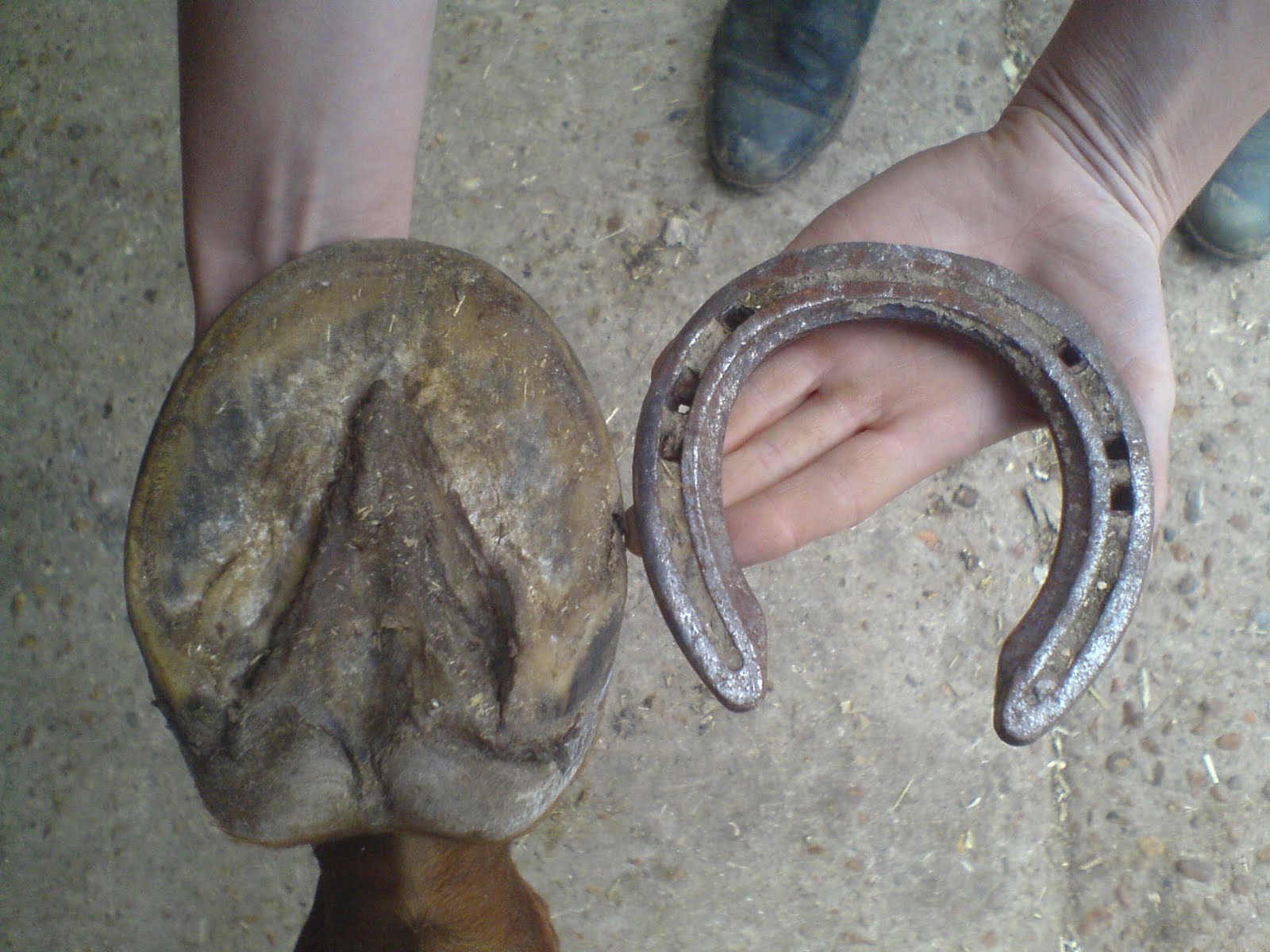
Heartbar shoe in situ

Note filler on inside of right fore

Immediately post deshoe

I always ask owners and carers for updates and this is what I got today:

"Well like a 2 year old to lead and a greyhound when turned out! He's never been like this before think I might have shoes put back on! Only joking his stride length in front has lengthened a lot, his walking perfectly on road and on stones path, slightly footy when turning. His frogs look even better than yesterday it's absolutely amazing, I've even showed YM the pics!!"

Not bad for 3 days deshod.

And the pain? Well that's nearly all mine - my arms are killing me! :-)

Tuesday, 2 April 2013

Out with a whimper in with a bang

Apologies for no posts since November.  Had a minor diversion.

Now I have a question for you guys.

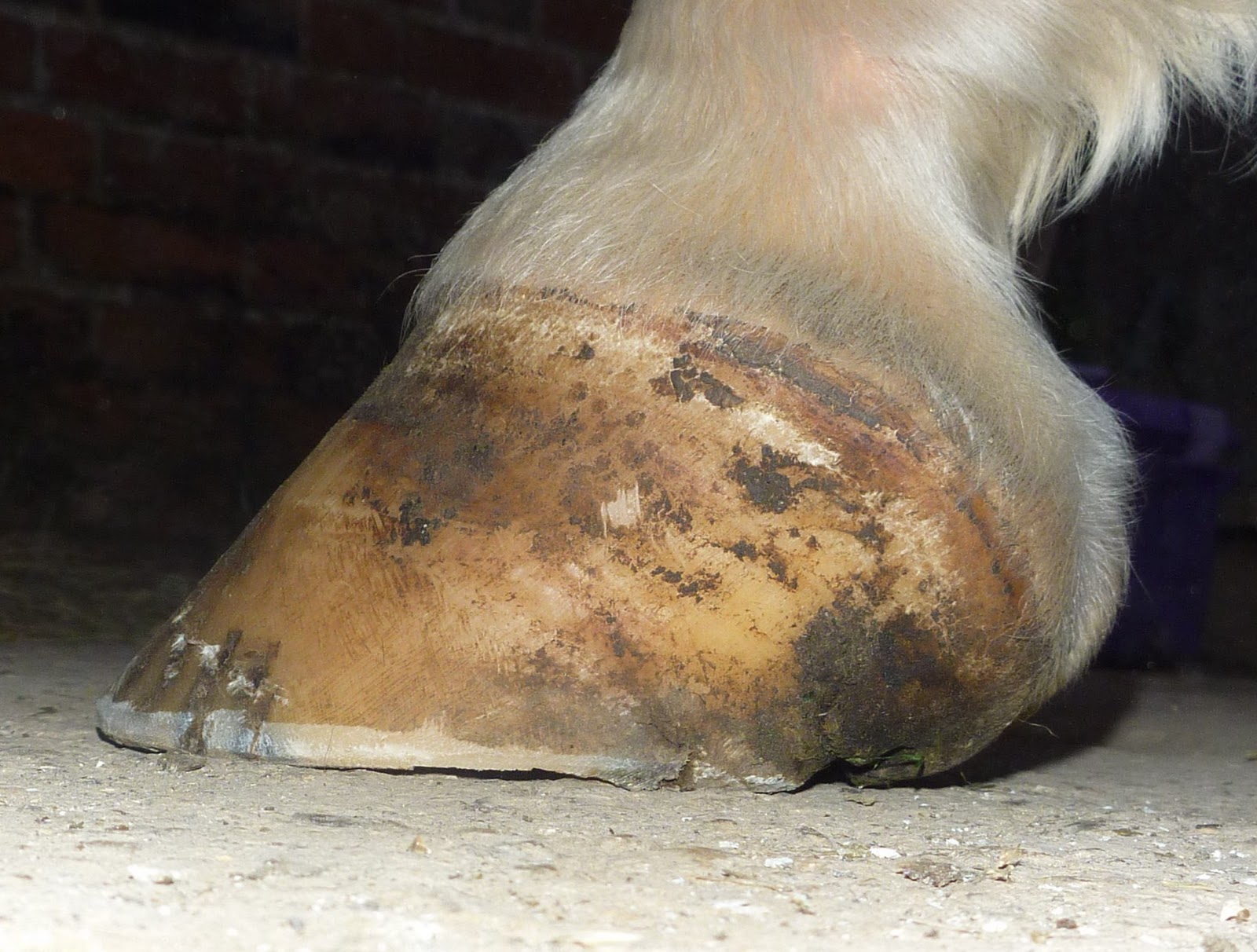
How long between these two photos.  Same hoof, promise!


Friday, 16 March 2012

Enjoy the journey

Sometime in the spring/early summer of last year I got a call about a navicular horse, lame in shoes, lamer still with wedges.

Fronts came off June, hinds a bit later (don't ask).

Regular readers of the blog will have seen how they looked straight out of shoes.

Left Fore side view June 2011.  Clipped for nerve blocks et al
Horse could not stand 'bare' on concrete, hence the straw


And then

Left Fore Oct 2011.  Note event line almost half way down


And yesterday

Left Fore March 2012.  Event line almost grown out


The horse* has passed a vetting including trotting a 10m circle on concrete. Hacks out sound over stones (shod companion couldn't do it and had to use the verge), schools and lunges happily.

I watched the horse trot up yesterday - the movement has changed from 'sewing machine' when shod (carer's words not mine) to positively floating.

And the behavioural changes are for me equally significant.  Used to have to be cross tied for tacking up etc.  Now will stand loose in the yard dozing while groomed, tacked up or trimmed.

Enjoy the journey?  Another client has asked that I blog about 'The Finish'.  Only there never is one, not until we pass over anyway.

The horses I attend prove to me time and again that give the right opportunities their hooves will continue to improve, regardless of age. 

Some will decline, from uncontrolled Cushings, Insulin Resistance or other metabolic disorder, but sort those out, feed the horse properly, work them appropriately and it is truly amazing how the hooves respond, even with horses in their twenties.

Age doesn't have to be a barrier to a healthy hoof and the journey never finishes.  So learn to enjoy it and appreciate the ride for whatever it brings.

* Note I am now excluding gender because too many people are starting to play the 'guess the horse' game and that is not fair on the carer's of the horses who have so generously agreed to their cases being put on the blog.

Friday, 25 March 2011

Thoroughbreds and barefoot

For successful barefoot performance does the breed of horse matter?  Yes and no.  Yes because there is so much prejudice about certain breeds that it can make it harder for the carer to get the support they need.  No, because any breed of horse can and does go bare successfully.

There are common issues no matter what the breed:
  • Inappropriate diet
  • Not enough movement
  • Stress (usually not noticed)
  • Inadequate/unhelpful hoof care
Unfortunately all of the above are especially prevalent among Thoroughbreds.  They are fed cr*p from a very young age, frequently confined, subject to far too much far too young and are shod as babies.

So in terms of hoof health, a lot of TB's start on the bottom or near bottom rung - which of course makes their barefoot transition that bit more challenging.  Doesn't mean it can't be done, does mean it takes more commitment, knowledge, patience and time to do it.

We do have some shining examples in the UK - Simon Earle manages all his racehorses barefoot and the Apsley End Polo Team are bare too.

But probably the best examples are the ones we never get to hear about - the private individuals who quietly just get on with it for the sake of their horse. And here is just one - the transition process has just started (about Jan 2011) after many false dawns and multiple set backs.  (Otherwise known as grass.... and an abscess.) This horse has a way to go, but as the video shows, he is sound on concrete! (bare not booted).

And big hugs and much appreciation to the owner of this lad and the supporting crew for allowing these photos and video to be published.  I know their journey has been a long and hard one and all credit to them for sticking with it despite all the negative 'ear mites' they have had to suffer.


Fore Aug 2010

Fore March 2011

Hind Aug 2010

Hind March 2011


Friday, 18 March 2011

And the mystery foot belonged to .....

Fred! 

Fred mid Oct 10

Fred end Feb 11


This horse has gone from strength to strength.  No more tripping and he looks years younger.

Sunday, 6 March 2011

Transition - how long?

How long does transition take?  To measure this we need to ask: -

'When does transition start?'

 and

'When does transition end?' 

And I am going to take these in reverse.

'When does transition end?
You know your horse's hooves are reaching optimum when the healing angle has reached the ground and there are no more divergent toe angles.  

But on top of this, for me, a horse has successfully transitioned from shod to barefoot when she can:

'Travel a reasonable distance, comfortably, over most surfaces, including tarmac, concrete and gravel car parks.' 

Why these surfaces? - because they are what most of my clients face in their daily grind and because a feral horse, living wild, faces similarly abrasive surfaces every day.  'Reasonable distance' is anything up to 20 miles per day because this is what horses have evolved to do.

Remember it doesn't matter if your horse's hooves don't conform to a human ideal of 'pretty', what is important is that they can perform.

When does transition start?
Current thinking is that 'transition' starts when the shoes come off.  I want to refine that a little.  Some of us need sign posts that show us we are making progress, especially if we have a metabolic horse.

I need a sign post - with really big writing please!
There are two big signs of progress which you will be able to note long before you have a perfect, fully functioning hoof.

Big sign posts
  • Healing angle* progresses beyond 1.5cm (approx) down the hoof and is maintained as hoof grows
  • Horse becomes more capable over hard and/or stoney surfaces**
* I will elaborate on healing angles in a future post.

Wednesday, 16 February 2011

Best time of year to transition

I have come to the conclusion that there isn't really a 'best' time.  It all depends on the horse, the carer and the circumstances.

If you have a 'metabolic' horse, when the shoes come off you may find a stretched white line, maybe a thin sole and a fair bit of thrush.  If you were previously unaware of these issues it can be a bit of a shock and it takes time to absorb the information and then adjust to managing the consequences.  It is easier to transition metabolic horses when there are the least amount of triggers around.  High summer or mid winter maybe.

Thin soles can struggle over hard, rutted or stony ground until they are restored to greater health, thickness and function.  But equally a horse prone to thrush is going to struggle with fetlock deep mud 24/7.  Not that it wouldn't be a problem with shoes on, it would, but it is more noticeable when the shoes are off.

These are just two of the reasons that your trimmer might recommend boots for the transition period.  So that you can keep a horse with compromised feet working, while you work on getting them better.  And as movement helps a lot, then it helps to fit boots if necessary to keep the movement going.  It is no good working a horse that is miserable.  You want to work your horse within their comfort zone.

Then think about you too, when you do your first barefoot transition it helps if you are mentally and practically prepared.  For some, the hostility encountered from well intentioned traditionalists is surprising and a bit hard to take. So do your research and make sure you have some support from somewhere.  You will be taking your horse bare for good reasons which you have thought through carefully, so write your reasons down somewhere, so you can remind yourself if the going gets tough.

Probably not a good idea to embark on the transition process just before competition season though.  Unless like me you gave up competing years ago (I so hate dressing up). Transitioning your horse doesn't mean you have to necessarily give up riding, but your horse may need boots and she may need her work programme tailored for hoof building purposes.  Boots go down like lead balloons in competition, so get your horse transitioned well in advance of any competitive activities.  Then you can proudly do your lap of honour 'naked' and not have to worry about losing a shoe the day before.

And remember, I tend to talk 'worst case' scenarios, some horses have their shoes off and barely notice.  Some skip, buck and grin with joy.  One got very 'fresh' - mistaking the foot care for foot fetish........ :-)

Thursday, 2 December 2010

Barefoot Fred - loses his stilettos and turns back the clock

LH - left 14/10/10; right 01/12/10


This is Fred, first met in October.  He used to trip, a lot!.  The hoof care professional looking after him was unwilling to remove any hoof height 'couldn't be done'.

So to start with on 14/10/10 (left hand picture) we removed his shoes.  He stopped tripping after his first post deshoeing trim.  Since then he has been hacking mostly on the road, but also on some softer field and woodland surfaces. 

With two further trims and his own efforts you can see the foot is much shorter.

Buff/orange line - to help me line up coronary bands
Red lines (both the same length) - to check I've sized the pictures properly
Red circle - nail holes
Blue lines (both the same length) - shows the difference in toe length of hoof

His 'Mum' commented yesterday that he is in overall better health, seems younger, happier and more comfortable (to ride) and in himself.  And he is standing so much better too - and he is 'smiling' :-)

We still have to work on decontraction and somewhat dodgy frogs, but not bad for under 7 weeks :-)

Tuesday, 30 November 2010

Hind foot shape change

Just deshod Beg Sep 09


End Nov 10


Apologies for the different views. I just happened to grab the second picture on my phone this evening and thought it worth sharing.

I actually took it because just 20 days ago Grace lost a huge chunk of frog in a field accident.

Note how the same hoof has different shapes in each photo.

Sep 09 is sporting blood in the toe. The toe is oddly square - showing how shoes can change the natural shape of the hoof. And there is a big chunk missing from the quarter. The bars are overlaid, the sole completely flat and the heels are contracted.

Nov 10 - no blood and the toe is naturally rounded. There is natural concavity (grown not cut), the heel is no longer contracted. This hoof could benefit from working on rougher surfaces or a modest trim, the frog has been shredded by a field accident, but is otherwise very firm, solid and healthy.

Thursday, 21 October 2010

Contracted tall hooves

Right hind shod six weeks previous


Right hind initial trim

Right hind solar with shoe

Right hind deshod before trim


Right hind heels

Right hind partially cleaned

Right hind solar initial trim


This is a hind foot from the tall footed horse in 'Tripping'  . To be honest you can see feet like this on most large yards. Now I often read on forums that abc breed is unsuitable for barefoot because of xyz. I am rapidly coming to the conclusion that some breeds are particularly unsuited to being shod. Because the challenges seen above seem to happen to them more often. But maybe that is just the luck of my draw.

The second photo shows the side view post initial trim - can you see the quarter scoop (ok it is kind of hard to miss). On some horses it is barely noticeable. This guy needed something more substantial. If a horse needs a QS and doesn't get it then in my experience the coronary band becomes pushed up (distorted) and quarter cracks and bruising can result; depending on what else is going on. When the quarter is relieved the distortion in the coronary band usually drops out quite quickly.

Just looking at the flat solar shots - well again you see this every day - it is accepted as normal.  I don't know many people with shod horses who would really think twice on the initial shod solar view.  I didn't use to(about 20 years ago mind.)

But if you then look at the heel view - now you can start to see that the foot is contracted, the walls are tall and the thrushy frog is getting buried in sole.

The next picture is designed to show you what the foot looks like when just the chalky sole has been cleaned out.  Hopefully you will get an idea of the depth (remember you can make the pictures bigger by clicking on them) and if you look at the far wall in the heel/quarter area you can see that it rises above the sole by a good 1cm (not quite half inch for the US).  We could have probably got more sole out, but I allow the horse two weeks or so to self exfoliate (and for the owner to get used to the changes) before coming back and checking progress and doing any further trimming required at that stage.

Often with these cases the foot undergoes rapid change in the early weeks and usually the horse is just fine, but the owner might get anxious.  It is important that they know I am coming out so that they can ask questions in the flesh.

If you can, try expanding the photo of the Right hind solar initial trim (the last picture).  Look at top left hand side where the nail holes are.  It would appear that two of the nails were inside the water line, this means they were in the white line; ie in the equine equivalent of the nail bed. It happens more often than is talked about.  Don't blame the farriers, it is almost inevitable that it will happen sometimes. (But do blame the habit of nailing things to living tissue.)

On a technical note and for reasons I can not explain (!) this entire trim was done only with nippers and rasp, no knife involved. Although if you saw the state of my wrists you might think that was a good idea! :-)

Wednesday, 20 October 2010

First trim post shoe removal from very tall/long foot

Shod six weeks previous

Shoe just removed

First trim


The owner of this horse has been incredibly brave and courageous in sticking up for the health of her horse, even though she was nervous of the unknown and had some local hostility.

These two factors alone are sufficient cause for many people not to try taking their horses shoes off. And when you look at this horse with shoes on; you can add fear of how the horse will adapt to a new shorter foot when his current feet are so long and distorted.

The answer as always is to facilitate nature, not force it. So when we took the shoe off we only removed what horn was ready to come. There was no cutting into 'live' tissue or any attempt to make the foot a predetermined shape. We just followed nature's guide. (In accordance with AANHCP principles.)

You will be pleased to know the horse walked away sound (and not tripping), over limestone chippings which are a tough surface, and disappeared into the night. The next day or so his owner contacted me to report that he has been seen hurtling round his field galloping and bucking which he has never done before. This is why in my 'Ouch' notes I mention the possiblity of the horse straining themselves post shoe removal. It is quite common for them to kick their heels up in joy :-)

There is a lot more to do for this foot, but we will have to give it time to heal. I'll be seeing them again soon and will post update pictures when I have them.

Thursday, 14 October 2010

Hooves and health

Start front
+ 10 weeks front


Start side/quarter


+ 10 weeks side/quarter


Start solar

+ 10 weeks solar


Start heel

+ 10 weeks heel


The horn quality on this hoof became too poor to hold a shoe. The deep event lines, the poor quality horn and heavy rasping of the toe are indicators that something somewhere is not right and it is probably, but not necessarily diet related. Some farriers will rasp out a toe to try and correct what they know to be a bad angle - but it is far more effective (and correct) to grow a good angle to start with.

10 weeks on, with a new diet it can be seen that the top half of the hoof has fewer event lines. The new horn has a better texture and the colours are more clearly defined and the darker shades have a deeper hue.

When first seen the coronary bands on this horses hooves wer almost horizontal, (a little earlier tthan the first photos in the entry but the camera with them on suffered my usual techno trauma). Here it can be seen hhow the hoof is adopting a more natural form. A lot of the change is self determined - as the shoes have been removed - but this has been helped by a correct trim according to the principles of the AANHCP. In particular the heels were lowered and the quarters relieved.

Although the heel views are not the same - I think you will be able to see how the central sulcus has filled out, cleared of thrush thanks to the determined efforts of the main carer. What is particularly interesting is that although the hoof horn in the heel area is shorter, the heel itself is bigger, more robust, 'beefy'. So the 'big' heel which some try to achieve by leaving the heel horn high, has been achieved by building up the back of the foot. This will allow the hoof to function much more effectively.

Although this is a challenging case - it still rocks! Best wishes and all the best to this horse and their people.

Saturday, 9 October 2010

Is it the rain? We've shrunk another one............. :-)

Forgive the rubbish picture. I wanted to experiment with something and I don't have the technology. Or I might have but don't know it, so I have hashed something together with PowerPoint.  If you want you can get a bigger version by clicking on the picture.

What you see is the same foot, first with a shoe on and second after 3-4 months of 'facilitative' hoof care. The four red lines are all the same length. Hopefully this will give a better perspective of how the hoof has changed when it has been allowed to grow the shape it wants to.

This foot has had many issues, not least paper thin walls and soles. But the transition has been ok, albeit tricky. Fortunately the owner has put the horse's welfare first and has been careful and considerate. The horse is now hacking out over the better surfaces without boots. Stones on a hard surface are still challenging, but we are getting there. 


Friday, 24 September 2010

Ouchiness - several hours post shoe removal

So you have done your preparation - improved your horse's diet for at least several weeks before shoe removal, read all the books and you are ready for the big day.

Excitement is mixed with a bit of trepidation; but you know it will be ok because all the horses you hear about have been just fine.

Only it's not.

Your horse was ok immediately post shoe removal but within hours they are looking uncomfortable, maybe just on one leg, maybe two, or horrors all four.

So why?

Well - you need on the spot experienced barefoot help to identify the actual problem but here are some starters for ten.

1 - the shoe remover decided to trim the feet and did a shoddy job of it
2 - your horse has previously undiagnosed laminitis or LGL issues
3 - the increase in blood supply once the shoes are removed can cause 'pins and needles' type effects
4 - muscles which had adapted to how the horse held its body when shod, are in the process of change
5 - when turned out post shoe removal your horse ran off bucking and strained something (oh yes it happens)
6 - your horse has thin soles (which can be improved) and is feeling the ground for the first time in ages (shoes numb the feet)
7 - your horse has thrush and can feel it now the shoes are off
8 - your horse has a poorly developed digital cushion/heel area and can now feel it
9 - your horse had wedge pads or egg bars or natural balance shoes on previously and these have upset the internal structures of the foot/foot balance and/or put strain on the tendons
10 - your horse has something else, entirely unrelated and it is just coincidence (for example pain in the cecum)

And don't forget, if in doubt always call your vet.  A horse should not be left miserable and in pain.  And - try to have boots to hand in case you need them.  Otherwise organise things so you can continue to work your horse while in transition without having to overly test them on horrible surfaces.

Saturday, 18 September 2010

Deviated hooves - now you see it now you don't

In April I started trimming a horse with a very interesting left fore.  Not only did it have an abscess hole (of which I will detail in another post) but it had a substantial deviation.

The horse has been trimmed regularly every 4-5 weeks and has continued with a reasonable workload and is now able to go over all surfaces without issue.  We still need to work on building up the back of the foot.
June '10

Sept '10


June '10


Sept '10

Friday, 10 September 2010

Transition - assessing visual changes

Shod
About 2 months later


Shod hoof - note heavily rasped outer wall.  You can see the paler inner hoof wall where the dark outer hoof wall has been rasped off.  Some hoof care practioners do this to try and shape the hoof to their ideal.

This has left the hoof weakened and vulnerable - you can see the seedy toe developing.  What you can't see is how much the hoof wall has been thinned (in terms of volume) which makes it crack and break up very easily.

There are multiple event lines and the healing angle can be clearly seen below the coronary band.
2 months later

When shod this was a slow growing hoof.  But if you compare the two photos above you can see just how quickly the hoof is growing now it is bare.  This hoof is still throwing out event lines, the cause of which will need to be investigated in due course.  The seedy toe is still in evidence.

The hoof is changing shape, quite dramatically, not just from this angle, but also (which can not be seen in these photos) the heel is widening and the toe is getting rounder.  I will post separately for to show this.

Side view 3rd week July

7 weeks later


The first side view picture matches up with the second front view photo.  (Apologies for the horrible angle.)  There is a deviation in the coronary band, which has dropped out by the second photo, this is not unusual and is something I am happy to see happen.  The event lines are easily seen, as is the high volume of growth.

This is still not a happy foot, but progress is being made and quite quickly.  It is just when you have a huge mountain to climb, even if you gallop along, it will still take a while.

Sunday, 29 August 2010

The shoe should fit the foot.............

August foot against June shoe
Shod
Recently(ish) deshod


Today we dug out the front shoes for one of the more difficult transition cases. Have a look at the photos? What is your view - did the shoe fit the foot or was the horse having to use a shod foot shape that was not natural to them?

An interesting 'tell' regardless of the photo evidence is
that the horse abscessed on both front outside quarters shortly after deshoeing.

Although this transition is tricky the carer for this horse is doing a remarkable job.

Sunday, 22 August 2010

For people considering transitioning 'metabolic' horses - some survival tips

Transitioning a horse with metabolic issues is rarely easy and I believe undiagnosed, misunderstood or hard to manage metabolic conditions are a key driver for why some horse/owner combinations never quite make it to full barefoot, sound, performance.

These same metabolic issues can cause problems for a shod horse too, but the symptoms can be masked by the shoes only to be revealed when the shoes come off. 

The experienced barefooter may have no major issues in dealing with a metabolic horse, having been through the process before, they know what to expect and how to deal with it.  But relative newcomers can be understandably terrified/dismayed/overwrought when their previously shod/sound horse goes lame shortly after having their shoes removed and without obvious or apparent reason. And for some so starts the journey into the upside down world of metabolic disorders of the horse.

I've transitioned a variety of horses with different metabolic issues including HYPP, EPSM, Insulin Resistance and Laminitis.  Along the way I have learnt a lot, not least some very vital 'Survival Tips'; which have helped me save most of my sanity and some of my bank balance.  In no particular order here are some of the things I wished I knew or had done before I took on my first metabolic horse.

Survival Tips
  • Most important of all - take complete ownership/responsibility for your horse's hoof health
    • this will enable you to be a more effective manager of the resources you need to restore your horse and their feet to better health
    • transition can be a roller coaster ride, taking responsibility will help you feel more in control
    • you will be in a better position to understand what works/doesn't work for your horse
    • you will be able to minimise the risk of negative outcomes caused by well meaning, but misguided individuals who want to 'help' by interferring with your horse's management
    • you will reassure all but the most (!?) of equine professionals, they want to know who is in charge and will be happy it is you
  • Educate yourself as thoroughly as possible.  Learn all you can about the management of bare hooves and research your horse's condition.  If you don't know quite what the metabolic issue is, beware of leaping on fashionable bandwagons.  Take a step back and consider all the options, discuss them with your vet, but don't rush headlong into a course of treatment unless a) it is urgently needed for life/health saving purposes or b) you and your vet are certain you have the correct diagnosis. 
  • Talk things through with educated individuals who have no agenda.  Listen politely but do not believe most of what the local 'experts' tell you; likewise be wary of internet sites and wild marketing claims, even those endorsed by vets.  Do your own desk research, read books* as well as websites.  Check sources.
  • Learn to trust your horse and her feet before all others
  • Learn to read your horse and her feet as well as you can read a book, or maybe better
  • Cultivate patience; understanding how to manage your metabolic horse successfully can take time, you will make mistakes and have set backs
  • Cultivate tolerance - for those who don't understand why you have chosen to go barefoot, for those who feel threatened by anything different, for those who are willing, but slower to understand the challenges and benefits of taking a metabolic horse barefoot
  • However difficult, try to keep your vet, yard manager and horsey friends on board.  Largely this involves no preaching to them (wait until they practically beg you for information) and getting very deaf when they start going on........ 
  • Find a decent barefoot trimmer - or invest in a proper training programme for yourself.  At the very least know what to look for and expect from a trimmer.
  • Learn how to distinguish between a functional trim, a 'pretty' trim and a just plain bad trim
  • Take each day as it comes and have no expectations other than that there will be good and bad days with no guarantees
  • Be really strict over diet. Yes really strict, no TGI Friday moments, they can really mess with your horse
  • Do not believe the big writing on bags of horse food.  Get the detailed analysis; protein, sugar, starch, plus a vitamin/mineral breakdown including percentages/quantities per kg.  If the manufacturer will not tell  you exactly what the product is made of don't buy it.  Many bagged feeds are full of cheap and unhealthy fillers like wheatfeed and the dust is kept down with molasses and/or sugar syrups.
  • Take all 'but this worked for my horse' advice with a pinch of salt, all horses are different
  • Don't believe anyone who says they know everything about equine diet or nutrition.  They may have a degree in it, but the truth is the science hasn't been done yet and no one really knows.  Most studies that have been completed have been on Thoroughbred racehorses and do not equally apply to different breeds of horses or those with different lifestyles. Some folk are also drawing conclusions about equine diet from studies done on people.  A useful starting point maybe, but a dangerous place to finish
  • Celebrate every small success or good day and try to view bad days as a reminder of what you are leaving behind
  • Learn deep breathing techniques (so you can walk away from the 'helpful' know-it-alls who want to advise you that you are mad/cruel/blind while their own horse walks around on tin can stilts for feet and colics every few months - and is as fat as butter with all the symptoms of IR)
  • Use any time off from ridden/driven work in a productive way - there are lots of useful 'life' lessons you and your horse can practice on the ground.  eg. standing still by the mounting block, standing untied for foot trimming/washing/picking, backing up/moving over, walk by your shoulder (or however you prefer) - I am sure you can think of many more which can either be done in the stable on on a surface which your horse is comfortable on.
  • Find out which hedge treats your horse likes best; this can be comforting because you are doing something positive for your horse and it can give you 'health safe' alternatives to the sugary rubbish generally sold as horse treats.  But do be careful and make sure you know what you are picking and that it has not been contaminated in anyway.
  • Take lots of photos, whole horse and hooves, and make a photo diary - to look back on in good times and bad. Take video too if you can
  • Keep a diary of feed, behaviour, hoof health, gut health, work load, grass, weather
  • Learn to take a step back and reflect before panicking (very useful skill in true emergency situations)
  • Chat up an independent (of feed companies) equine nutritionist
  • Research the equine digestive system (it is truly fascinating - yes really)
  • Enlist a barefoot friend for support
  • Prepare open, non threatening questions for any professionals whose support or opinion you may need and learn to agree to disagree without falling out, you may need the object of your conflict for something else later
  • Try to avoid just managing symptoms and instead tackle the cause whenever possible
  • Read this blog and http://danceswithgrace.blogspot.com/ for a warts and all commentary on barefoot and all its ups and downs
  • Sell the horse and get a motorbike (ONLY JOKING!)

*Good books, all available from Amazon include:

The Natural Horse: Lessons From the Wild (1992)
Horse Owners Guide to Natural Hoof Care (1999)
Founder: Prevention & Cure the Natural Way (2000)
Guide to Booting Horses for Hoof Care Professionals (2002)
Paddock Paradise: A Guide for Natural Horse Boarding (2006)

Thursday, 19 August 2010

Ok for a bit of fun - Spot the difference; a hoof in transition

Recently deshod

 
Several months later


Quiz - for a bit of fun - I'll post answers in a few days

  1. How can you tell these pictures are of the same foot?
  2. Describe five differences in the hoof between the pictures (ignore the trimming)
  3. Are these differences for better or worse?  

Tuesday, 17 August 2010

Heels - same horse, fore foot

RF Shod
RF Deshod approx 1 month

 
Solar views

 
RF Shod solar view
RF 3.5 weeks ago
RF just deshod
RF 2 days ago

 
This horse has abscessed in both fronts during the transition. This is unusual, but it does happen when the foot has a lot of rubbish to clear out. You can see how the shod foot is a different shape to the unshod foot, and over time it is changing shape.

 
Positive changes include:

 
  • improved frog quality (denser, less thrush)
  • heels broader
  • buttresses becoming more robust
  • sole depth improving
  • foot becoming more front foot shaped

 
Some of the challenges faced include:
  • abscess in each front outside quarter
  • heavy thrush infection
  • seedy toe
  • tender soles
  • pink in the white line
But the horse is making better than expected progress, allowing for where the feet started.  Boots would allow the horse to continue a moderate work load.

About Me

My photo
Southern England, United Kingdom