Custom Search
Shoes mask weaknesses, barefoot highlights strengths
Showing posts with label barefoot hoof cracks. Show all posts

Sunday, 30 October 2011

Does your overweight horse have hooves that are 'starving'?

Lower half free access to grazing and overweight,
upper half same grazing but muzzled and correct weight

Hard to see, but hoof has 'dessicated' texture,
 horse overweight


Dessicated hoof has split (outer hoof wall only).
New growth - horse correct weight is coming in much
healthier


Solar view of split hoof above, pre trim,
you can see crack is outer hoof only


I freely admit some uses of the English language freak me out a little. One of which is 'you need to get after him' - more of which in a future post, and another is: 'I don't feed any supplements in the summer, he is out on the grass.' This latter phrase, in tandem with the to my mind somewhat romantic notion that horses (in the UK) can get what they need from their environment can lead to problems.

The hooves above are attached to horses belonging to the very best type of carers. Dedicated to the welfare of their companions and prepared to research and investigate how to optimise their health. Both horses are 'metabolically challenged' - so are more difficult than the average horse to look after.  So all credit to the carers for putting in the extra effort it takes to look after them.

Unfortunately both horses got a bit on the round side. It happens. Most of the time the results are no more than a bit of porkiness and a shortness of breath. But with horses there are times when the outcome is a bit more unfortunate.

As you know long term overweight in a horse can lead to Insulin Resistance and Laminitis (2/3 lami cases are linked to obesity). But what doesn't seem to be recorded in any data I have found is any material on the fat but 'starving' horse.

There is growing awareness, but it is still low, that in the UK our forage tends to be short of copper, zinc and magnesium. So if your porker is reliant on forage alone they may well be short of these vital minerals.

The hooves above have succumbed to fungal infections which have damaged the outer hoof walls. This happened when they were overweight and reliant on grazing alone. Put on a diet and given a modest amount of supplementation and you can see the hooves are improving.

It's early days for one of the hooves, but although it will take a few months for the cracks to grow out, the quality of the new horn is good.

So keep an eye on the texture of your horse's hooves. Dry and crumbly or dessicated coconut hooves don't really need hoof dressings*, but they probably do need 'feeding', with a correct mineral balance not more sugar.

*Which unless carefully chosen can make the type of fungal infections seen in these hooves worse

Tuesday, 14 June 2011

Seedy toe, abscess and 'false' sole ...........

Do you remember the somewhat spectacular toe crack? Well the path to hoof heaven is never a straight one and living in the UK makes it exceptionally wet and muddy too.

Mud and seedy toe can lead to abscess and so it did in this case.  But every cloud has a silver lining .........

The foot abscessed during the very wet muddy spell we had mid winter and we were dealing with the consequences.  The foot had gone somewhat backwards.  The last 3 photos in this array are June 2011, the rest are May 2011.

And the warmest of thanks to the owner for letting me share these photos.

Oh and yes, the horse is sound and apparently rather 'forward going' - not bad for a girl in her 20's! :-)

Long toe scooting forwards


Toe crack has extended


NB semi circular solar split just
above frog apex
'False' sole lifted from solar toe area


Cleaned back to bars


Note wall height now 'false' sole exfoliated. New sole is hard

Oblique view of partial clean

Cleaned and rolled

06 11 - Side view compare with 1st photo. 
Note abscess hole

06 11 - Front view post trim, note reduction in toe crack,
compare with photo 2

06 11 - Solar view post trim

Tuesday, 22 February 2011

Hoof cracks - update

31 05 10

06 02 11


This horse is in their early 20's. Written off several years ago unsound. May 2010 unsound. Now sound, rather lively and being ridden and has been since last summer (not sure of precise date).

Regular rolling has allowed the crack on this hoof to grow out. Trim intervals were initially 4 weeks, these have now been extended to 5. Any longer and the crack starts to lever open. The horse lives out 24/7 on very wet ground.

Hoof cracks do not necessarily need to be a cause for major concern, or shoeing, filling or otherwise high octane intervention.

Tuesday, 30 November 2010

Hind foot shape change

Just deshod Beg Sep 09


End Nov 10


Apologies for the different views. I just happened to grab the second picture on my phone this evening and thought it worth sharing.

I actually took it because just 20 days ago Grace lost a huge chunk of frog in a field accident.

Note how the same hoof has different shapes in each photo.

Sep 09 is sporting blood in the toe. The toe is oddly square - showing how shoes can change the natural shape of the hoof. And there is a big chunk missing from the quarter. The bars are overlaid, the sole completely flat and the heels are contracted.

Nov 10 - no blood and the toe is naturally rounded. There is natural concavity (grown not cut), the heel is no longer contracted. This hoof could benefit from working on rougher surfaces or a modest trim, the frog has been shredded by a field accident, but is otherwise very firm, solid and healthy.

Saturday, 30 October 2010

Successful barefoot - putting the horse first

Left hind front day one

Left hind front plus 5 months
Left hind solar day one

Left hind solar plus 5 months


Putting the horse first
One of the things that will make/break a barefooter is the ability to take responsibility.  The other is the wisdom to put the horse first. 

The foot in the photos is attached to a horse cared for by the most wonderful person.  The first thought when the horse was footy was:

'How can we make them better?' rather than:

'Damn I can't ride!'.

And I've seen for myself time and again how this approach leads to a sounder, happier horse and if the partnership chooses; more riding hours.

I hope you can see how the hoof in the 5 month photos is much healthier than at the start of this particular journey.  Especially look at the solar view - the frog is no longer ragged with thrush, the white line is less stretched, the seedy toe is slowly growing out and the back of the foot is bulking out nicely.  Note the horse lives out 24/7 in all weathers on grass.

When I first saw this horse it was suffering chronic hind leg lameness.  So long as we maintain the roll, this is no longer an issue and the horse has been happily in work.

But the every journey has its downs as well as ups and today we found the horse a bit sore from thrush in a front foot.  But as it is bare, the soreness is soon noticed and the problem can be more readily resolved.

Here is wishing a very special partnership all the best.

Wednesday, 1 September 2010

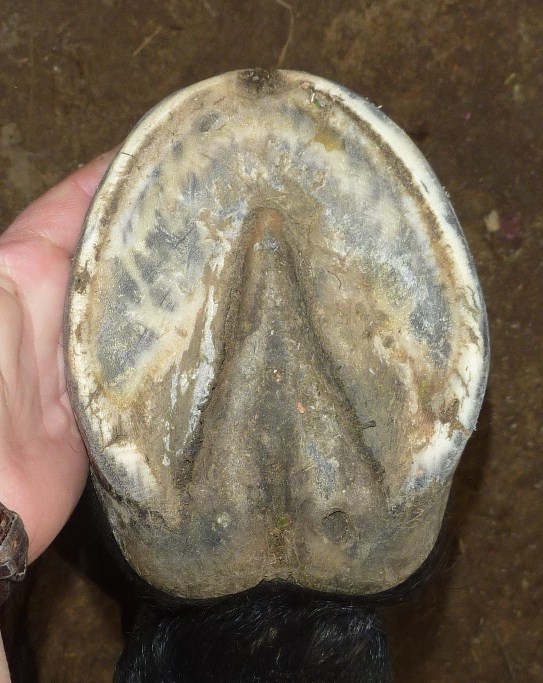
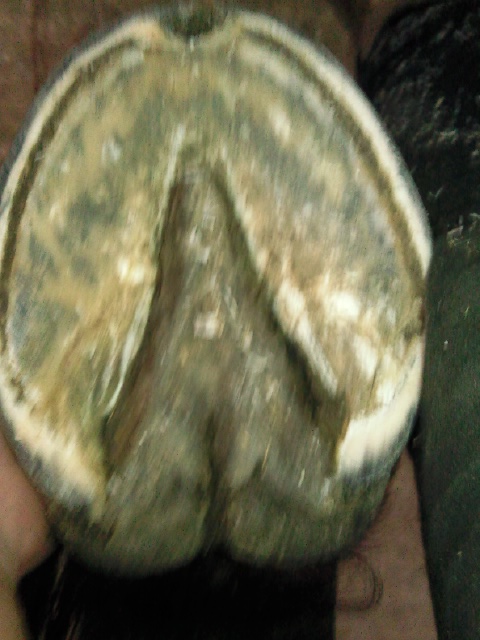
Solar view hoof crack

End May 2010
End August 2010


We looked at a significant hoof crack a couple of days ago.  The above photos are of the solar view.  (Apologies for lack of focus in second, I've broken my camera.)

Look carefully at the toes.  In the second photo the deep part of the crack has reached the ground and formed a hole.  This will be flushed with a non necrotising product (probably salt water) but not packed.

Putting the crack to one side, can you see how the frog is getting healthier, the heel buttresses have more substance and the white line is tightening up.

Monday, 30 August 2010

Growing out hoof cracks, deviations etc

Throughout this blog you will see hooves with various issues; missing quarters, hoof cracks and deviations.

All of these have been managed by applying the AANHCP trimming/hoof management protocols.

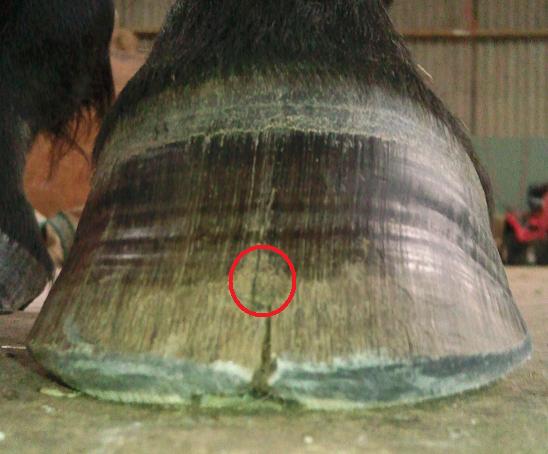
The crack in yesterday's post is resolving much faster than I anticipated, because when I first saw it, not only was is worryingly long and wide, it was also very deep and somewhat infected.  I forgot to mention it yesterday (exhausted) but the red circle shows just how fast the hoof is growing.

The foot is trimmed at precisely 4 week intervals and the horse lives out 24/7 in the damp UK climate.  The owner is very conscientious and I have shown them how to maintain the mustang roll in between visits.

As always the difference is really made by the owner.  In this case someone who is devoted to their horse and prepared to buck tradition in order to maintain them in good health.

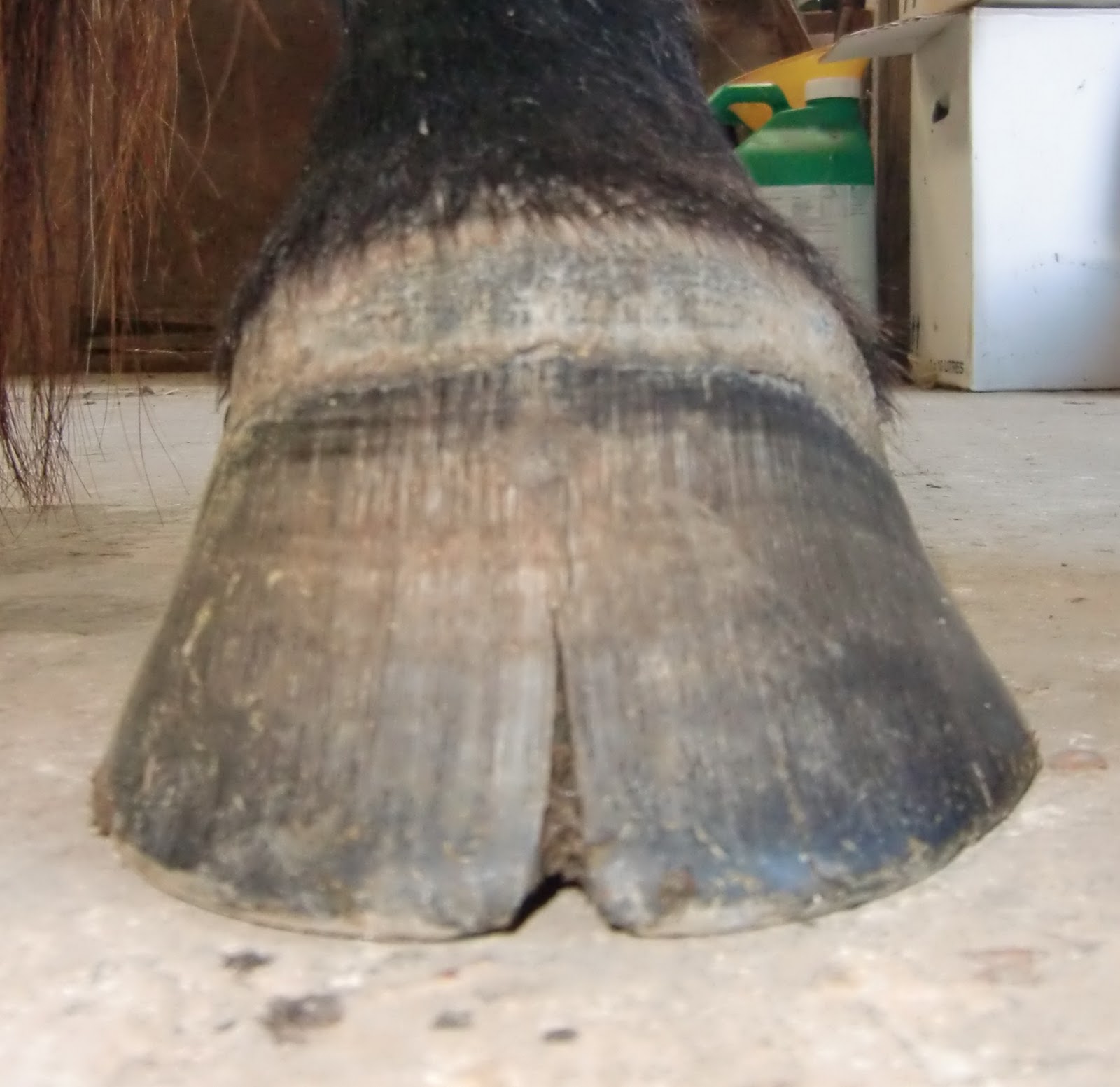
Hoof cracks

End May 2010
End August 2010
This horse is 22 years old and in May 2010 was already officially retired with an unresolvable lameness.

Extensive vet tests had revealed no probable cause other than psychosomatic. The farrier had found no fault with her feet.


The first picture shows a hind foot, front view six weeks post the last farrier visit.

The second picture shows the same foot 3 months later after 3 AANHCP protocol trims. This horse is now sound enough for quiet hacking which she apparently thoroughly enjoys! :-)

Age need not be a barrier to improving feet, regaining soundness or having a good time :-)

About Me

My photo
Southern England, United Kingdom