Shoes mask weaknesses, barefoot highlights strengths
A lot of comment is made about 'long toes' and many a poor horse has had their toes dumped or worse in an attempt to correct a problem by addressing a symptom without a complete understanding perhaps of the anatomy of the hoof or the consequences of addressing symptoms not cause.
The following photos are of three different horses, Horses One and Two had a toe shape typically criticised for being overly long. The last one, Horse Three, was considered to be fine.
Horse One
 |
Long toe? Look at the shape and size of the heel,
particularly the lateral cartilage. Can we just cut the toe off? |
 |
Can you see the lamellar wedge? The heel is weak.
See picture below. |
 |
| Collapsed heel - very weak digital cushion and lateral cartilages |
 |
Same foot a few months later, still in rehab but
compare heel and lateral cartilage with first picture |
 |
| Lamellar wedge almost gone |
Horse Two
 |
| Is this a long toe? |
 |
Solar view of above foot. Which bit of the toe
would you cut off to shorten?
Notice contracted heel and thrush |
 |
Still a work in progress, but notice how the heel
has bulked up apparently shortening the toe |
Horse Three
 |
| This is a genuinely long toe. Shod every 6 weeks |
 |
| Front view of above |
 |
| Same foot two months later, sound, no longer tripping |
So what is often considered to be a 'long' toe is actually one with a shallow angle, often caused by a weak/atrophied caudal hoof. This can be only be properly fixed by developing the back of the foot through proper diet and exercise.
A truly long toe is often completely missed - they are even considered normal or desirable in some circles. Despite the fact that they can cause secondary problems such as tripping or injury. The truly long toe as shown in Horse Three is easily remedied by a competent HCP.
 |
| Shod - hoof wall rasped 'moderately' |
 |
Note how foot is running forward, heels are collapsed
and are forward of the back of the foot which is in suspension |
 |
Shod solar view note overlaid bars,
position of shoe against frog |
 |
| Deshod view of above |
 |
| Cleaned up view of above |
|
Reminder - 'ideal' nail placement -
oriented on water line |
 |
| Nail on pair of above |
 |
| Detail of above |
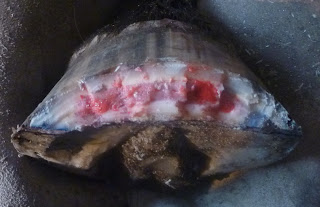 |
| Very thin sole |
I don't know what killed this horse. I do know it had the most enormous abscess - pus was blowing out through the frog in huge quantities - so I have my suspicions.
I chose this foot for this post, because you see feet like it on every yard. Probably the majority of shod feet I see look something like this.
The hooves are running forward, the heels are collapsed and the sole is thin. In an attempt to reduce the duck bill impersonation the hoof wall gets rasped - further weakening the foot. This leaves little space for the farrier to place the nail and mistakes happen.
My question is - you can see the issues the foot has, you know how to fix them (diet, exercise, natural living as much as possible) - what contribution to foot health did the shoe make for this horse...


 Posts
Posts