Custom Search
Shoes mask weaknesses, barefoot highlights strengths
Showing posts with label lamellar wedge. Show all posts

Tuesday, 30 September 2014

Long toes - a change in perspective

A lot of comment is made about 'long toes' and many a poor horse has had their toes dumped or worse in an attempt to correct a problem by addressing a symptom without a complete understanding perhaps of the anatomy of the hoof or the consequences of addressing symptoms not cause.

The following photos are of three different horses, Horses One and Two had a toe shape typically criticised for being overly long.  The last one, Horse Three, was considered to be fine.

Horse One
Long toe?  Look at the shape and size of the heel,
particularly the lateral cartilage.  Can we just cut the toe off?

Can you see the lamellar wedge? The heel is weak.
See picture below. 
Collapsed heel - very weak digital cushion and lateral cartilages
Same foot a few months later, still in rehab but
compare heel and lateral cartilage with first picture

Lamellar wedge almost gone

Horse Two

Is this a long toe?
Solar view of above foot.  Which bit of the toe
would you cut off to shorten?
Notice contracted heel and thrush


Still a work in progress, but notice how the heel
has bulked up apparently shortening the toe

 Horse Three

This is a genuinely long toe.  Shod every 6 weeks


Front view of above
Same foot two months later, sound, no longer tripping
 
So what is often considered to be a 'long' toe is actually one with a shallow angle, often caused by a weak/atrophied caudal hoof.  This can be only be properly fixed by developing the back of the foot through proper diet and exercise.
 
A truly long toe is often completely missed - they are even considered normal or desirable in some circles.  Despite the fact that they can cause secondary problems such as tripping or injury.  The truly long toe as shown in Horse Three is easily remedied by a competent HCP.


Friday, 7 September 2012

Should I shoe my laminitic?

Way way back I deshod a laminitic that was due to be PTS that week. Shod by an award winning farrier there was apparently nothing more that could be done. The horse was lame and fed up having suffered conventional therapy and been box rested for months. The owner was naturally distraught.

It wasn't long before he was sound and even with a few dietary hiccups he has been sound since and is currently in work.

I want to walk you through a few pictures - some are gross so finish your dinner before you read any further.

This first picture shows 'Henry', one of my freeze dried legs.  You can see the lamellar wedge, imminent solar penetration and how the poor thing is forced to bear weight on the tip of his pedal bone.
'Henry' NB wedge, angle of the pedal bone & heel height
 
 These photos tell their own story.  I understand that some HCP are taught to maintain the toe wall between 45 and 55 degrees. 
 
Initially this is done by rasping out the outer hoof wall, then when this option is exhausted (no outer wall left), the heel is raised. 
 
This of course will invert the hoof capsule so the horse has to bear progressively more weight on the tip of the pedal bone.  This is both painful and injurous to the horse.


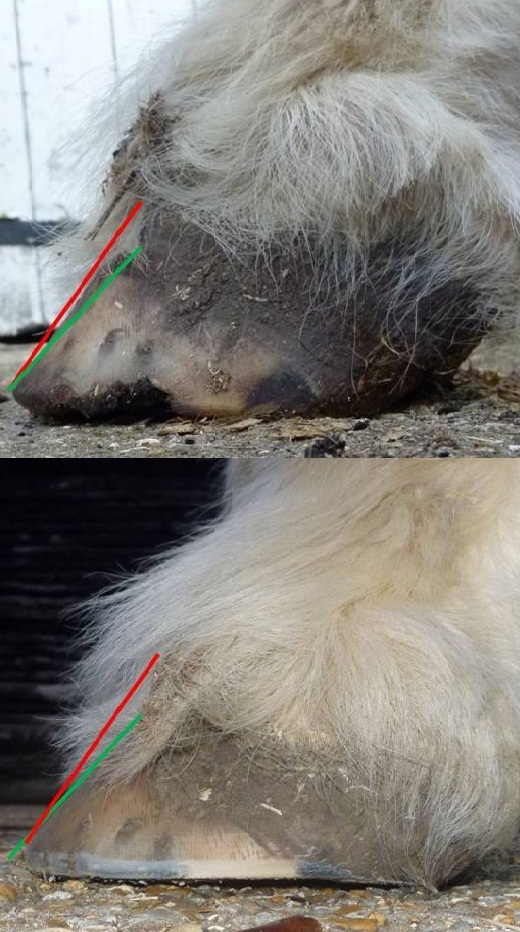
Red is pre trim angle, green post
NB heel height - pre trim, sole has been dechalked
With no more heel raising, but a complete diet change and lots of movement, the healing angle (HA) can grow down.
 
You can see the difference betwee the angle the horse was forced to maintain when he had shoes on, compared with the angle the hoof is meant to grow at. 
NB Wedge, red line denotes HA when fully grown in
You can see the history of trials and tribulations the horse went through during his rehab - dietary misadventures mostly.  But the last bit of wedge is nearly grown out.  Horse was sound throughout.
A few months later, not without hiccups and the wedge has
all but grown out.  Hoof in background has yet to be trimmed.

About Me

My photo
Southern England, United Kingdom