Shoes mask weaknesses, barefoot highlights strengths
- Look at it. Then look again. And again.
- Ask yourself, how did this hoof get like this?
- This foot is from southern UK not a backwater in a third world country.
Let's work together to ensure that feet like this get consigned to history.
 |
| Shod - hoof wall rasped 'moderately' |
 |
Note how foot is running forward, heels are collapsed
and are forward of the back of the foot which is in suspension |
 |
Shod solar view note overlaid bars,
position of shoe against frog |
 |
| Deshod view of above |
 |
| Cleaned up view of above |
|
Reminder - 'ideal' nail placement -
oriented on water line |
 |
| Nail on pair of above |
 |
| Detail of above |
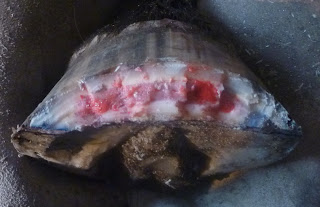 |
| Very thin sole |
I don't know what killed this horse. I do know it had the most enormous abscess - pus was blowing out through the frog in huge quantities - so I have my suspicions.
I chose this foot for this post, because you see feet like it on every yard. Probably the majority of shod feet I see look something like this.
The hooves are running forward, the heels are collapsed and the sole is thin. In an attempt to reduce the duck bill impersonation the hoof wall gets rasped - further weakening the foot. This leaves little space for the farrier to place the nail and mistakes happen.
My question is - you can see the issues the foot has, you know how to fix them (diet, exercise, natural living as much as possible) - what contribution to foot health did the shoe make for this horse...


 Posts
Posts