Custom Search
Shoes mask weaknesses, barefoot highlights strengths

Wednesday, 20 October 2010

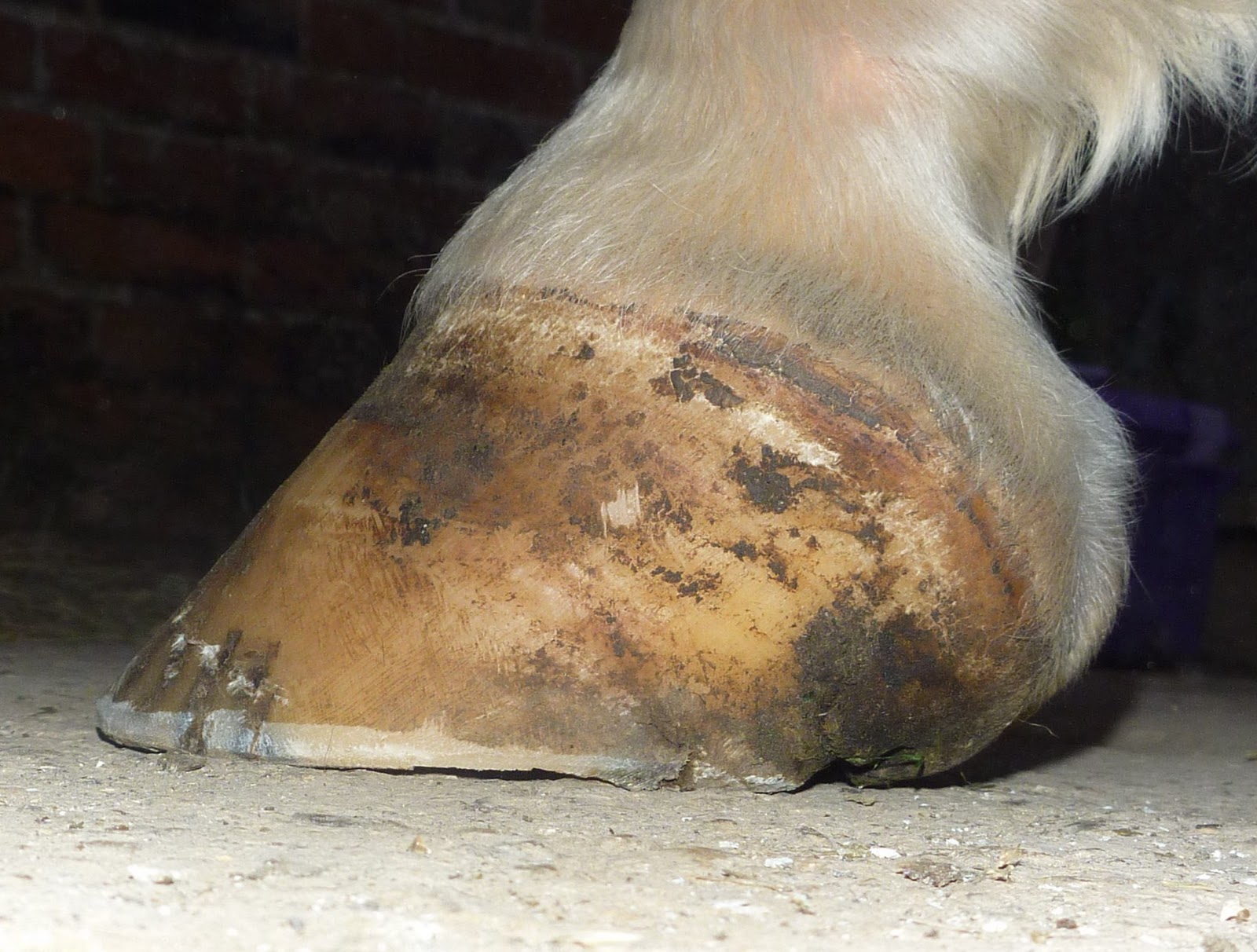
First trim post shoe removal from very tall/long foot

Shod six weeks previous

Shoe just removed

First trim


The owner of this horse has been incredibly brave and courageous in sticking up for the health of her horse, even though she was nervous of the unknown and had some local hostility.

These two factors alone are sufficient cause for many people not to try taking their horses shoes off. And when you look at this horse with shoes on; you can add fear of how the horse will adapt to a new shorter foot when his current feet are so long and distorted.

The answer as always is to facilitate nature, not force it. So when we took the shoe off we only removed what horn was ready to come. There was no cutting into 'live' tissue or any attempt to make the foot a predetermined shape. We just followed nature's guide. (In accordance with AANHCP principles.)

You will be pleased to know the horse walked away sound (and not tripping), over limestone chippings which are a tough surface, and disappeared into the night. The next day or so his owner contacted me to report that he has been seen hurtling round his field galloping and bucking which he has never done before. This is why in my 'Ouch' notes I mention the possiblity of the horse straining themselves post shoe removal. It is quite common for them to kick their heels up in joy :-)

There is a lot more to do for this foot, but we will have to give it time to heal. I'll be seeing them again soon and will post update pictures when I have them.

Monday, 18 October 2010

Tripping

There are lots of reasons why a horse trips.  But a very common one is poor foot form. So let's use the foot from yesterday as an example -and provide the extra shots requested.

Compare this foot with the mustang foot
Note:
Heel in suspension
Coronary band distorted
Quarters need relieving
Very long/tall
Toe heavily rasped

Although this is a hind foot (and hinds have a slightly different shape), you can see how the relationship with the red rectangle are quite different to those of Fred's front.  From this view and for the purpose of comparing relationships the fact that one is a hind and the other a front doesn't matter too much.
Hoof does not appear balanced
Outer wall heavily rasped, inner wall can be seen at toe
Event lines
Deviation

Shoe slipped
Impinging on frog
Thrush
Contraction


Heel very high
Contracted
Thrushy
Lateral cartilages skinny and under developed


Remember the owner has done her very best to seek professional advice for her horse and the farrier has done their best too, according to how they have been trained. The purpose of this blog is not to point fingers or criticise, but to try and illustrate good and bad examples of hoof form, so that we can all do a better job of caring for our horses in the future.

After all, the welfare of our horses comes first.

Sunday, 17 October 2010

What would you think?

Met a truly fab lady the other day who clearly loves her horse (we will call him Fred) and puts his needs first.  They are both just beginning the journey that so many of us have found ourselves on.  The scenario goes like this:

Fred  is constantly tripping, has had two abscesses in one year and maggots in one foot.  His carer has sought professional advice from more than one source, but Fred continues to trip.  Fred is shod every six weeks, seen by a vet when needed and has every care and attention lavished on him.

Because so many of us start the barefoot journey with similar scenarios I thought it might be useful to hand over the commentary to readers for this one.  So just based on the picture below; what would you think and what other views of the hoof would you like to see?

And on behalf of all readers and the horses that benefit - thank you to Carer and Fred for allowing us to use these photos.

Thursday, 14 October 2010

Hooves and health

Start front
+ 10 weeks front


Start side/quarter


+ 10 weeks side/quarter


Start solar

+ 10 weeks solar


Start heel

+ 10 weeks heel


The horn quality on this hoof became too poor to hold a shoe. The deep event lines, the poor quality horn and heavy rasping of the toe are indicators that something somewhere is not right and it is probably, but not necessarily diet related. Some farriers will rasp out a toe to try and correct what they know to be a bad angle - but it is far more effective (and correct) to grow a good angle to start with.

10 weeks on, with a new diet it can be seen that the top half of the hoof has fewer event lines. The new horn has a better texture and the colours are more clearly defined and the darker shades have a deeper hue.

When first seen the coronary bands on this horses hooves wer almost horizontal, (a little earlier tthan the first photos in the entry but the camera with them on suffered my usual techno trauma). Here it can be seen hhow the hoof is adopting a more natural form. A lot of the change is self determined - as the shoes have been removed - but this has been helped by a correct trim according to the principles of the AANHCP. In particular the heels were lowered and the quarters relieved.

Although the heel views are not the same - I think you will be able to see how the central sulcus has filled out, cleared of thrush thanks to the determined efforts of the main carer. What is particularly interesting is that although the hoof horn in the heel area is shorter, the heel itself is bigger, more robust, 'beefy'. So the 'big' heel which some try to achieve by leaving the heel horn high, has been achieved by building up the back of the foot. This will allow the hoof to function much more effectively.

Although this is a challenging case - it still rocks! Best wishes and all the best to this horse and their people.

Saturday, 9 October 2010

Is it the rain? We've shrunk another one............. :-)

Forgive the rubbish picture. I wanted to experiment with something and I don't have the technology. Or I might have but don't know it, so I have hashed something together with PowerPoint.  If you want you can get a bigger version by clicking on the picture.

What you see is the same foot, first with a shoe on and second after 3-4 months of 'facilitative' hoof care. The four red lines are all the same length. Hopefully this will give a better perspective of how the hoof has changed when it has been allowed to grow the shape it wants to.

This foot has had many issues, not least paper thin walls and soles. But the transition has been ok, albeit tricky. Fortunately the owner has put the horse's welfare first and has been careful and considerate. The horse is now hacking out over the better surfaces without boots. Stones on a hard surface are still challenging, but we are getting there. 


Wednesday, 6 October 2010

Ballerina feet - minis go en pointe

Even the little guys need good foot care.  But the trouble is if you have a mini it can be hard to find.  I don't know why, but many foot care specialists can't be bothered with them.  Personally I love the little guys, even when they like to blunt their teeth on my backside :-)
Side before

Side after

Heels before
Solar before

Solar after


This mini had 'classic' traditionally trimmed feet - something I see on horses of all sizes - so you could argue he had been treated just the same (unfortunately). Much longer headed in this direction and he would have been in danger of knuckling over.

We lowered the heels and rolled the tiniest walls ever. Took a bit of finesse but the little guy walked off better afterwards.

Saturday, 2 October 2010

News Flash - lameness a case study

This horse which had been very lame with undiagnosed laminitis type symptoms for at least 8 months, is now hacking out sound after just 3 months barefoot.  The owner is delighted, the vet wants to use the horse as a 'show case', and best of all the horse is happy :-)

What did we do?

Changed the diet
Soaked the hay
Restricted access to grass with a grazing muzzle
Instituted an appropriate exercise programme
Maintained comfort for the horse at all times
Trimmed in accordance with AANHCP guidelines

What didn't we do?

Confine to the stable 24/7
Resection
Shoe
Radical or unnatural trimming
Spend a lot of money

Sunday, 26 September 2010

Bruised hooves

I think it is important to understand where the bruise comes from in relation to where it is when you see it. 

For example, if your horse has a bruised sole you can be pretty certain that at some point in recent history there has been trauma to the solar corium.

I say 'recent history' because the time it takes for the bruise to reach the solar surface depends on:

Solar thickness
Rate of wear/growth

It is not unusal for me to see a bruise, remove chalk and then it is gone.  It all depends on how deep the bruise goes.

So for the moment let's focus on external trauma to the solar corium.  This can be a short sharp shock, ie the horse trod on a stone.  Or something more long term; overlaid bars causing corns for example.

But the chances of either type of trauma occuring can be reduced in the same way. 

1  Maintain proper foot health
2  Feed the horse appropriately
3  Trim on when required (not seveal weeks late) and in accordance with natural principles
4  Treat your horse with respect and listen to them

For wall bruises I fear I may have to be a little more controversial - but only reflecting what I have seen.

There are broadly two types of wall bruise.  One is the big purple/pink stain that is localised and typically seen in the quarters (moving towards the toe as the foot grows).  This type of bruise is often seen in the shod white foot, not so much in bare, although it does occur in barefeet too.  Sometimes, not always, this type of bruise is human/mechanical in origin.  What I mean is this; the foot has been allowed to grow or has been trimmed into a (usually) boxy shape.  The strain on the foot of this unnatural form causes trauma in the quarters, which then bruise.  It won't be seen in dark feet (usually) because the bruise is covered by the horn pigment.

The second is the big purple ring that circles the whole hoof, in the same way as an event line.  Again this is easily seen in pale hooves, but not those with pigment.

There are two main causes of the purple ring; dietary and mechanical and the latter falls into two further sub-divisions.  When there is dietary stress the horse will throw an event line in its hooves.  In extreme cases this will be bloody.

Mechanically, if the hoof wall is very weak it can fold under the weight of the horse near the bottom edge - for example when it is growing out a period of ill health.  This will cause bruising, but it is only for a short time because the fold will be near the bottom of the foot and will soon grow out.  The second mechanical cause I have seen is when a horse is shod 'aggressively' and the trauma to the foot will cause a bruise at the coronary band which will then grow down as a ring.

So if your horse is regularly getting bruises it is another indicator that somewhere, something is not quite perfect and you may need to rethink your horse's management.

Friday, 24 September 2010

Pins and needles

Ok as always I try and make this blog relevant to the everyday horse owner who has or wants to have a barefoot horse.  So I am not shy of acquiring ideas from the queries raised on forums - even though I do advise that these are not always good places to go to learn about barefoot.

Anyway someone contacted me about their horse, via a forum and this inspired the previous post about Ouchiness just post deshoeing.  The good news is that their issue seems to be resolving itself and they were kind enough to suggest that I might use their experience to help others.

Here is their note (names removed to protect the innocent).

Hi again,


This is the update and hopefully I won't have to bother you again....

Got to my horse's stable this morning and it was obvious that she hadn't moved alnight - all four limbs were slightly filled, poop in one big pile etc, etc. Got a halter on her and asked her to move...she was very reluctant and walking really strangely - exaggerated steps like when you put travel boots on them??... The filled legs cleared immediately but she was still walking really strangely.

Left her stabled and checked again about 3 hours later - repeat display from the morning so called the vet as I wasn't sure if moving her was wrong.


Vet attended - all life signs normal, no heat in feet, no sensitivity in feet, eating/drinking fine, no digital pulses, farrier had done a spot on job with removing shoes and balancing feet, no laminitis - still wouldn't move....weird
Transpires then 'pins and needles effect' were not allowing her to feel where her feet were. Got her out in the school and after a few mins she was walking normally. Will keep walking her in hand till she gets to realise that she still can walk!! Hopefully, that will be it and we can proceed with our rehabilitation programme!!


Thanks again, and just thought you would like to have another record of 'strange results' for your blog!!

Regards,

Ouchiness - several hours post shoe removal

So you have done your preparation - improved your horse's diet for at least several weeks before shoe removal, read all the books and you are ready for the big day.

Excitement is mixed with a bit of trepidation; but you know it will be ok because all the horses you hear about have been just fine.

Only it's not.

Your horse was ok immediately post shoe removal but within hours they are looking uncomfortable, maybe just on one leg, maybe two, or horrors all four.

So why?

Well - you need on the spot experienced barefoot help to identify the actual problem but here are some starters for ten.

1 - the shoe remover decided to trim the feet and did a shoddy job of it
2 - your horse has previously undiagnosed laminitis or LGL issues
3 - the increase in blood supply once the shoes are removed can cause 'pins and needles' type effects
4 - muscles which had adapted to how the horse held its body when shod, are in the process of change
5 - when turned out post shoe removal your horse ran off bucking and strained something (oh yes it happens)
6 - your horse has thin soles (which can be improved) and is feeling the ground for the first time in ages (shoes numb the feet)
7 - your horse has thrush and can feel it now the shoes are off
8 - your horse has a poorly developed digital cushion/heel area and can now feel it
9 - your horse had wedge pads or egg bars or natural balance shoes on previously and these have upset the internal structures of the foot/foot balance and/or put strain on the tendons
10 - your horse has something else, entirely unrelated and it is just coincidence (for example pain in the cecum)

And don't forget, if in doubt always call your vet.  A horse should not be left miserable and in pain.  And - try to have boots to hand in case you need them.  Otherwise organise things so you can continue to work your horse while in transition without having to overly test them on horrible surfaces.

Wednesday, 22 September 2010

Flat feet - using DETEC3T

Oct '09
June '10
Profile front


June '10
Sept '10
Profile side


People worry about horses having flat feet, much more I think than the horses ever do.  Part of the problem, is that sometimes flat feet are lumped together with thin soles.

A 'flat' foot, with a good solid, thick sole and no underlying inflammation should be just fine.  You often see this conformation with some of the heavy horses and cobs, and they are often some of the most successful barefooters.

But a horse with a thin sole is going to struggle.  The good news is that you can fix this; if you follow the DETEC3T protocol.

The two feet profiled above both started with flat feet and thin soles.  The first foot belongs to a horse with extreme metabolic issues, so tends to only be 'rock-crunching' when conditions are optimal.  Winter, no grass, thoroughly soaked hay, etc.  regardless of how thick her soles are.  But the three pictures do show that a flat foot can gain concavity.

The second foot had one of the thinnest soles I have come across.  Taking the shoes off allowed better circulation to the foot and a natural foot form to develop. As you can see from the last three pictures, this foot has developed some concavity (and a thicker sole) relatively quickly.  The horse can now hack out on grass and concrete without boots.  Stones are still too much, but at the current rate of progress, it won't be too long.

So what is DETEC3T (long term readers will know this already so apologies)

Diet - feed a diet appropriate for your horse, which means knowing if they are 'metabolic' or not.
Exercise - feet grow in response to movement - so get your horse moving as much as they can, comfortably
Time - give the horse time to adapt, to any change in diet or exercise, to grow new feet
Environment - a hoof responds to the surface it lives and works on, so vary the terrain
C3 - commit to growing a healthy hoof, be consistent with diet/exercise, commuciate - listen to your horse
Trim - learn what is a good trim, get one when the hoof needs it, don't try to cheat nature

Monday, 20 September 2010

Story of an abscess

April '10
May '10
June '10
July '10
August '10
Sept '10


You can see the diagonal split in the quarter of the April hoof, what you can't see is underneath an infection has run from the abscess hole right through to the solar end of the water line.

By May this has opened up and June sees a whole chunk of foot breaks away.

You can see how the foot grows down and forward, the hole is now disappearing towards the toe.  By August all that is left is a slightly odd shaped foot and an unseen 'nip' at the edge of the hoof wall.

By September you would never know that this horse had abscessed.  Interestingly as the abscess hole has grown out the 'matching' deviation to the inside has also disappeared.  Because I didn't see the horse prior to the abscess I can not tell if she grew the deviation at the same time as she abscessed.  But I wouldn't be surprised.  Horses have an innate ability to grow the foot they need if we are smart enough to let them.

When I first met the horse in April she was ouchy over stones - but this I think was more due to a rather weak foot overall rather than the abscess.  The horse now works quite hard over all surfaces very comfortably.  And by quite hard I mean much harder than 80% of horses I meet.

In terms of trimming what did I do?  Well nothing fancy, I stuck to the AANHCP guidelines.  There was no packing of the hole, fancy treatments or washes, flushes or anything else required.  The owner did pick out the feet everyday and bad back allowing washed the feet with either a solution of cider vinegar or salt water.

Easy! :-)  The horse has remained in full work throughout.

Saturday, 18 September 2010

Deviated hooves - now you see it now you don't

In April I started trimming a horse with a very interesting left fore.  Not only did it have an abscess hole (of which I will detail in another post) but it had a substantial deviation.

The horse has been trimmed regularly every 4-5 weeks and has continued with a reasonable workload and is now able to go over all surfaces without issue.  We still need to work on building up the back of the foot.
June '10

Sept '10


June '10


Sept '10

Thursday, 16 September 2010

TB Feet

Yearling TB
Found this gem on the internet.  Yearling TB being prepared for sale.  Feet a bit upright so this shoe is put on complete with gel sole and wire expansion.

Had a client with similar problem.  A few weeks walking 3X/week in hand and his feet have been restored to a healthier, natural form.

So pay your money, make your choice.  Give your youngsters the opportunity to move as horses should, failing that take them for a walk.  Or you could spend a lot of money on some fancy shoeing.

Wednesday, 15 September 2010

Honey I shrunk the horse........

Went to see a client today.  I swear the horse has shrunk in the wash. Really, it is quite a bit shorter than when I first met them. 

So I was sorting through photos this evening (yay time I got a life!). And I think I found out why.
Spring 2010


Sept 2010


The angles are not the same, but even so, I think you can see that the Spring foot is quite a bit taller than the Sept. foot. And no, we haven't just lopped the bottom off :-)

Horse is very sound and working hard.

Saturday, 11 September 2010

Time X
Time X plus 6 days


Check out: toe shape, frog, heel bulbs.  With this much change in such a short space of time, don't be surprised if there are 'off' days.  Actually though, the reverse is more surprising, just how little bother there is (all things considered).

Friday, 10 September 2010

Transition - assessing visual changes

Shod
About 2 months later


Shod hoof - note heavily rasped outer wall.  You can see the paler inner hoof wall where the dark outer hoof wall has been rasped off.  Some hoof care practioners do this to try and shape the hoof to their ideal.

This has left the hoof weakened and vulnerable - you can see the seedy toe developing.  What you can't see is how much the hoof wall has been thinned (in terms of volume) which makes it crack and break up very easily.

There are multiple event lines and the healing angle can be clearly seen below the coronary band.
2 months later

When shod this was a slow growing hoof.  But if you compare the two photos above you can see just how quickly the hoof is growing now it is bare.  This hoof is still throwing out event lines, the cause of which will need to be investigated in due course.  The seedy toe is still in evidence.

The hoof is changing shape, quite dramatically, not just from this angle, but also (which can not be seen in these photos) the heel is widening and the toe is getting rounder.  I will post separately for to show this.

Side view 3rd week July

7 weeks later


The first side view picture matches up with the second front view photo.  (Apologies for the horrible angle.)  There is a deviation in the coronary band, which has dropped out by the second photo, this is not unusual and is something I am happy to see happen.  The event lines are easily seen, as is the high volume of growth.

This is still not a happy foot, but progress is being made and quite quickly.  It is just when you have a huge mountain to climb, even if you gallop along, it will still take a while.

Thursday, 9 September 2010

Barefoot - not so new

How long has barefoot been around?  Well if you are a horse, for well over a million years :-)

Thought you might like this extract from a work originally published around 1880.

In November, 1878, a correspondent wrote in a contemporary: — ‘The argument against horseshoes seemed to me so strong, and the convenience of doing without them so great, that I resolved to try the experiment. Accordingly, when my pony’s shoes were worn out, I had them removed, and gave him a month’s rest at grass, with an occasional drive of a mile or two on the high road while his hoofs were hardening. The result, at first, seemed doubtful. The hoof was a thin shell, and kept chipping away, until it had worn down below the holes of the nails by which the shoes had been fastened. After this, the hoof grew thick and hard, quite unlike what it had been before. I now put the pony to full work, and he stands it well. He is more sure-footed; his tread is almost noiseless; and his hoofs are in no danger from the rough hands of the farrier; and the change altogether has been a clear gain, without anything to set off against it. The pony was between four and five years old, and had been regularly shod up to the present year. He now goes better without shoes than he ever did with them; and without shoes he will continue to go as long as he remains in my possession.’

That eight months after — in August, 1879 — this gentleman should send a copy of this same article to a provincial paper, is proof that he had never had any difficulties after the first month, the time needed for the ‘thick,’ ‘hard’ horn to reach the ground. There is one thing that he does not tell us, but which would have been interesting to know; and it is, whether any of his neighbours found heart and brains enough to profit by his example. His silence leaves room for the conjecture that ‘they had eyes, but saw not.’ It is even possible they still look upon his proceeding as an eccentricity. Such is life; the world might stand still for all that some people care to the contrary.

At the same time that this was passing, a well-known farmer and breeder of shorthorns in Cumberland wrote: — ‘I had a brood mare which had been running barefooted for several years, when, ceasing to breed, I took her up and used her as a shepherd’s hack, where she had constant work for two years; and, in travelling from farm to farm, she had a considerable distance of hard road to traverse daily, yet she never required shoeing. In the summer of 1877 I purchased a farm horse which had had the misfortune to get a nail into its foot, and he had been under the farrier’s treatment for several months; but had made so little progress towards recovery, that I determined to try what Nature would do for him. I had his shoes taken off and turned him to pasture. In the spring of 1878, being still rather lame, I put him to work on the land; and he is now doing all sorts of farm work, including drawing manure from the town, and drags his load as well over hard pavement as any shod horse that I have. Whether he could stand constant work on hard roads I am unable to say; but he does all that I require of him, and the experiment is so satisfactory that I intend to put another horse through the same training.’ The ‘Lancet’ says: — ‘As a matter of physiological fitness, nothing more indefensible than the use of shoes can be imagined. Not only is the mode of attaching them by nails injurious to the hoof; it is the probable, if not evident, cause of many affections of the foot and leg, which impair the usefulness, and must affect the comfort, of the animal.’ There is no dearth of complaints about horseshoes; but people still ‘cling so tenaciously to the favourite superstition’ of regarding them as ‘necessary evils,’ that the idea of fully examining the other side of the question never seems to occur to them; although, when it is brought to their notice, some are found willing to listen to argument and profit by it.

Wednesday, 8 September 2010

Continuing professional development - AANHCP

One of the joys of belonging to the AANHCP is the wealth of experience within the ranks that I can call on any time.  And I mean anytime because there are members all round the world.  I doubt there is an equine foot problem that hasn't been encountered by an AANHCP member somewhere.  So when you use an AANHCP trimmer you know you are benefiting from that, not just the person under your horse.

Ok promo over!  :-)

I am just on my way back from 3 days of CPD in Denmark - a great experience and my whole hearted thanks to the people who facilitated it for me and made the whole trip a pleasure and so worthwhile.  And the horses for lending me their hooves.

Now all we need is a set of replacement arms and legs (for me) :-)

And for those of you that know me personally, I can assure you that the minor traffic incident was in no way anything to do with my driving.......  and a collision was avoided and I have still to find out where the horn is on a Danish car.  Or how to fill up with fuel, or drive on the right hand side of the road, or where the rear view mirror is.........

But the car is back safely and unscratched and I am now sitting in the airport hoping that EasyJet fails to live up to it's reputation.  Who knows we may actually leave the airport on time and without any hiccups!

But don't hold your breath :-)

Normal service will resume when I am back in the UK.

Tuesday, 7 September 2010

Diet - learn from my mistakes - confessions of a barefoot trimmer!

The moral of this story is:  Find something that works and stick with it.  Do not be tempted to change anything without very good reason and unless what you have is not working.

But the biggest point once again is 'hooves don't lie', so listen to them before all others.

I have a rescue horse 'Grace'.  It was a while before I could really address healing her feet, we had other stuff which was higher priority.  Anyway, I was really chuffed this year when she became rock crunching in February.  It all went horribly wrong in April when she was wormed with one of those long acting wormers, she promptly went footy and we have struggled ever since.

Her footiness was made worse when she was let out of her dirt paddock onto lush grazing by a well intentioned, but uninformed person.

Normally a bout of footiness if caught early can be quickly remedied with appropriate management.  But unfortunately the long acting wormers sit in the liver and do their damage over weeks and months.

Equally unfortunately Grace also has EPSM.  So resting her is not an attractive or sensible option and tweaking her diet is more than normally complicated.

We moved her onto a strict routine of exercise within comfort levels 3X a day.  Turnout only in an arena.  Hay soaked for 12 hours and then thoroughly hosed off to get rid of as much sugar as possible and any traces of chemical fertilizer.

Her feed was forage based, very low sugar, (but high in oil for the EPSM) and the minerals fed made allowances for the high iron levels we have locally.  So we were doing the best we could with what we had, but were chasing the elusive rock crunching we had before spring.  (I am going to have 'there is no magic bullet' tattooed on my forehead).

There is no published data that I can find which firmly pulls together the damage caused by long acting wormers and how to fix it with a horse that is both prone to laminitis and has EPSM.  As you can imagine, it is a tough place to be.

Perhaps against my better judgement I tried a couple of new 'laminitic safe' products.  One of which caused very unfortuate negative behaviour changes and the other which made her EPSM symptoms surface quite badly.

So we have reverted back to our normal feeding programme of:

Soaked hay
Micronised linseed (from Charnwood Milling - less than £1kg)
Kwikbeet
Vit/Min supplement
Herbs according to need including lots of nettles and milk thistle
Probiotic

And from now on I will never use another long acting wormer, nor will I let anyone persuade me that they know better than my horse what she can or can not eat.

Touch wood, but slowly slowly her feet are improving and she is gradually returning to rock crunchiness :-)

About Me

My photo
Southern England, United Kingdom