Well yesterday was weird but kind of wonderful.
Here is a snapshot of the highlights:
Key note: Soaking hay - a pain, but not as much as when it can't be done, the happy sound lamis become unhappy footy lamis on the dry stuff. This is very noticeable on the rounds today.
Deshod one horse, must have been in agony because most of the nails (6 per foot) were through the white line. Horse was a total gent throughout. Oddly his fronts had been 'scalped' (toe wall rasped to white line and sole taken down to the quick) but his backs were mile high with chalk and excess wall. Can't think of any justification for that. I have to be honest the shoeing was pretty bad. Big chap but the gap between the heels was left at not much more than an inch. No surprise his feet are massively contracted.
Big time lami still sound despite problems with hay, but the foot is showing the signs - not a lot to take off volume wise, but very important to keep on top of balance and roll for this one.
New horse (a) - badly stretched white line with loads of blood. Lameness not immediately obvious because equally short on all four. I didn't plan it, but while I am talking the owner through the feet and what I am seeing, I find myself getting pretty tough. Probably tougher than usual. I worry I have over done it and when I get a call today I am expecting a telling off. Instead owner tells me they are onboard and are overhauling diet. Haylage yet again is the key suspect. Very pleased for horse; total gent, the sort that gets kissy when they know you are trying to help and always does their best no matter how poorly they are. Owner is great for taking hard news on the chin and putting her horse first.
New horse (b) - simple consult - as above; makes me wonder why existing hoof care provider for this horse hasn't said anything?
Regular client (RC1) - sore legs; getting better thanks to dedicated owner. Still have to trim without touching his legs at all (trust me it's really tricky!) but we have reached an agreement - I will avoid touching his legs and he will do his best not to kick me. It takes a while but he gets done and we both walk away sound :-)
RC2 - Big teaching session - ambition to get horse more or less self maintaining. Horse is slightly tricky, but the owner is very capable and the right person for the job.
RC3 - Also teaching session - not just hooves, but lots to explore on diet. Horse is in trouble, but hides it well before reaching a point where it is all just too much. I see a lot of horses like this. Unfortunately too many get blamed and then 'lumped' for what is really human error. This owner is too smart for that kind of nonsense and is using her brain to help her horse, rather than a stick to beat it. Gold stars for this one - we will get there. Smashing horse, smashing owner *
Newbie - horse never known to be sound, walks like a clown. Not really surprising, the poor thing is on stilts. Horse is nervous but co-operative, doesn't have the muscle tone to handle too much, so we do enough to restore balance without being prissy. Makes my (and the owner's) day when the horse walks off like a dead posh expensive show horse. Get a text this morning reporting that horse is still smiling and is being very, very affectionate. R-E-S-U-L-T :-)
* The wonderful thing about today - lots of tricky horses, but every owner/carer is determined to work in their horse's best interests, even if it means putting their own ambitions to one side for a while. Big hugs and gold stars to all of them.
And why weird; ah well, I have to have some secrets :-)
Wednesday, 5 January 2011


Sunday, 2 January 2011
Problems with 'plumbing'
The recent freeze has been unhelpful. Frozen water pipes made getting enough water for the horses to drink was hard enough. Sufficient water for soaking hay was not practicable. In any case the soaking nets were emerging from their baths as popsicles.
So as poor old Grace is something of a lab rat, I thought now was my chance to test out a branded haylage product which has the Lamintis Trust seal of approval and comes in at 3% sugar or less.
Well that was a total bust. The lami (an unofficial, but unavoidable second test subject) definitely went down hill (as reported by a third party) and POG was distinctly unwell, in three areas; her hind gut was so sore I couldn't touch that side at all, she lost effective locomotion in her iffy hind leg (the one that shows signs of tying up first) and her feet have 'gone'.
Another symptom was that although her droppings were of perfect consistency they smelt really odd. If you have ever had a dog that has had extreme gastroenteritis (where they are squitting jelly and in need of antibiotics) - well you won't forget the smell - and Grace's droppings smelt just like that. This and the pain were both clear indications that her 'plumbing' was not coping with the haylage. I suspect it is the acidity. Which is another reason why we don't recommend feeding haylage, no matter how low the sugar, to laminitics.
Further proof of this particular pudding is how much better both guinea pigs are 48 hours after the last haylage 'dose'.
Grace was on probiotics throughout, otherwise I suspect she might have fared far worse. And I have yet to figure out how we are going to cope if the water pipes freeze again.
Otherwise I love the snow, it is great for barefeet and where many other horses were skating all over the place Grace coped with the ice very well, even with her iffy leg and upset tummy.
So as poor old Grace is something of a lab rat, I thought now was my chance to test out a branded haylage product which has the Lamintis Trust seal of approval and comes in at 3% sugar or less.
Well that was a total bust. The lami (an unofficial, but unavoidable second test subject) definitely went down hill (as reported by a third party) and POG was distinctly unwell, in three areas; her hind gut was so sore I couldn't touch that side at all, she lost effective locomotion in her iffy hind leg (the one that shows signs of tying up first) and her feet have 'gone'.
Another symptom was that although her droppings were of perfect consistency they smelt really odd. If you have ever had a dog that has had extreme gastroenteritis (where they are squitting jelly and in need of antibiotics) - well you won't forget the smell - and Grace's droppings smelt just like that. This and the pain were both clear indications that her 'plumbing' was not coping with the haylage. I suspect it is the acidity. Which is another reason why we don't recommend feeding haylage, no matter how low the sugar, to laminitics.
Further proof of this particular pudding is how much better both guinea pigs are 48 hours after the last haylage 'dose'.
Grace was on probiotics throughout, otherwise I suspect she might have fared far worse. And I have yet to figure out how we are going to cope if the water pipes freeze again.
Otherwise I love the snow, it is great for barefeet and where many other horses were skating all over the place Grace coped with the ice very well, even with her iffy leg and upset tummy.
Sunday, 19 December 2010
Do horse shoes hurt horses?
The answer has to be yes.
Both in the short term because of badly fitted shoes and in the long term because of damage to structure.
In the second photo the hoof wall has been thinned and the farrier has been left with no wall to nail into. As a consequence the nails have gone through the white line (ouch) or worse through the body of the foot (double ouch). Look again at the cadaver nail - you can see for yourself what this means.
Note also on the second photo how the white line is stretched and there is evidence of blood.

This has happened in at least half of the horses I deshoe.
Has it happened to a horse near you?
A quick anecdote. Had my last horse from 19 months of age. At two the farrier said I should take her back because she had terrible feet. We had a lengthy conversation and one of the things that I remember was the farrier telling me that 'All horses feet creep forwards and the only way to deal with them is to rasp the toes back.' and that 'All wild horses are dead by about 5 because there is no one to take care of their feet.'. He also told me that 'We had bred the feet off horses.' and that 'Modern horses feet were too small.'.
I am happy to report the horse didn't have terrible feet, at least not genetically. Upto that point we had been making a complete hash of looking after them. But we got better and in later years she was happy to cover all sorts of terrain for many miles completely barefoot.
But boy did I have a lot to learn to get them that way. (mostly cut the sugar and expensive bagged rubbish and let her move naturally and a lot)
Both in the short term because of badly fitted shoes and in the long term because of damage to structure.
We have looked at the cadaver photo before. It shows a nail which has been placed under veterinary supervision into a hoof. You can see how it is slipped between the inner (water line) and outer walls.
Often when hoof is not healthy and is not maintaining the healing angle to the ground, the toe starts to become more sloping and creeps forward. Farriers are taught that hooves need to be maintained within certain angles. And they do this using largely by thinning the hoof wall and jacking up the heels.
Again looking at the cadaver hoof, you can see how if the outer wall is thinned, this precludes the 'ideal' nail placement. So where does the nail then go? We can see this from the second photo.
 |
| Nail placement |
In the second photo the hoof wall has been thinned and the farrier has been left with no wall to nail into. As a consequence the nails have gone through the white line (ouch) or worse through the body of the foot (double ouch). Look again at the cadaver nail - you can see for yourself what this means.
Note also on the second photo how the white line is stretched and there is evidence of blood.

This has happened in at least half of the horses I deshoe.
Has it happened to a horse near you?
A quick anecdote. Had my last horse from 19 months of age. At two the farrier said I should take her back because she had terrible feet. We had a lengthy conversation and one of the things that I remember was the farrier telling me that 'All horses feet creep forwards and the only way to deal with them is to rasp the toes back.' and that 'All wild horses are dead by about 5 because there is no one to take care of their feet.'. He also told me that 'We had bred the feet off horses.' and that 'Modern horses feet were too small.'.
I am happy to report the horse didn't have terrible feet, at least not genetically. Upto that point we had been making a complete hash of looking after them. But we got better and in later years she was happy to cover all sorts of terrain for many miles completely barefoot.
But boy did I have a lot to learn to get them that way. (mostly cut the sugar and expensive bagged rubbish and let her move naturally and a lot)
Friday, 10 December 2010
Wet wet wet..........
Just back from soggy land, otherwise more usually known as Inverness. It was wet. Very wet. Knee deep in slush. Slush and assorted animal droppings. But cold enough that my water bottle froze completely solid and refused to defrost, even after a several hours inside.
Thought you might like to know how the hooves were doing?
Well this time I only saw hooves that were on a low sugar, well balanced, organic, no junk diet. And putting aside the mud fever and a bit of thrush they were great. Forage was hay and oat straw.
Nice hard hooves and very solid soles. No white line infections, soggy soles or other dramas.
I would have taken photos, but trust me, there was no way I was taking my gloves off :-)
Thought you might like to know how the hooves were doing?
Well this time I only saw hooves that were on a low sugar, well balanced, organic, no junk diet. And putting aside the mud fever and a bit of thrush they were great. Forage was hay and oat straw.
Nice hard hooves and very solid soles. No white line infections, soggy soles or other dramas.
I would have taken photos, but trust me, there was no way I was taking my gloves off :-)
Tuesday, 7 December 2010
Which one has laminitis?

Yes it's the cob at the front, previously confined to a box for many months. Now deshod, AANHCP trimmed and barefoot diet.
Long may it last and woe betide this little guy if he injures himself........ cross your fingers please
Friday, 3 December 2010
Let there be light part two - laminitic cob hind foot
 |
| Left = Before/Right = After |
 |
| Before trim |
 |
| Partly cleaned |
 |
| Wall height |
 |
| Trimmed |
 |
| Heel view post trim |
This is the foot from 'Are you being kept in the dark?' If you look at the Before picture you will see that it looks like 1'000s of other cob feet across the globe. Only this one is attached to a horse that has been in a box for 9+ months with laminitis which has not resolved. Advice has included PTS. Upon shoe removal the owner was advised that the feet could not be trimmed because there was nothing to take off.
In the partly cleaned photo the chalk has been scraped (not cut) from the sole and the bars have been started. Wall height shows just how high the walls have become. That is a standard hoof pick for comparison purposes. Walls should not be the sole weight bearing mechanism for a horse, it causes all sorts of problems. You can see that prior to trimming this horse had no option but to largely walk on his walls. With laminitis, that was probably quite painful and not at all helpful for the healing process.
The trimmed view (solar) shows a rather different foot. Longer than wide, the stretched white line at the toe is now clearly visible. The quarters which had looked flared, now look quite tight and much of the gunk in the walls and around the frog and on the sole has gone.
The final view across the back of the foot shows a frog which can now be properly engaged. It is slightly prominant but it will flatten and toughen quite quickly. The hoof is no longer peripheral loading and the true state of the sole can be seen.
This foot has been trimmed to the AANHCP guidelines, which seek to facilitate nature rather than work against it.
This horse now has limited turnout onto a nettle patch, which he loves and will shortly be going out onto a track. Photos when we have them.
Thursday, 2 December 2010
Barefoot Fred - loses his stilettos and turns back the clock
 |
| LH - left 14/10/10; right 01/12/10 |
This is Fred, first met in October. He used to trip, a lot!. The hoof care professional looking after him was unwilling to remove any hoof height 'couldn't be done'.
So to start with on 14/10/10 (left hand picture) we removed his shoes. He stopped tripping after his first post deshoeing trim. Since then he has been hacking mostly on the road, but also on some softer field and woodland surfaces.
With two further trims and his own efforts you can see the foot is much shorter.
Buff/orange line - to help me line up coronary bands
Red lines (both the same length) - to check I've sized the pictures properly
Red circle - nail holes
Blue lines (both the same length) - shows the difference in toe length of hoof
His 'Mum' commented yesterday that he is in overall better health, seems younger, happier and more comfortable (to ride) and in himself. And he is standing so much better too - and he is 'smiling' :-)
We still have to work on decontraction and somewhat dodgy frogs, but not bad for under 7 weeks :-)
Wednesday, 1 December 2010
Let there be light...... part one
 |
| Pre cleaning heel/sole view |
 |
| Partly cleaned heel/sole view |
 |
| Partly cleaned oblique view |
Remember the previous hoof care professional wouldn't trim this horse because 'there was nothing to take off'.
A different foot to the previous one, bur suitably grotty.......
Can you see how just be cleaning the chalk from the sole that there is a better view of just how much excess hoof wall there is? For newbies - chalk is dead 'chalky' sole which if the hoof was working hard enough in the right environment would have worn away naturally. Many domestic horses just don't work hard enough on abrasive enough terrain, so the job of the trimmer is to remove (only) what nature would have taken given the chance.
Pictures post trim to follow.
Tuesday, 30 November 2010
Hind foot shape change
 |
| Just deshod Beg Sep 09 |
 |
| End Nov 10 |
Apologies for the different views. I just happened to grab the second picture on my phone this evening and thought it worth sharing.
I actually took it because just 20 days ago Grace lost a huge chunk of frog in a field accident.
Note how the same hoof has different shapes in each photo.
Sep 09 is sporting blood in the toe. The toe is oddly square - showing how shoes can change the natural shape of the hoof. And there is a big chunk missing from the quarter. The bars are overlaid, the sole completely flat and the heels are contracted.
Nov 10 - no blood and the toe is naturally rounded. There is natural concavity (grown not cut), the heel is no longer contracted. This hoof could benefit from working on rougher surfaces or a modest trim, the frog has been shredded by a field accident, but is otherwise very firm, solid and healthy.
Thursday, 25 November 2010
Are you being kept in the dark?


Reason I ask - couple of conversations recently made me realise that with shoes covering up our horses feet we really have little idea of what is going on underneath and often during the shoeing process we are not always encouraged to have a good look or ask questions.
So just to get the thought process flowing - have a look at the two pictures above. Recently deshod, not trimmed because the hoof carer was concerned there was nothing to take off.
Your thoughts please - no wrong answers as such. I will post more on this in a few days.
Monday, 22 November 2010
If I kiss this frog will I find my prince?
 |
| Frog of left hind 21 11 10 |
 |
| Right hind 11 11 10 |
 |
| Frog right hind 21 11 10 |
 |
| Detail frog apex 11 11 10 |
 |
| Detail frog apex 21 11 10 |
Usually when you see a tattered frog it has been ravaged by thrush. In this case the frog has been sliced through by a chunk of tarmac/ashphalt (black top). Twice.
So as an example of how quickly things can progress we have two sets of photos just 10 days apart.
The first photo shows the frog on the other hind. The sliced one looked like this too, before Grace decided to play reining pony.
The frog in photo two was down to the 'quick' at the apex and very squidgy to the touch and if I pressed I think it hurt a bit. Ten days later, photo three and the new apex can be seen sticking up a little black snout. The whole frog is very solid, hard rubber to the touch and even hefty probing provokes no pain.
Photos four and five show the apex in more detail.
The horse has been sound throughout.
Sunday, 21 November 2010
Hind gut acidosis - learn to love your microbes
And you thought that all you had to worry about was your horse?
They might not be fluffy and cuddly and have super cute silvery moustaches, but the microbes in your horses gut deserve your love...... :-) if only because keeping them healthy helps keep your horse healthy too.
You'd be forgiven for thinking I've given microbes quite enough attention in this earlier post. I certainly did, but some recent conversations with various horsey peeps including experienced professionals made me realise just how little is known about hind gut acidosis (where the hind gut becomes too acidic).
The symptoms of hind gut acidosis can range from mild short term 'not quite right' to reduced appetite, mild colic symptoms, diarrhoea, development of repetative behaviours such as wood chewing, weaving, and box walking,weight loss, reduced performance and according to some sources eventually laminitis. The first thing you may notice is sour smelling, loose droppings.
Techy Stuff
The equine digestive system alters ph along its length; the stomach is acidic, the cecum is relatively neutral and the colon is alkaline.
The beneficial fibre digesting bacteria in the cecum such as Ruminococcus albus and Fibrobacter succinogenes are sensitive to decreases in pH. For optimal performance, these bacteria prefer an environment with a pH between 6.5 and 7.0. When pH drops below 6.0, which is often the case with subclinical acidosis, fibre digesting bacteria become less efficient and begin to die off.
In contrast, lactate-producing and lactate-utilizing bacteria thrive in an environment with a low pH. Certain microorganisms such as Streptococcus bovis actually shift their metabolism and produce lactic acid rather than VFA (volatile fatty acids) when exposed to acidic conditions, serving only to compound the problem.
Some research uses ph testing of droppings to test for cecal acidosis, but this doesn't appear to be a widespread, general practice. Certainly a number of vets I have spoken to were not that familiar with the practice, but I can't help but think I might try it, just to see what I get.
Hind gut acidosis is usually triggered by over ingestion of sugars/starches. There is some anecdotal evidence that other factors, such as stress or over use of antibiotics may also be implicated.
If you suspect your horse has hind gut acidosis, and you know you are not over feeding sugars/starches, then please speak to your vet about potential causes and how to manage them. Acidosis is not trivial and shouldn't be ignored.
Personal note
My own horse Grace arrived with sour smelling droppings and had them for ages, months even. At first I just dismissed it as 'normal for her'. Now I know it is not normal and I can help her by feeding a 'proper' good quality probiotic. (As well as watching her diet etc).
Grace also makes me think about causes, her diet could not practically be any lower in sugar/starch, but she still on occasion gets rancid droppings. I pretty much have these incidents tied into stressful episodes. So as I can not predict when Grace will stress out, I now feed probiotics routinely. A little expensive, but better than her being ill.
They might not be fluffy and cuddly and have super cute silvery moustaches, but the microbes in your horses gut deserve your love...... :-) if only because keeping them healthy helps keep your horse healthy too.
You'd be forgiven for thinking I've given microbes quite enough attention in this earlier post. I certainly did, but some recent conversations with various horsey peeps including experienced professionals made me realise just how little is known about hind gut acidosis (where the hind gut becomes too acidic).
The symptoms of hind gut acidosis can range from mild short term 'not quite right' to reduced appetite, mild colic symptoms, diarrhoea, development of repetative behaviours such as wood chewing, weaving, and box walking,weight loss, reduced performance and according to some sources eventually laminitis. The first thing you may notice is sour smelling, loose droppings.
Techy Stuff
The equine digestive system alters ph along its length; the stomach is acidic, the cecum is relatively neutral and the colon is alkaline.
The beneficial fibre digesting bacteria in the cecum such as Ruminococcus albus and Fibrobacter succinogenes are sensitive to decreases in pH. For optimal performance, these bacteria prefer an environment with a pH between 6.5 and 7.0. When pH drops below 6.0, which is often the case with subclinical acidosis, fibre digesting bacteria become less efficient and begin to die off.
In contrast, lactate-producing and lactate-utilizing bacteria thrive in an environment with a low pH. Certain microorganisms such as Streptococcus bovis actually shift their metabolism and produce lactic acid rather than VFA (volatile fatty acids) when exposed to acidic conditions, serving only to compound the problem.
Some research uses ph testing of droppings to test for cecal acidosis, but this doesn't appear to be a widespread, general practice. Certainly a number of vets I have spoken to were not that familiar with the practice, but I can't help but think I might try it, just to see what I get.
Hind gut acidosis is usually triggered by over ingestion of sugars/starches. There is some anecdotal evidence that other factors, such as stress or over use of antibiotics may also be implicated.
If you suspect your horse has hind gut acidosis, and you know you are not over feeding sugars/starches, then please speak to your vet about potential causes and how to manage them. Acidosis is not trivial and shouldn't be ignored.
Personal note
My own horse Grace arrived with sour smelling droppings and had them for ages, months even. At first I just dismissed it as 'normal for her'. Now I know it is not normal and I can help her by feeding a 'proper' good quality probiotic. (As well as watching her diet etc).
Grace also makes me think about causes, her diet could not practically be any lower in sugar/starch, but she still on occasion gets rancid droppings. I pretty much have these incidents tied into stressful episodes. So as I can not predict when Grace will stress out, I now feed probiotics routinely. A little expensive, but better than her being ill.
Thursday, 18 November 2010
Mind your language - laminitis/LGL/Sub Clinical Laminitis
No pictures today. Just a bit of a health warning.
You have probably realised that the words laminitis and navicular are used a lot. But unfortunately they mean very different things depending on who is using them.
For example there has been some research publicised this year which promotes the finding that fructans do not cause laminitis. Now this might very well be the case. But for this particular piece of research the definition of laminitis does not include all those horses which we barefooters observe going footy after X length time out on grass. The definition for the research is quite limited and only includes (if I understand my source correctly) cases where there has been (their words not mine) rotation of the pedal bone.
My source tells me that for the purposes of the research (and in other areas too) laminitis is viewed in the same way as a heart attack; kind of on or off. It is not viewed as something with a continum. So the spectrum of symptoms/degrees of problem that many barefooters are so familiar with are not recognised by the veterinary community involved in the research. Or if a back office technician wants to recognise it they are not allowed to because of the directives they are working under.
Second element of health warning. The research also promotes the idea that obesity alone is the causal factor for laminitis. This research seems to quietly ignore all the thin horses that get laminitis and the separate piece of research that shows that a high proportion of in work/fit racehorses also have sub clinicial laminitis. I did raise this point and it is not that the researchers are unaware of these points, but they don't fit the story and are not allowed to discuss them. Which naturally makes me then question the research; because research shouldn't have an agenda and findings should not (in my opinion) be reported 'pick and mix' style.
So what does the research show? Well to be grossly over simplistic; if you put a large and completely unnatural bolus of fructans by stomach tube into a horse then they won't get rotation of the pedal bone. And that is about it - from a practical point of view.
How does it help the barefooter who knows that 30 mins on spring/summer grass will make their thin/fit horse lame? Not at all. So it is back to bare paddocks and grazing muzzles for now.
Now onto 'navicular'. Not everyone is aware that the diagnosis of 'navicular' is a rather loose one. That changes to the navicular bone on x-ray can be pretty meaningless, that lots of horses have changes and are perfectly sound and lots don't have changes and are lame. Equally 'navicular disease' is confused with 'navicular syndrome'. Again unfortunately the latter tends to be the diagnosis when the horse has caudal heel pain (pain in the back of the foot) and the source of pain can not be identified.
What research does show is that soft tissue damage of the DDFT happens in advance of damage to the navicular bone. What is starting to happen is that people (a very small minority) are realising that poor foot health is a key contributor and if the foot is brought back to health (yes you have guessed, good diet, appropriate exercise, natural trim) then the symptoms resolve. No need for drugs or expensive shoes.
But it is important to distinguish between 'disease'; usually referring to damage to the navicular bone and 'syndrome' which is a catch all that sometimes involves damage to the DDFT but not always. I don't know anyone who is claiming that the barefoot approach mends diseased bones.
Please also be aware that 'syndrome' can include any kind of caudal heel pain, even if the horse only actually has a bad case of thrush. (and that comes from personal experience)
So in summary be very careful to check that when you are having a discussion about laminitis or navicular that all parties are talking about the same thing. Unfortunately at the moment, it can't be guaranteed.
You have probably realised that the words laminitis and navicular are used a lot. But unfortunately they mean very different things depending on who is using them.
For example there has been some research publicised this year which promotes the finding that fructans do not cause laminitis. Now this might very well be the case. But for this particular piece of research the definition of laminitis does not include all those horses which we barefooters observe going footy after X length time out on grass. The definition for the research is quite limited and only includes (if I understand my source correctly) cases where there has been (their words not mine) rotation of the pedal bone.
My source tells me that for the purposes of the research (and in other areas too) laminitis is viewed in the same way as a heart attack; kind of on or off. It is not viewed as something with a continum. So the spectrum of symptoms/degrees of problem that many barefooters are so familiar with are not recognised by the veterinary community involved in the research. Or if a back office technician wants to recognise it they are not allowed to because of the directives they are working under.
Second element of health warning. The research also promotes the idea that obesity alone is the causal factor for laminitis. This research seems to quietly ignore all the thin horses that get laminitis and the separate piece of research that shows that a high proportion of in work/fit racehorses also have sub clinicial laminitis. I did raise this point and it is not that the researchers are unaware of these points, but they don't fit the story and are not allowed to discuss them. Which naturally makes me then question the research; because research shouldn't have an agenda and findings should not (in my opinion) be reported 'pick and mix' style.
So what does the research show? Well to be grossly over simplistic; if you put a large and completely unnatural bolus of fructans by stomach tube into a horse then they won't get rotation of the pedal bone. And that is about it - from a practical point of view.
How does it help the barefooter who knows that 30 mins on spring/summer grass will make their thin/fit horse lame? Not at all. So it is back to bare paddocks and grazing muzzles for now.
Now onto 'navicular'. Not everyone is aware that the diagnosis of 'navicular' is a rather loose one. That changes to the navicular bone on x-ray can be pretty meaningless, that lots of horses have changes and are perfectly sound and lots don't have changes and are lame. Equally 'navicular disease' is confused with 'navicular syndrome'. Again unfortunately the latter tends to be the diagnosis when the horse has caudal heel pain (pain in the back of the foot) and the source of pain can not be identified.
What research does show is that soft tissue damage of the DDFT happens in advance of damage to the navicular bone. What is starting to happen is that people (a very small minority) are realising that poor foot health is a key contributor and if the foot is brought back to health (yes you have guessed, good diet, appropriate exercise, natural trim) then the symptoms resolve. No need for drugs or expensive shoes.
But it is important to distinguish between 'disease'; usually referring to damage to the navicular bone and 'syndrome' which is a catch all that sometimes involves damage to the DDFT but not always. I don't know anyone who is claiming that the barefoot approach mends diseased bones.
Please also be aware that 'syndrome' can include any kind of caudal heel pain, even if the horse only actually has a bad case of thrush. (and that comes from personal experience)
So in summary be very careful to check that when you are having a discussion about laminitis or navicular that all parties are talking about the same thing. Unfortunately at the moment, it can't be guaranteed.
Saturday, 13 November 2010
Hoof pastern axis
These photos are terrible - sorry - but for today the detail is not so important - we are talking bigger picture - in every sense of the word.
Just an aside - using my cameraphone which has been in two loos and a bucket of water and it still works! But being just a cameraphone it struggles with the confines of Grace's stable.
Having a discussion with a foot specialist vet a few weeks back and naturally we got to technology, in particular x-rays, MRI scans and of course their impact on trimming. One of the points the vet made which I think worth passing on is how misleading the technology can be. For illustrative purposes we talked about hoof pastern axis.
Now I like my clients horses to end up with a naturally full square stance. Many start off with their legs all over the place, usually trying to cope with undiagnosed pain. Particularly common is having one or both fore limbs tucked slightly behind the vertical. Rectifying this usually means finding the source of pain and dealing with it; however that may be - but it is often deep central sulcus thrush. Othertimes it might be a corn, or just sky high heels that are forcing the foot and leg out of balance.
The vet's point was that if the limb being x-rayed wasn't properly set up, and in their opinion the very act of putting the foot on blocks destroys the natural stance, then the x-ray can be misleading. Didn't go on to explain how to fix this though. I'll try and get that next time.
The trouble is; if your horse has pain in the back of the foot they may stand with the limb out of true. With this stance you may be told your horse has a problem with their pastern axis. Which is true. But the common treatment of wedges and/or 'remedial' shoes don't actually address the problem. They can make it worse.
Below are the terrible pictures I promised, showing the same foot seconds apart. The horse doesn't have thrush and wasn't manipulated in any way for the pictures. Grace was eating and no one with any sense interrupts her when she is chowing down. The image with the broken axis is when she is leaning forward and the better one is when she is standing more upright, chewing. This is her left fore - can't remember the last time I trimmed it (well rolled really). It is about time I gave it a slight tidy, if only for aesthetics, but it is working for her just fine for the minute - although I think trouble is brewing - we will see in due course.
Just an aside - using my cameraphone which has been in two loos and a bucket of water and it still works! But being just a cameraphone it struggles with the confines of Grace's stable.
Having a discussion with a foot specialist vet a few weeks back and naturally we got to technology, in particular x-rays, MRI scans and of course their impact on trimming. One of the points the vet made which I think worth passing on is how misleading the technology can be. For illustrative purposes we talked about hoof pastern axis.
Now I like my clients horses to end up with a naturally full square stance. Many start off with their legs all over the place, usually trying to cope with undiagnosed pain. Particularly common is having one or both fore limbs tucked slightly behind the vertical. Rectifying this usually means finding the source of pain and dealing with it; however that may be - but it is often deep central sulcus thrush. Othertimes it might be a corn, or just sky high heels that are forcing the foot and leg out of balance.
The vet's point was that if the limb being x-rayed wasn't properly set up, and in their opinion the very act of putting the foot on blocks destroys the natural stance, then the x-ray can be misleading. Didn't go on to explain how to fix this though. I'll try and get that next time.
The trouble is; if your horse has pain in the back of the foot they may stand with the limb out of true. With this stance you may be told your horse has a problem with their pastern axis. Which is true. But the common treatment of wedges and/or 'remedial' shoes don't actually address the problem. They can make it worse.
Below are the terrible pictures I promised, showing the same foot seconds apart. The horse doesn't have thrush and wasn't manipulated in any way for the pictures. Grace was eating and no one with any sense interrupts her when she is chowing down. The image with the broken axis is when she is leaning forward and the better one is when she is standing more upright, chewing. This is her left fore - can't remember the last time I trimmed it (well rolled really). It is about time I gave it a slight tidy, if only for aesthetics, but it is working for her just fine for the minute - although I think trouble is brewing - we will see in due course.
 |
| Left leaning forward, right stood upright |
Crumbling hooves
The farrier refused to shoe this horse any more because the wall quality was too poor (my hat off to the guy for being so honest).
Hefty event lines, crumbly walls the texture of cardboard, quite a bit of bruising, washed out colours, they all add their clues.
This is a work in progress of which we may never see the end. But here are photos just a few months apart.
Note the changes in angle, event lines, colour, texture. No bruises particularly in these views, but the other views have quite a few.
Hefty event lines, crumbly walls the texture of cardboard, quite a bit of bruising, washed out colours, they all add their clues.
This is a work in progress of which we may never see the end. But here are photos just a few months apart.
Note the changes in angle, event lines, colour, texture. No bruises particularly in these views, but the other views have quite a few.
 |
| LF side beg Aug 10 |
 |
| LF side mid Oct 10 |
 |
| RH solar beg Aug 10 |
 |
| RH solar mid Oct 10 |
Wednesday, 10 November 2010
Robust health really helps - what happens when your horse cuts its frog off
 |
| Depth of sole where frog apex missing approx 1cm (0.4 inch) |
 |
| Detail of where apex of frog missing |
My focus with Grace is maintaining her in good general health; a task complicated by EPSM, a tendancy towards laminitis and a yard which is completely unsuitable for a 'metabolic' horse. Her feet get no special attention beyond a daily scrub with salt water and walking over a variety of surfaces.
Her basically ok general health is currently standing her feet in good stead. We have had to battle an onslaught of crab apples in her field and the quarter horse part of her brain has decided to practice sliding stops. Fine in a sand arena, not so much in a sloping field with thick mud dotted with large (4x4) chunks of tarmac (black top).
She has twice sliced her right hind frog, this time removing the apex entirely. Although there are large bits missing, what is left is solid, leathery and dense. The only bit I am a bit concerned about is the apex where the damage is greatest.
These feet are a good example of how the hooves are a window to health. The sensitivity to sugar is showing in the slight white line stretch and the solar ridge. But her high quality forage based diet has given her the nutrition she needs to build good horn and frog. Even if she does try to destroy it with her adventures.
I am going to carry on as usual, but I will pay special attention to looking out for any infections/thrush because her frog is temporarily more vulnerable.
Monday, 1 November 2010
Sub Clinical Laminitis - happy days
Very quickly as I have to dash...........
I LOVE MY VETS!
You know want to know why? - Because they have openly acknowledged the existance of sub clinical laminitis. Have it in writing in a glossy newsletter they have just sent out.
Yippee! May all vets become equally enlightened.
Want to know who they are?
Visit http://www.priorsfarm.co.uk/
tell them you love them and tell them I sent you :-)
I LOVE MY VETS!
You know want to know why? - Because they have openly acknowledged the existance of sub clinical laminitis. Have it in writing in a glossy newsletter they have just sent out.
Yippee! May all vets become equally enlightened.
Want to know who they are?
Visit http://www.priorsfarm.co.uk/
tell them you love them and tell them I sent you :-)
Sunday, 31 October 2010
Managing your microbes (or how to decrease horse farting..........)
Sorry guys but I promised a client I would post tonight about farts (and how to reduce them - in horses that is.)
One of the coincidental (or not) things I have noticed is that a horse with LGL or worse is usually a bit gassy (or may have been gassy in the immediate past). A horse with a happy tummy tends to have less gas - so fewer farts and just maybe, less incidence of LGL.
This is not a precise or even any kind of science. Just one of the things to watch out for when managing your horse for optimum health. Certainly since Grace has been on her mega low sugar and very high fibre diet she doesn't fart at all. Whereas client horses with high starch diets have a habit of dropping wet ones at the most inopportune moments, certainly I regularly sport a unique and unsaleable brand of hair gel. Maybe it is their way of getting their own back for me messing with their toes.
Anyway, enough of the locker room humour and onto the techy stuff.
Techy stuff
The equine Cecum is pretty big; 28-36 litres (7.4 - 9.5 US gallons) (6.2 - 7.9 UK gallons) and it is home to billions of microbes.
These microbes are reliant on their horse for protection as well as for nutrition. The horse’s diet provides the microbes in the cecum with an energy resource unusable by the horse. In turn, the end products of the microbes’ metabolism provide the horse with an energy resource.
Horses rely on the microbes in the cecum, to aid in digestion and to make nutrients available that would otherwise be unavailable through enzymatic digestion alone.
It has been observed that disruptions to the delicate balance of cecal microflora can have systemic effects on horses, including changes in fecal and blood pH levels, diarrhea, weight loss and lameness due to laminitis.
One common source of microbial imbalance occurs when a horse ingests a large amount of cereal grains or grass that is too rich in carbohydrates or starch. Such a carbohydrate overload is common in pasture-fed horses during the spring and summer when grass grows very rapidly. It is also common when horses are fed large amounts of cereal grains.
When the cecum is overloaded with sugars/starches certain bacteria such as Lactobacillus and Streptococcus bovis over grow, resulting in an increase in lactic acid production and an overall change in bacterial populations as pH levels decrease. (Rowe)
The exact mechanism of laminitis is still not fully understood. Fortunately for us, we don't really need to know, we just need to keep the microbes happy so the that unhappy chain of events that lead to founder never get started. (Also read this blog entry.)
So - keep the farts to the minimum, feed your horse the diet he was designed for. Low sugar/starch and high in fibre please :-)
Important note
If your horse is lacking in energy - before you whack extra carbs into his diet, consider reducing them instead. Sugar overload is exhausting. The bacteria in the cecum are disturbed, digestion goes haywire and the horse actually gets deprived of nutrients rather than getting extra. You may find your horse sleeping more, or standing around with head hanging; maybe with a slightly hungover expression. If you get any of these, cut the sugar as a first option, give it a few days and then reevaluate.
If your horse is losing weight then add safe energy - always fibre first. If they can't chew another blade then add a low sugar/starch food source such as linseed (flax seed in the US).
Fibre digestion keeps a horse warm too, so you won't need as many (or maybe any) rugs.
One of the coincidental (or not) things I have noticed is that a horse with LGL or worse is usually a bit gassy (or may have been gassy in the immediate past). A horse with a happy tummy tends to have less gas - so fewer farts and just maybe, less incidence of LGL.
This is not a precise or even any kind of science. Just one of the things to watch out for when managing your horse for optimum health. Certainly since Grace has been on her mega low sugar and very high fibre diet she doesn't fart at all. Whereas client horses with high starch diets have a habit of dropping wet ones at the most inopportune moments, certainly I regularly sport a unique and unsaleable brand of hair gel. Maybe it is their way of getting their own back for me messing with their toes.
Anyway, enough of the locker room humour and onto the techy stuff.
Techy stuff
The equine Cecum is pretty big; 28-36 litres (7.4 - 9.5 US gallons) (6.2 - 7.9 UK gallons) and it is home to billions of microbes.
These microbes are reliant on their horse for protection as well as for nutrition. The horse’s diet provides the microbes in the cecum with an energy resource unusable by the horse. In turn, the end products of the microbes’ metabolism provide the horse with an energy resource.
Horses rely on the microbes in the cecum, to aid in digestion and to make nutrients available that would otherwise be unavailable through enzymatic digestion alone.
It has been observed that disruptions to the delicate balance of cecal microflora can have systemic effects on horses, including changes in fecal and blood pH levels, diarrhea, weight loss and lameness due to laminitis.
One common source of microbial imbalance occurs when a horse ingests a large amount of cereal grains or grass that is too rich in carbohydrates or starch. Such a carbohydrate overload is common in pasture-fed horses during the spring and summer when grass grows very rapidly. It is also common when horses are fed large amounts of cereal grains.
When the cecum is overloaded with sugars/starches certain bacteria such as Lactobacillus and Streptococcus bovis over grow, resulting in an increase in lactic acid production and an overall change in bacterial populations as pH levels decrease. (Rowe)
The exact mechanism of laminitis is still not fully understood. Fortunately for us, we don't really need to know, we just need to keep the microbes happy so the that unhappy chain of events that lead to founder never get started. (Also read this blog entry.)
So - keep the farts to the minimum, feed your horse the diet he was designed for. Low sugar/starch and high in fibre please :-)
Important note
If your horse is lacking in energy - before you whack extra carbs into his diet, consider reducing them instead. Sugar overload is exhausting. The bacteria in the cecum are disturbed, digestion goes haywire and the horse actually gets deprived of nutrients rather than getting extra. You may find your horse sleeping more, or standing around with head hanging; maybe with a slightly hungover expression. If you get any of these, cut the sugar as a first option, give it a few days and then reevaluate.
If your horse is losing weight then add safe energy - always fibre first. If they can't chew another blade then add a low sugar/starch food source such as linseed (flax seed in the US).
Fibre digestion keeps a horse warm too, so you won't need as many (or maybe any) rugs.
Deviated hooves and an abscess - updates
Regular readers may remember the interesting hoof that both lost a quarter to an abscess and deviated somewhat wildly to the medial side.
I didn't think that hoof could get much prettier than it was in September when I last posted about it. I was wrong.......
It will be interesting to see how the hoof copes with a reduced workload over the winter.
The attached horse lives very simply on the recommended barefoot diet and is out 24/7 on average UK type grass.
I didn't think that hoof could get much prettier than it was in September when I last posted about it. I was wrong.......
 |
| Abscessed and deviated in April - hoof as is today |
 |
| Abscessed and deviated in April - hoof as is today |
It will be interesting to see how the hoof copes with a reduced workload over the winter.
The attached horse lives very simply on the recommended barefoot diet and is out 24/7 on average UK type grass.
Saturday, 30 October 2010
Successful barefoot - putting the horse first
 |
| Left hind front day one |
 |
| Left hind front plus 5 months |
 |
| Left hind solar day one |
 |
| Left hind solar plus 5 months |
Putting the horse first
One of the things that will make/break a barefooter is the ability to take responsibility. The other is the wisdom to put the horse first.
The foot in the photos is attached to a horse cared for by the most wonderful person. The first thought when the horse was footy was:
'How can we make them better?' rather than:
'Damn I can't ride!'.
And I've seen for myself time and again how this approach leads to a sounder, happier horse and if the partnership chooses; more riding hours.
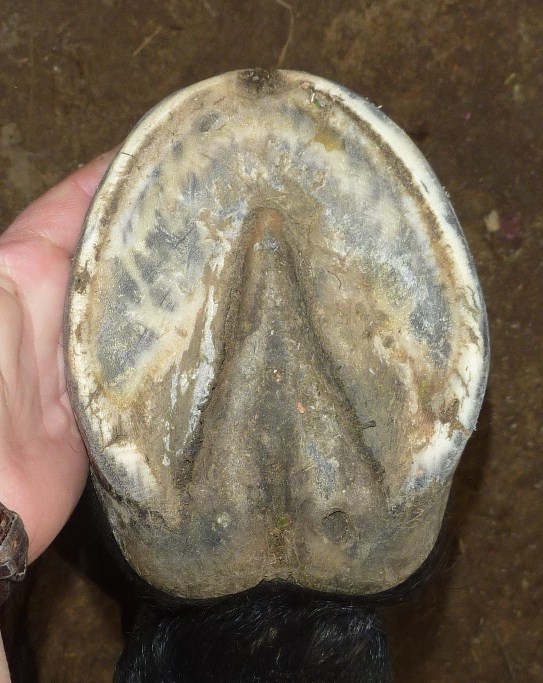
I hope you can see how the hoof in the 5 month photos is much healthier than at the start of this particular journey. Especially look at the solar view - the frog is no longer ragged with thrush, the white line is less stretched, the seedy toe is slowly growing out and the back of the foot is bulking out nicely. Note the horse lives out 24/7 in all weathers on grass.
When I first saw this horse it was suffering chronic hind leg lameness. So long as we maintain the roll, this is no longer an issue and the horse has been happily in work.
But the every journey has its downs as well as ups and today we found the horse a bit sore from thrush in a front foot. But as it is bare, the soreness is soon noticed and the problem can be more readily resolved.
Here is wishing a very special partnership all the best.
Subscribe to:
Posts (Atom)
Subscribe


 Posts
All Comments
Posts
All Comments