Wednesday, 31 August 2011
Hoof reading
I'm giving you just one photo. Tell me what you see. There is a huge amount of background to this with more photos, but first I want your views. So if you want more photos of this case you need to work a little for it! :-)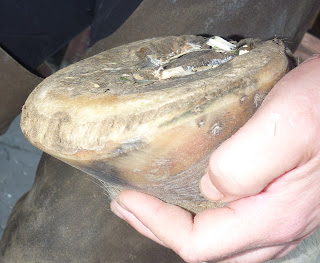


Saturday, 20 August 2011
Sweet dreams - who said WBs can't go barefoot?
 |
| Wow! look at them go :-) |
 |
| Tracks don't have to be over complicated |
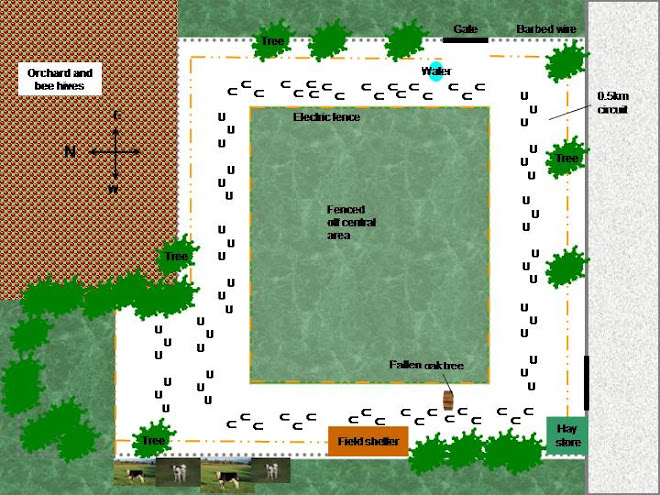
Someone (the local 'expert') confidently told me that warmbloods can't go barefoot. Fortunately these guys don't suffer ear mites.
Three warmbloods (only two shown) all barefoot, all confident over a variety of surfaces and having a blast now they can hack out without slipping. Their carer has been brilliant, an example to us all of how to do it. Lots of observation, an open mind and the horses' health always a priority.
And what a great track! Lucky lucky them, but for those without this blessing - these guys got good barefoot before they got the track. It can be done and you know what - I tend to find WB's make excellent barefooters. But just don't feed them 'junk' - it messes with their heads as well as their feet.
Friday, 19 August 2011
Hoof shape and shoes
Same hoof as previous; but solar view. Note how the widest part of the foot is moving towards the heel. You might find it hard to see, but the sole is increasing (slowly) in thickness and concavity. Also note how the frog has quickly widened and how it was somewhat cramped by the shoe.
 |
| 30 05 11 |
 |
| 24 07 11 |
 |
| 11 08 11 |
Navicular and 'metabolic' - 10 weeks 3 days
By kind and generous permission of the carer.
Vets have given a 'Navicular' diagnosis. Horse on presentation has very thin soles, fronts are running forward, heels are collapsed, bulbs pointy rather than full, toe wall has been rasped out in places, frog is squishy (but not rotten, just unused), digital cushion is undeveloped (on palpation) and there is some red in the white line.
Subsequent trial and error shows the horse is sensitive to grass, probably oats and haylage. Does better on night time turnout with soaked hay in the day. Horse is on/off footy depending on circumstances but is generally improving. Progress would probably be faster if 24/7 turnout on a grass free track could be provided. But this carer has chosen to learn how to manage a tricky case, at livery, because long term they want to know how to provide for this horse. Even so, and even with some set backs they are making progress.
In the photo array the first picture (top left) was taken 30/05/11, the last (bottom right) 11/08/11. Can you see the differences?

Vets have given a 'Navicular' diagnosis. Horse on presentation has very thin soles, fronts are running forward, heels are collapsed, bulbs pointy rather than full, toe wall has been rasped out in places, frog is squishy (but not rotten, just unused), digital cushion is undeveloped (on palpation) and there is some red in the white line.
Subsequent trial and error shows the horse is sensitive to grass, probably oats and haylage. Does better on night time turnout with soaked hay in the day. Horse is on/off footy depending on circumstances but is generally improving. Progress would probably be faster if 24/7 turnout on a grass free track could be provided. But this carer has chosen to learn how to manage a tricky case, at livery, because long term they want to know how to provide for this horse. Even so, and even with some set backs they are making progress.
In the photo array the first picture (top left) was taken 30/05/11, the last (bottom right) 11/08/11. Can you see the differences?

Monday, 18 July 2011
No miracles here
Regular readers probably know that I write this blog (more accurately, sweat, bleed and salt the air - seeing as how I am not that IT literate) to provide some inspiration for people with more challenging horses and barefoot newbies. Yeah and there is a bit of personal satisfaction too, let's not forget that. I am only human and a pretty flawed one.
But I don't do it to parade 'miracles'. All the horses on this blog are cared for either in livery or at home, with the exception of the odd rehab I had before I ever went pro.
And that is the point really, because it is the care that they receive that transforms these horses. Not my trimming, not some super special feed or supplement, but a general holistic, horse centric care approach.
True, the tall horses need the length adjusted etc, but without proper care all I could achieve would be some pretty basic adjustments. Some horses need a long period of rehabiliation and the carer may need advice on how to rehabiliate a hoof, but they should take the credit for any success because they are the ones who have delivered the care.
And yes, sometimes progress is a little slower than it could be because the owner is learning, but you know equally it is sometimes really really fast. And previous horse experience is not really any kind of guide. What does count is putting the horse first and learning to 'read' them and respond appropriately.
So what I am trying to say is, when trawling the net and this blog in particular, as you peruse the before and after photos, just remember the only miracle at play is the miracle of mother nature.
But I don't do it to parade 'miracles'. All the horses on this blog are cared for either in livery or at home, with the exception of the odd rehab I had before I ever went pro.
And that is the point really, because it is the care that they receive that transforms these horses. Not my trimming, not some super special feed or supplement, but a general holistic, horse centric care approach.
True, the tall horses need the length adjusted etc, but without proper care all I could achieve would be some pretty basic adjustments. Some horses need a long period of rehabiliation and the carer may need advice on how to rehabiliate a hoof, but they should take the credit for any success because they are the ones who have delivered the care.
And yes, sometimes progress is a little slower than it could be because the owner is learning, but you know equally it is sometimes really really fast. And previous horse experience is not really any kind of guide. What does count is putting the horse first and learning to 'read' them and respond appropriately.
So what I am trying to say is, when trawling the net and this blog in particular, as you peruse the before and after photos, just remember the only miracle at play is the miracle of mother nature.
Friday, 15 July 2011
More tall walls
Another day, another horse, another set of overly tall feet.
This one came as a perpetual tripper. I have never seen such an enormous jumpers bump (not pictured) on a medium heavy cob (and no he doesn't do any jumping). Also camped under. I suspect that this guy, being 20, is going to have more problems with reeducating his muscles than he will have with his new feet.
That's not to say the 'new' feet won't be noticed. His heels will widen, the frog will come into use, breakover will come back, the proportions will change, the walls will get denser as will the sole. How could all these changes not have an impact and not be felt? Sometimes I wish the horses could talk to us - other times I am quite glad they can't.
This one came as a perpetual tripper. I have never seen such an enormous jumpers bump (not pictured) on a medium heavy cob (and no he doesn't do any jumping). Also camped under. I suspect that this guy, being 20, is going to have more problems with reeducating his muscles than he will have with his new feet.
That's not to say the 'new' feet won't be noticed. His heels will widen, the frog will come into use, breakover will come back, the proportions will change, the walls will get denser as will the sole. How could all these changes not have an impact and not be felt? Sometimes I wish the horses could talk to us - other times I am quite glad they can't.
 |
| Frog is tiny and not touching ground, heels are very tall |
 |
| Heel is contracted, bars bent inwards, foot is 50/50 rather than 2/3 and 1/3 |
 |
| Wall much taller at quarters than toe |
 |
| Height on opposite quarter |
Comparison between shod and unshod height
This hoof has just been deshod. Although there has been a significant shortening of the whole hoof capsule, over time it will get shorter still - and all to the good.
There are two ways in the above photos of comparing the differences between the before and after shots. The horizontal amber lines give an overall comparison of the height of the hoof before and after.
The pairs of coloured lines show more detail. Each colour pair is the same length and angle in both the before and after shots. So the red line which marks the toe length, by being the same length and angle shows the difference in the hoof toe before and after. The green line shows the change in height of the heel. The blue line joins the red to the green, showing their relationship to each other is the same in each photo.
And where did the extra height on the shod horse come from?
Not just the shoe but a lot of untrimmed hoof wall too.
 |
| Before and after deshoeing, same day, same hoof |
There are two ways in the above photos of comparing the differences between the before and after shots. The horizontal amber lines give an overall comparison of the height of the hoof before and after.
The pairs of coloured lines show more detail. Each colour pair is the same length and angle in both the before and after shots. So the red line which marks the toe length, by being the same length and angle shows the difference in the hoof toe before and after. The green line shows the change in height of the heel. The blue line joins the red to the green, showing their relationship to each other is the same in each photo.
And where did the extra height on the shod horse come from?
Not just the shoe but a lot of untrimmed hoof wall too.
 |
| Hoof wall is longer in toe than heel, tipping foot backwards |
Thursday, 14 July 2011
Well where do I start?
Apologies for lack of posts! So much to blog about I don't know where to start.
Thought you might find these interesting. Older horse, started tripping, shod 7 weeks ago. Clenches not risen at all.
This horse has quite hard feet, not bad at all for such a long time shod. But they are quite contracted, the frog hasn't been in contact with the ground for ages and there appears to be some dietary issues.
There have been lameness and tripping issues. Some related to the feet, but others ? Whatever happens, this guy is going to be able to move more comfortably now he is not on stilettos. I am expecting him to have a few good and a few bad days though as he gets used to his new feet, as they decontract and while we figure out what regime is going to suit him, especially as he has many of the symptoms of Insulin Resistance.
His owner is considering setting up a track and we may fit boots in order to be able to step up his exercise a little more sharply than we would otherwise.
Thought you might find these interesting. Older horse, started tripping, shod 7 weeks ago. Clenches not risen at all.
 |
| 1 Frog not touching ground, foot clearly peripheral loading |
 |
| 2 Note inverted 'V' of back of foot/heel bulbs & detrius under toe of shoe |
 |
| 3 Note height of foot and nail holes in relation to ground |
 |
| 4 Note narrowness of heels, and tiny frog |
 |
| 5 Compare with 1 |
 |
| 6 Inverted 'V' very noticeable, heel too tall and contracted |
 |
| 7 Compare with 3 note excessive height |
 |
| 8 Compare with 4 |
 |
| 9 Post trim, compare with 1 and 5 |
 |
| 10 Post trim, compare with 4 and 7, note nail holes, multiple event lines and change in angle |
 |
| 11 Post trim and short road walk compare with 4 and 8, note dip in toe |
This horse has quite hard feet, not bad at all for such a long time shod. But they are quite contracted, the frog hasn't been in contact with the ground for ages and there appears to be some dietary issues.
There have been lameness and tripping issues. Some related to the feet, but others ? Whatever happens, this guy is going to be able to move more comfortably now he is not on stilettos. I am expecting him to have a few good and a few bad days though as he gets used to his new feet, as they decontract and while we figure out what regime is going to suit him, especially as he has many of the symptoms of Insulin Resistance.
His owner is considering setting up a track and we may fit boots in order to be able to step up his exercise a little more sharply than we would otherwise.
Tuesday, 21 June 2011
Just 3 weeks later
And another 80km (50 miles old money), only this time all in one day. (see hooves from one year ago and 3 weeks ago here. And post the one day 80km ride the hooves look like this:
Ride conditions were wet and muddy. For those who worry about slipping/traction and the need for studs. This horse had minor slips, unlike the shod horse they rode with who slid down one bank on its bottom.
I think the effort that the owner has put into preparing this horse is really paying off. Confident on her feet, the work over varied terrain to build the hooves has also conditioned her body - both body and hooves look great, good structure and strength.
 |
| LFSR post Rufus 50m 2011 |
 |
| LHSR post Rufus 50m 2011 |
 |
| RFSR - post Rufus 50m 2011 |
 |
| RHSR - post Rufus 50m 2011 |
Ride conditions were wet and muddy. For those who worry about slipping/traction and the need for studs. This horse had minor slips, unlike the shod horse they rode with who slid down one bank on its bottom.
I think the effort that the owner has put into preparing this horse is really paying off. Confident on her feet, the work over varied terrain to build the hooves has also conditioned her body - both body and hooves look great, good structure and strength.
Tuesday, 14 June 2011
Seedy toe, abscess and 'false' sole ...........
Do you remember the somewhat spectacular toe crack? Well the path to hoof heaven is never a straight one and living in the UK makes it exceptionally wet and muddy too.
Mud and seedy toe can lead to abscess and so it did in this case. But every cloud has a silver lining .........
The foot abscessed during the very wet muddy spell we had mid winter and we were dealing with the consequences. The foot had gone somewhat backwards. The last 3 photos in this array are June 2011, the rest are May 2011.
And the warmest of thanks to the owner for letting me share these photos.
Oh and yes, the horse is sound and apparently rather 'forward going' - not bad for a girl in her 20's! :-)
Mud and seedy toe can lead to abscess and so it did in this case. But every cloud has a silver lining .........
The foot abscessed during the very wet muddy spell we had mid winter and we were dealing with the consequences. The foot had gone somewhat backwards. The last 3 photos in this array are June 2011, the rest are May 2011.
And the warmest of thanks to the owner for letting me share these photos.
Oh and yes, the horse is sound and apparently rather 'forward going' - not bad for a girl in her 20's! :-)
 |
| Long toe scooting forwards |
 |
| Toe crack has extended |
 NB semi circular solar split just above frog apex  |
| 'False' sole lifted from solar toe area |
 |
| Cleaned back to bars |
 |
| Note wall height now 'false' sole exfoliated. New sole is hard |
 |
| Oblique view of partial clean |
 |
| Cleaned and rolled |
 |
| 06 11 - Side view compare with 1st photo. Note abscess hole |
 |
| 06 11 - Front view post trim, note reduction in toe crack, compare with photo 2 |
 |
| 06 11 - Solar view post trim |
Saturday, 28 May 2011
And my (old) vet said
 |
| LF April 10 - corn, sole thin at toe, weak heels, spoon shaped |
 |
| LH April 10 |
 |
| RF April 10 |
 |
| RH April 10 - apologies for poo! |
 |
| LF - May 11, 5 days post GH, more concavity, sole thicker, heel bulbs developed, wider at heel |
 |
| LH - May 11 5 days post GH |
 |
| RF - May 11 5 days post GH |
 |
| RH - May 11, 5 days post GH |
........... "Horses can do everything barefoot except Endurance."
The May 11 hooves are 5 days post the Golden Horseshoe. 80km in two days over a stoney moor*. Although the owner reports it is not as stoney as their regular training ground. Horse vetted sound with a Silver, missing Gold by one heart beat. The icing on the cake was the compliments from the vet on the hooves! :-)
Maybe if my original vet were still practicing today he would change his mind? He was pretty open minded and pragmatic so I like to think so.
* I took this horse on as a client April 10. Previously always ridden out in boots as always a bit footy. Diet change and a few modifications to hoof care and what a difference a year makes. Owner is incredibly dedicated and it wouldn't work without their ability to manage their horse. Horse lives out 24/7, until recently in regular grass livery. Now on a grass track.
Saturday, 21 May 2011
Flare
There seems to be a hell of a lot of confusion about flare. Certainly conversations with my clients makes me realise it has become a dangerous term to use unless both parties are absolutely certain they are discussing the same thing. So for the purpose of this post I am going to try to be more specific.
Many of the horses I deal with suffer from white line stretch. This largely occurs because the lamellar bonds have been weakened, generally but not always from dietary disturbance. I'll cover this in more detail in a future post. For now stick with the idea that the lamellar bonds are compromised and a visual clue is that the white line is now wider than the edge of a credit card.
Other horses, in squaring off their toes create a hoof wall which has an uneven thickness. The solar view may show a thicker hoof wall at '10am' and '2pm'. For horses that don't move perfectly straight this might be '9am' and '1pm' or '11am' and '3pm' but you get the general idea. The hoof wall in between has been worn thinner, creating 'corners' at either end of the thin section.
Much more rarely and I don't really see this in the South East, although I have seen it on my travels, the hoof wall grows at significantly variable thicknesses.
And then there is what looks like 'flare' from the outside but is actually nothing of the kind. An update on this hoof is here. Let's call this a 'deviation'.
On various occasions I have heard each of these scenarios described as 'flare'. As each needs a different approach I think it is important to label/understand them more clearly to ensure the correct techniques are adopted.
Starting with the last scenario first - a deviated hoof. More than one person has suggested that this foot should be tackled by rasping the outer hoof wall. But check out the solar view - can you see what would happen if this were done? The hoof wall would be substantially weakened, possibly badly compromised and the deviation would still be there. Only with a weakened hoof wall the hoof would be less able to continue with the (fairly substantial) work load the horse currently enjoys - completely boot free over all sorts of surfaces.
Continuing my backwards theme....... the uneven thickness of hoof wall (which I don't see much of these days). If this is significant and likely to cause problems as it grows out then this can be dressed out, but extreme care needs to be taken as over enthusiasm can leave the hoof wall compromised. Less is more.
Squared off toes. I see this most often in horses that do a lot of straight line work on more abrasive surfaces and those that are seeking to bring their breakover back. If the 'corners' are left they can break off leaving a ragged and unsightly edge. Usually this causes the humans more problem than the horses. Sometimes, especially if the horn quality is very plastic, a nasty tear can result. If the hooves are very tough and the corners don't snap off then they can interfere with the horse's ability to move efficiently. Corners are dealt with as part of the normal roll process. The hoof should not need dressing higher up as there is no uneven wall thickness, just uneven wear.
White line stretch. Now bear in mind you are dealing with a horse that has compromised feet. Sometimes substantially compromised. Along with the white line stretch there may be quite poor hoof quality, depending on how long the horse has been in distress. I have seen some real shockers where the whole capsule reminds me of one of those chicken eggs with a weak shell. Dealing with this by rasping the outer hoof wall is unhelpful at best.
There are but two things to do. Remove the causal factor which is usually but not always diet related. Grow down a tightly bonded hoof capsule (see posts on healing angle). And trim the hoof according to AANHCP guidelines, removing only what nature would have done given the chance.
Many of the horses I deal with suffer from white line stretch. This largely occurs because the lamellar bonds have been weakened, generally but not always from dietary disturbance. I'll cover this in more detail in a future post. For now stick with the idea that the lamellar bonds are compromised and a visual clue is that the white line is now wider than the edge of a credit card.
Other horses, in squaring off their toes create a hoof wall which has an uneven thickness. The solar view may show a thicker hoof wall at '10am' and '2pm'. For horses that don't move perfectly straight this might be '9am' and '1pm' or '11am' and '3pm' but you get the general idea. The hoof wall in between has been worn thinner, creating 'corners' at either end of the thin section.
Much more rarely and I don't really see this in the South East, although I have seen it on my travels, the hoof wall grows at significantly variable thicknesses.
And then there is what looks like 'flare' from the outside but is actually nothing of the kind. An update on this hoof is here. Let's call this a 'deviation'.
On various occasions I have heard each of these scenarios described as 'flare'. As each needs a different approach I think it is important to label/understand them more clearly to ensure the correct techniques are adopted.
Starting with the last scenario first - a deviated hoof. More than one person has suggested that this foot should be tackled by rasping the outer hoof wall. But check out the solar view - can you see what would happen if this were done? The hoof wall would be substantially weakened, possibly badly compromised and the deviation would still be there. Only with a weakened hoof wall the hoof would be less able to continue with the (fairly substantial) work load the horse currently enjoys - completely boot free over all sorts of surfaces.
Continuing my backwards theme....... the uneven thickness of hoof wall (which I don't see much of these days). If this is significant and likely to cause problems as it grows out then this can be dressed out, but extreme care needs to be taken as over enthusiasm can leave the hoof wall compromised. Less is more.
Squared off toes. I see this most often in horses that do a lot of straight line work on more abrasive surfaces and those that are seeking to bring their breakover back. If the 'corners' are left they can break off leaving a ragged and unsightly edge. Usually this causes the humans more problem than the horses. Sometimes, especially if the horn quality is very plastic, a nasty tear can result. If the hooves are very tough and the corners don't snap off then they can interfere with the horse's ability to move efficiently. Corners are dealt with as part of the normal roll process. The hoof should not need dressing higher up as there is no uneven wall thickness, just uneven wear.
White line stretch. Now bear in mind you are dealing with a horse that has compromised feet. Sometimes substantially compromised. Along with the white line stretch there may be quite poor hoof quality, depending on how long the horse has been in distress. I have seen some real shockers where the whole capsule reminds me of one of those chicken eggs with a weak shell. Dealing with this by rasping the outer hoof wall is unhelpful at best.
There are but two things to do. Remove the causal factor which is usually but not always diet related. Grow down a tightly bonded hoof capsule (see posts on healing angle). And trim the hoof according to AANHCP guidelines, removing only what nature would have done given the chance.
Saturday, 14 May 2011
Help my horse has gone footy
Footiness is a mixed blessing. Now don't get me wrong, we would all rather our horses never got footy. But with the barefoot horse it's a really useful early indicator of something going wrong. And this is something that I think a lot of people don't quite grasp.
Footiness is a symptom of less than perfect health. Sometimes only minor, sometimes something more. But less than perfect health nevertheless.
This is a quick list of things to consider:
But please don't be tempted to shoe until you know what the problem is - you may resolve the footy symptom, but you won't resolve the cause and without the footiness to guide you, you won't know if your horse has been restored to better health.
If you are determined to shoe (and of course I'd counsel against) then only shoe a sound horse.
Footiness is a symptom of less than perfect health. Sometimes only minor, sometimes something more. But less than perfect health nevertheless.
This is a quick list of things to consider:
- too much grass
- impact on grass of change in environment (rain after drought, several days of frost, fertilizer)
- too much sugary/starchy feed
- sugary hay (for cool season grasses)
- other non specific dietary upset
- course of antibiotics
- thrush
- bruise
- corn
- abscess brewing
- sole been thinned by inappropriate trimming
- foot overdue for trimming
But please don't be tempted to shoe until you know what the problem is - you may resolve the footy symptom, but you won't resolve the cause and without the footiness to guide you, you won't know if your horse has been restored to better health.
If you are determined to shoe (and of course I'd counsel against) then only shoe a sound horse.
Friday, 13 May 2011
Heels
 |
| Aug 10 - slightly contracted - note lack of substance and the groove between bulbs |
 |
| Aug 10 solar view of above - note weak butresses and deep central sulcus |
 |
| Oct 10 - heels decontracted - note how groove has disappeared |
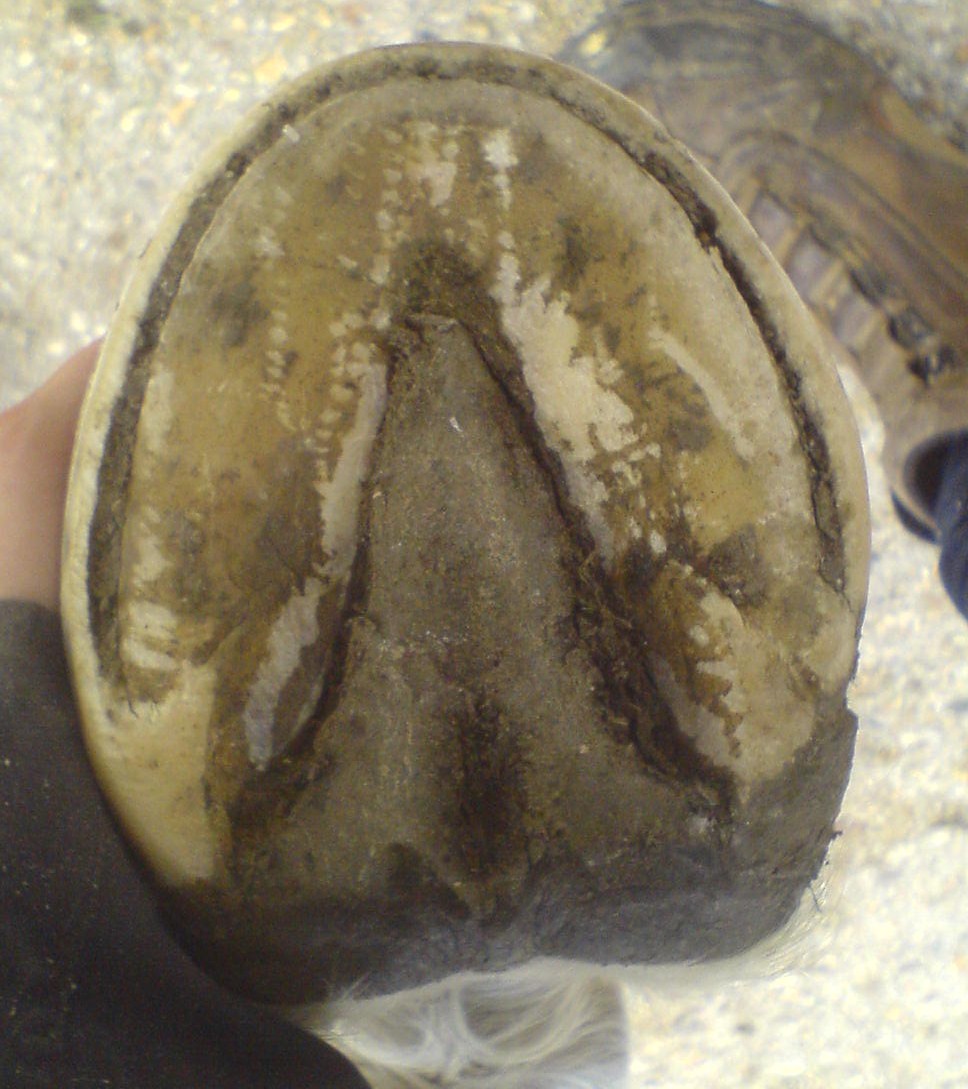 |
| Oct 10 solar view of above - note changes to buttresses, central sulcus, sole and frog generally |
 |
| Note weight bearing section of heel is towards middle of foot Note weak structure, poor horn quality, excessive wall rasping |
 |
| Slowly weight bearing section moving back to where it should be - toe still really long, quality improving a little |
 |
| Heel in suspension, lami rings, excessive wall rasping |
 |
| Contracted, infected, sore and weak |
 |
| Few weeks later, decontracting, infection cleared, not sore |
 |
| later still, note heel bulb position and shape |
Of all the structures most abused in the horses hoof, my current bug bear is heels. Remember 'Fred'? Tall heels, contracted heels, infected heels and underrun heels. None of these are normal or healthy and with appropriate care, diet and exercise they can all be improved. A good heel is vital to a horse and sentiment aside, a horse with a well formed hoof is going to stay sound longer.
Oh and for those debating shoes/boots - if you need to put something on your horse's foot, boot everytime. I have yet to deshoe a horse that had a good heel, but they can usually grow/build one pretty quick once that shoe gets taken off.
NB - building good heels doesn't happen by magic or overnight - a good diet and an appropriate management regime are important. And even horses living in less than ideal conditions can have a good foot/heel if they work hard enough
Subscribe to:
Posts (Atom)
Subscribe


 Posts
All Comments
Posts
All Comments