Custom Search
Shoes mask weaknesses, barefoot highlights strengths

Thursday, 15 July 2010

Speed of growth (and hoof cracks)


This foot is trimmed at four weekly intervals. Each photo is four weeks apart. Therefore there are 12 weeks between the first photo and the last.

The crack in the hoof has grown out quickly with no fancy putty, packing, burning, clipping, dressings or gunk of any kind.

The horse has continued throughout with a normal workload (heavy by today's standards) and has been sound throughout.

Transition - it's a bit like gardening.........


Feed appropriately, trim as necessary and let it grow, let it grow, let it grow.

A work in progress, in the third photo you can see very clearly the difference between the healing angle and the basement. The paper thin sole is thickening up (slowly) ditto the crumbling walls.

Wednesday, 14 July 2010

Lameness removing shoes a case study - 33 days


Thank you to the carer of this horse for generously allowing me to use the photos.

The first photo shows the hoof prior to being deshod on day one. The second photo is how the hoof looks 33 days later.

Notes

Horse is foot sore, but is making progress - sound in walk in the school

Hay is soaked for 12 hours and the horse is being fed a high quality general purpose mineral supplement.

Stabled during the day the horse is turned out in a grazing muzzle overnight

Exercise is 20 minutes or so at walk, in hand in a school

The horse's carer is working on their mustang roll technique

The healing angle is very healthy at approximately 52 degrees and is heading towards the ground nicely

The basement angle is approximately 39 degrees

The picture below shows the healing angle marked up in red and the basement in orange.

Sunday, 11 July 2010

Shoe sizes


A big 'Thank you' to the owner of these shoes for allowing me to photograph them and use the picture on this blog.

These shoes were put on the same foot - the time interval just one shoeing. So one of them was taken off and the other nailed on immediately after.

I've seen hooves change shape really quickly - but never that fast - it usually takes at least a few days for a noticeable difference.

I obviously don't have the requisite magic rasp............

Monday, 5 July 2010

Shoeing intervals


I have no doubt that some foot problems are caused by overly long shoeing/trimming intervals.

But I am not so sure that this can be the causal factor for all the foot problems I see in recently deshod hooves.

The foot above (not one I have worked on) is most likely to have had a fair amount of farrier attention judging by the nail holes and interesting shoe pad combo. It took a long time for the foot to get like that.

To be honest, I am wary of posting pictures like the ones above. But unfortunately I have met horses still living, attached to feet that are going in the same direction. So I post with the hope that maybe these pictures will serve as a timely warning and prevent such tragedy happening for someone and their horse.

Thursday, 1 July 2010

Can't see the foot for the shoes

The feet below have all recently had the shoes removed.


I've removed the shoes from a fair few horses. A common theme is the poor health of the foot when the shoe comes off. I have yet to remove a shoe from a foot that has been in perfect condition.


The things we tend to find are:


  • terrible smell


  • thrush


  • white line separation


  • contracted heels


  • squishy contracted frog


  • thin sole


  • crumbling walls


  • laid over bars


  • shallow collateral grooves


  • really long walls

Tuesday, 29 June 2010

Barefoot hooves - speed of growth/wear


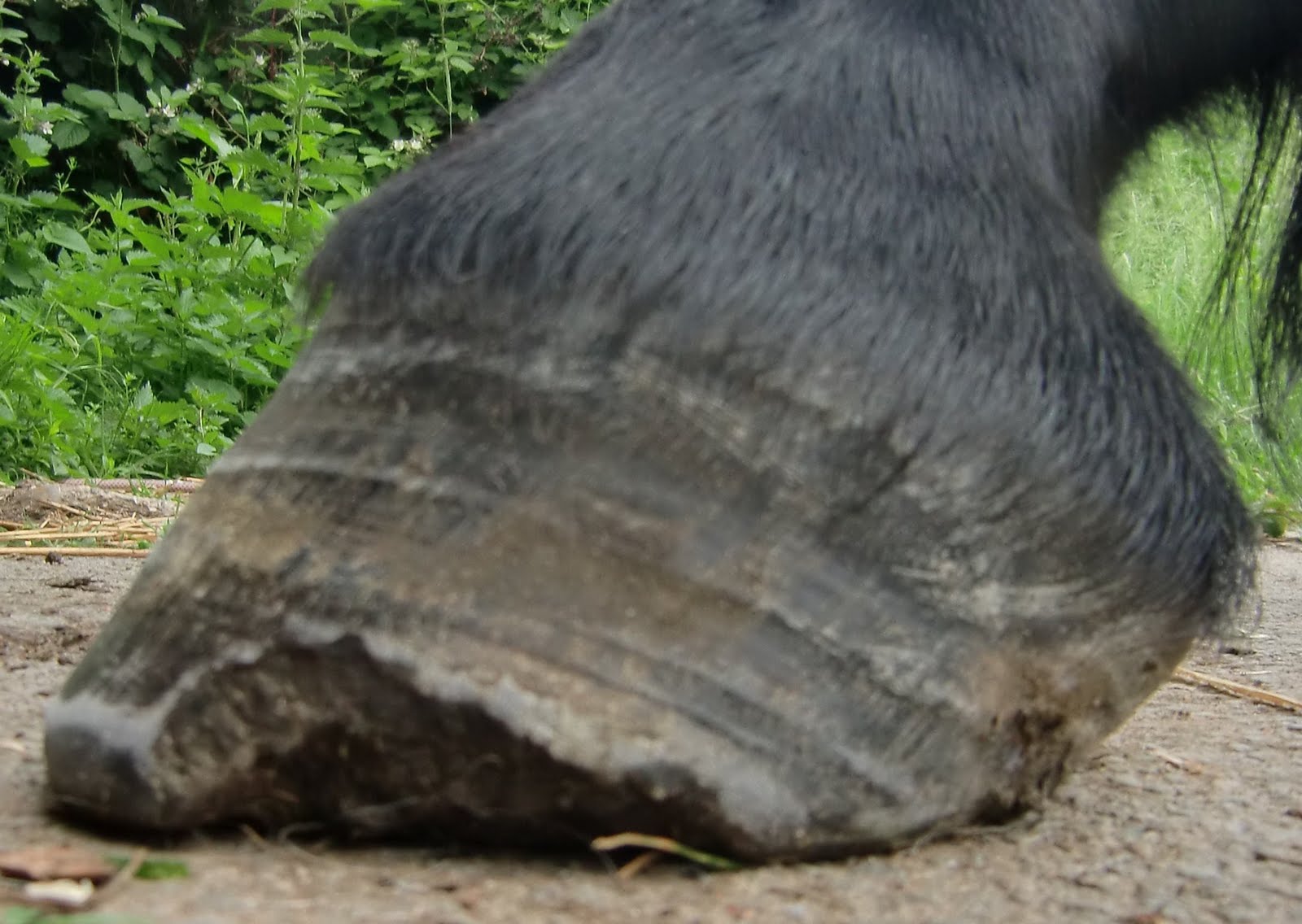
Hooves are a window to your horse's health. Event lines - as can be clearly seen in the first photo are reminders of 'events'. The two biggest lines, at just below half way down the hoof and the one below were caused by vaccinations - which this horse will probably not have again because they made her very ill.


In the second photo you can see one big event line just above the bottom edge of the hoof. This is the same one which in the first photo is just below half way down. The hoof has grown that much in 8.5 weeks - or just about 2 months. I estimate that this hoof is replacing itself completely roughly every 6 months. Oddly before I checked the history I had always thought this horse grew foot quite slowly.


So it pays to keep records and to realise just how fast hooves can grow - barefoot ones anyway.


And despite being stabled this horse is almost self trimming. She works 3x a day on a variety of surfaces including sand, stones, grass and car park. Extreme metabolic issues mean she is not quite rock crunching at the moment, but she has been in the past and we hope that she will be in the future. But never again will I use a wormer that claims to be effective over a number of weeks. It takes too long to grow out the damage from this horse's feet.

Monday, 28 June 2010

Hind foot - 9 month changes


First photo just deshod, second photo not quite 9 months later.

Sunday, 27 June 2010

Event lines and laminitis


The first picture was just after the horse was deshod. A previous laminitis attack is evidenced by the heavy, broad rings in the heel area of the hoof wall. The hoof wall had been severely rasped when the horse was shod to remove the rings from the front portions of the hoof wall.

The second picture is 9 months later. You can see the hoof wall maintains the same angle more or less from coronary band to floor. If you look closedly you can see there are faint event lines. Some of them are from diet, others from wormers and vaccination. By carefully monitoring the appearance of these, it is possible to deduce what does and doesn't work for an individual horse.

This particular horse is an exceptional challenge and it is gratifying to have been able to get a reasonable angle all the way to the ground. Rock crunching comes and goes. A well intentioned but 'unfortunate' wormer is taking a long time to grow out.

Saturday, 26 June 2010

Transition - changes in hoof shape


When a hoof 'transitions' it sometimes changes shape in one or more dimensions. The above hoof has changed from just about every view.

In this solar view you can see how the;

  • length from frog apex to toe tip has shortened,
  • collateral grooves are wider
  • depth of sole around the frog apex is deeper,
  • sole has gone from almost bulging to having a modest amount of concavity

Friday, 25 June 2010

Lameness - Removing shoes - a case study

Front Foot Shod
The purpose of this blog is to question, inform and encourage in equal measure.

If you are a regular follower, the questions will be easy to answer. If not then previous posts may be helpful.

If you are the owner of a horse which is in transition then I hope that this and previous posts will provide some inspiration.

In order to provide the photographic material a very very kind horse owner has given me permission to use pictures of their horse - which has just started the transition process.

The horse attached to the feet in the pictures has been progressively lame for some months. Besides being lame the horse was unable to stand without the front legs continually trembling at the knee. The regular vet referred to a specialist. Diagnosis was nothing wrong with feet. I'll let you make your own minds up.

Solar View Both Fronts Just Deshod


Two Weeks Later


Since removing the shoes the horse has been on a high fibre, low sugar diet. Exercise is on soft surfaces until the horse is able to cope with more. The knee trembling almost entirely stopped and the horse is 'beaming'.

Although footy over stones the horse is moving better in a straight line and around corners. The owner is incredibly hard working and dedicated to their horse. A credit to themselves and an example to us all. :-)


And here is one we did earlier ......

Monday, 7 June 2010

EPSM and barefoot with added sugar at livery

If you have an EPSM horse with sugar issues you may find yourself driven to distraction until you find the formula that works for your horse, especially if like me you keep it at livery with no grass free turnout.

My own horse Grace has been up and down like the proverbial yoyo. First it took an educated guess to realise that she may have EPSM. We already knew about the sugar problem. Several weeks on the EPSM diet and we were making progress. Now Grace only ties up when under extreme mental/emotional stress (until the next unexplained episode of course and touching lots of wood).

But her feet ....... they react just as badly as her muscles and take longer to recover. Every millimetre of concavity is hard won and very easily lost. We had a month or so in February when she could crunch rocks. Then a few things happened and we have been struggling. (Wormers, vaccinations, grass, stress, they all impact.) So I have recruited the EasyCare Gloves and only regret that I didn't get a pair sooner.

Look at the pictures below. If you imagine a steady switch between the two on a monthly or more frequent basis you might have some idea of life with an EPSM sugar sensitive ned.

In the first picture (old camera phone) the foot is completely flat and starting to scoot forward at the toe. In the second picture the foot is now wider than long (just) and has some concavity.


It has now come to a bit of a pause at this point. With extra Vitamin E we are holding steady for the moment. I am not planning to change anything until I know this current state is stable.

Of course I'd be so happy if we get a more concave foot, but right now I'd be grateful to hang on to the concavity that we have.

Another look at a deviated hoof

In April we looked at a deviated hoof and how if you trimmed it just by looking at the outside you could end up resecting the hoof (a complete no no).

The hoof in question also had an extensive white line separation in one quarter, and some damage higher up in the same quarter, possibly from where an abcess had errupted from the coronary band.

The damaged hoof wall and white line separation have now 'connected' and the quarter has broken away. I thought you might like to see the extent of the damage - and to know that the horse is still sound. In fact she is increasingly 'perky'.

The pink lines broadly track where the upper portion of hoof wall is indicating it would like to go. We are still in the same position of not being able to remove the 'flare' as it is a deviation and to do so would mean cutting into the live foot.

This hoof is showing evidence of dietary issues, which the owner is seeking to address. Much easier to say than do when keeping a horse at grass in the UK.


Wednesday, 2 June 2010

We need a new acronym............

Regular readers of this blog will be familiar with DEET which then became DEETT - standing for

Diet
Exercise
Environment
Time
Trim.

But I need to add in Education and Communication.

Suggestions for a new acronym will be warmly welcomed!

Tuesday, 20 April 2010

In suspension


This is a hoof comparison. The photos are taken 7 months apart.

First photo
Horse rarely stood with feet as a pair - one was always in advance of the other
Extensive stress rings/event lines had been rasped out - but still evidenced in the heel
The heel is in mid air suspension
It's hard to see in this photo but the heel is starting to run under
Coronary band has a deviation above the quarter
Lateral cartilage looks weak

Second photo
Feet are paired
Stress rings still in evidence but much less extreme and not rasped out
Heel is supporting the horse and in turn is supported by the ground
The heel is not running under
Cartilage is more robust
Whole hoof appears stronger

Monday, 19 April 2010

You can't necessarily judge a book by its cover

And a 'pretty' hoof won't necessarily perform better than one which is less photogenic. This foot has become rock crunching against the odds. It might only last for a few days, the horse is so metabolically challenged I plan to celebrate while I can :-)


Photos can be misleading. So let me describe what I see 'hands on'. The sole is really very flat and has been for months. Every time we get a smidge of concavity we have a metabolic event of some sort and it splats.

The white line is stretched and doing something rather nasty at the toe. We have also had a bit of thrush in the frog. But the horse is sound over some pretty nasty rocks. Bouncingly sound. Long may it last. We can work on better form, but healthy, active, function will go a long way to helping that happen.

Cross your rasps for this one. :-)

Monday, 12 April 2010

Transition goes both ways

Transition is often talked about as moving from a poor foot to a good foot. But you can take a good foot and add a little sugar and just like magic the good foot goes bad.
The pictures below span just two months. It took rather longer to get the foot back, but the owner is fantastic, made the effort and once again the horse has great feet.


Tuesday, 6 April 2010

Barefoot - know your landmarks

I was trimming a foot the other day and an observer told me I should 'Take a bit more off one side to make the foot symetrical.'. Well I didn't and I wouldn't.

Using a completely different foot belonging to a very kind volunteer I will try and explain why.

I must emphasise that the foot in the pictures is for demonstration purposes only and is not the foot which sparked this post.

The pink lines show the vertical and the green the horizontal planes. I hope you can see where and how the foot deviates from being symetrical.

If this were the foot in question the observer would want me to take off the portion of foot sticking out towards the bottom on the left hand side.

Now look at the solar view below.


The pink line bisects the centre of the foot. The green lines to the left and right are equal distances from the pink line. If (please don't) but if you followed the chop it off to make it symetrical theory then in this picture you would take out the right hand side. (Completely opposite to that suggested by the front view.)

Yes it's the same foot, the pictures are taken seconds apart on the same day.

If I had followed the observer's advice I would have ended up resecting the foot which is of course completely unacceptable.

I'll post a bit more about this later in the week. Questions welcome.

Monday, 5 April 2010

Sudocrem Balls

Do you sometimes like to play the five year old and get a little messy while having fun?

Well if your horse has thrush you can try treating it with Sudocrem balls.

First clean your horse's foot and if you wish flush/spray with something completely innocuous like dilute cider vinegar. Then stuff any cracks/crevices with the Sudocrem balls. Pictures below.

First get your 'ingredients' :-) Sudocrem or equivalent and clean cotton wool.

Pull off a small amount of cotton wool - about the size of a 10 pence piece or small gum ball (remember my hands are quite small)


Roll it around in the Sudocream. Make sure your hands are clean. You can make loads in advance and either store them in the tub or in a clean plastic bag.


I did say it gets messy.


Take one clean foot with thrush (see grotty central sulcus).

Stuff Sudocrem ball in the crevice and you are done. Plug all the holes/crevices and leave in situ.


Repeat daily if possible until the thrush has cleared. This may take a long time. But at least you know with the crevice plugged it will stop any more dirt and painful stones wedging in there.

Thursday, 1 April 2010

Masking problems rather than fixing them

This post is inspired by my current horse; Grace.

Grace is barefoot and is in transition. Her shod feet were in poor condition and she is laminitic with suspected EPSM. To add further insult at sometime in her past she has received fairly traumatic injuries.

The reason I mention the laminitis, the EPSM and the injuries is that it is important to have a good understanding of the context in which a horse makes its transition.

Earlier this week, when I noticed that Grace was struggling to trot on a plain concrete surface it would have been very easy for 'Shoddies' (today's handle for people that shoe their horses) to blame her bare feet. It would have been equally easy to blame an influx of excess sugar from the spring grass. Or maybe even the EPSM. And I spent some time working through these thoughts.

After doing some research and sharing my thoughts with other experienced barefooters we figured out that the problem is at least in part related to her old injuries. It was even harder for me to realise that the school work that we have been doing to help with the injuries was also part of the problem. In fact it was Grace who had to point this out, I'd never have got there on my own.

So we have a smart, sensitive horse which was going lame on concrete - and at first glance it did look like a foot problem. In the bad old days she would have been shod and maybe with 'corrective' shoes. - However as this is not actually a foot problem she would still be lame. Then there would have been the endless rounds of nerve blocks, trot ups and pain killers and expense.

But because Grace is barefoot she can feel her feet. And because she can feel her feet her feedback to me about what is going wrong, where, is so much more accurate. Because I don't put on the shoes she hated so much she is learning to trust me and is getting more communicative as a result. Because shoes are not affecting the way Grace uses her feet and limbs I can more clearly observe what is happening in what circumstances.

Because the communication channels are not blurred in a multitude of ways by rings of steel we have been able to take a horse that was unsound in trot on concrete and get it sound again. And it didn't cost a penny or involve any drugs. And she is getting more trusting on an almost daily basis.

I am not saying Grace is cured and will forever be sound. I very much doubt this as there is so much more to unravel with her. But I do know that by taking her shoes off we removed a mask which hid problems rather than solved them. And don't get me started on shoes and laminitis :-)

About Me

My photo
Southern England, United Kingdom