The former on purpose and willingly; the latter not so much.
Lesson learned - even on a really hot day don't leave your car window open - the YO dog will jump in, eat your lunch and an entire family packet of plain choclate digestives - leaving you with nothing but a seat full of crumbs and wrappers, an apple and a can of Fanta. Poor dog - I hope he wasn't too ill afterwards.
It was a day full of blessings, starting with the gift of a sun hat and an ice lolly. Finishing with meeting a truly wonderful family who have just taken on two young ponies. Both total sweethearts. Great feet.
I started at 4am - didn't get home til 9.30 pm - but arrived floating on cloud 9. You know, I am the luckiest girl ever - my clients are brilliant! :-)
Tuesday, 12 April 2011


Friday, 8 April 2011
Who to trust?
Well your horse of course.
Sad but true, in these days of a market driven economy you have to be very careful. We are all aware of various horse oriented products which don't quite live up to the big print on the front of the packet.
My own horse Grace was compromised big time when on the recommendation of another trimmer I tried a 'lami safe' feed. Mmm - not for her nor for a few other horses I've heard about either. Grace did react spectacularly badly - not only did she get very foot sore, but she also had extended EPSM issues and it made her really grumpy.
So listen to your horse, if something makes them footsore they are not faking it. If they do well on a product celebrate - but don't expect it to work for the horse in the stall next door.
Even scientific research has to be questioned. I was brought up to think 'scientifically' and I've had a job editing and publishing research - and I benefit from that experience probably every day. Does make me a big time cynic though.
At present there is debate among the scientific community about the role of fructan as a causal factor of laminitis in horses. While the process of debate is interesting, it can be unhelpful if it only serves to confuse or bemuse people struggling with managing their lami prone horse.
Most of us barefooters are more than aware that grass can be a big time problem and we don't need scientific research to tell us that - especially when different sources contradict each other. What would be helpful is greater awareness of the impact of inappropriate diet on hooves beyond the barefoot community and more useful and reliable information on how we can manage our horses in a way which benefits them but also fits with our available resources.
Most regular readers of this blog will be aware of the Jamie Jackson material on feral horses and paddock paradise systems - and I am sure many of us long to be able to provide our horses with these types of facilities.
However in the meantime we have to find ways to make the best of what we have. So how do you know that what you are doing is working? Listen to your horse and trust what they are telling you. They don't have an agenda or a product to sell.
Listen to your horse, not to the feed rep, the barn owner or the man next door :-) Sound or lame that is the question.
Sad but true, in these days of a market driven economy you have to be very careful. We are all aware of various horse oriented products which don't quite live up to the big print on the front of the packet.
My own horse Grace was compromised big time when on the recommendation of another trimmer I tried a 'lami safe' feed. Mmm - not for her nor for a few other horses I've heard about either. Grace did react spectacularly badly - not only did she get very foot sore, but she also had extended EPSM issues and it made her really grumpy.
So listen to your horse, if something makes them footsore they are not faking it. If they do well on a product celebrate - but don't expect it to work for the horse in the stall next door.
Even scientific research has to be questioned. I was brought up to think 'scientifically' and I've had a job editing and publishing research - and I benefit from that experience probably every day. Does make me a big time cynic though.
At present there is debate among the scientific community about the role of fructan as a causal factor of laminitis in horses. While the process of debate is interesting, it can be unhelpful if it only serves to confuse or bemuse people struggling with managing their lami prone horse.
Most of us barefooters are more than aware that grass can be a big time problem and we don't need scientific research to tell us that - especially when different sources contradict each other. What would be helpful is greater awareness of the impact of inappropriate diet on hooves beyond the barefoot community and more useful and reliable information on how we can manage our horses in a way which benefits them but also fits with our available resources.
Most regular readers of this blog will be aware of the Jamie Jackson material on feral horses and paddock paradise systems - and I am sure many of us long to be able to provide our horses with these types of facilities.
However in the meantime we have to find ways to make the best of what we have. So how do you know that what you are doing is working? Listen to your horse and trust what they are telling you. They don't have an agenda or a product to sell.
Listen to your horse, not to the feed rep, the barn owner or the man next door :-) Sound or lame that is the question.
Thursday, 7 April 2011
Slightly gruesome - don't view if you are squeamish
I chose this foot for this post, because you see feet like it on every yard. Probably the majority of shod feet I see look something like this.
The hooves are running forward, the heels are collapsed and the sole is thin. In an attempt to reduce the duck bill impersonation the hoof wall gets rasped - further weakening the foot. This leaves little space for the farrier to place the nail and mistakes happen.
My question is - you can see the issues the foot has, you know how to fix them (diet, exercise, natural living as much as possible) - what contribution to foot health did the shoe make for this horse...
 |
| Shod - hoof wall rasped 'moderately' |
 |
| Note how foot is running forward, heels are collapsed and are forward of the back of the foot which is in suspension |
 |
| Shod solar view note overlaid bars, position of shoe against frog |
 |
| Deshod view of above |
 |
| Cleaned up view of above |
 |
| Detail of above |
 |
| Reminder - 'ideal' nail placement - oriented on water line |
 |
| Nail on pair of above |
 |
| Detail of above |
 |
| Very thin sole |
I don't know what killed this horse. I do know it had the most enormous abscess - pus was blowing out through the frog in huge quantities - so I have my suspicions.
I chose this foot for this post, because you see feet like it on every yard. Probably the majority of shod feet I see look something like this.
The hooves are running forward, the heels are collapsed and the sole is thin. In an attempt to reduce the duck bill impersonation the hoof wall gets rasped - further weakening the foot. This leaves little space for the farrier to place the nail and mistakes happen.
My question is - you can see the issues the foot has, you know how to fix them (diet, exercise, natural living as much as possible) - what contribution to foot health did the shoe make for this horse...
Never buy a shod horse
Based on recent (and past) experiences - of my own and my clients.
Too many people are buying problems in blissful ignorance. Even with horses that have been vetted.
Shoes are being used to cover up a range of problems from footiness to twisted limbs.
Don't set yourself up for heartache and a financial black hole.
If you want to buy a horse - buy a sound barefoot horse.
Too many people are buying problems in blissful ignorance. Even with horses that have been vetted.
Shoes are being used to cover up a range of problems from footiness to twisted limbs.
Don't set yourself up for heartache and a financial black hole.
If you want to buy a horse - buy a sound barefoot horse.
Thursday, 31 March 2011
Toe Cracks and an excess of Acronyms
Three things to investigate with toe cracks.
1) Is the crack in the outer wall only or does it include the white line?
2) Has the hoof wall been thinned or had any kind of oil/hoof dressing applied
3) Trimming
Five broad categories
Stretched white line - The bulk of toe cracks I deal with are an end symptom of a stretched white line which of course is a symptom of damaged laminae which is of course a symptom of hind gut issues of some sort.
When the white line is compromised opportunistic bacteria invade, (it's lovely and moist and bacteria friendly in there, especially under shoes. They chomp away and eventually the whole lot becomes compromised sufficiently for the hoof to split. This can be fixed. It takes time - because you have to grow the crack out and a bit of hard work, because you need to ensure the foot has the stimulation it needs to put out the growth and you may need to treat the bacterial infection.
Hoof wall length - LOTD (lack of trimming disease). The hooves have simply got too long and the cracking, splitting and chipping is the hoof trying to self trim.
Hoof dressings - CED - (I'll let you work that out), where OTC (over the counter) products available at any feed store have damaged the hoof wall - chemically or by disturbing the moisture balance, either over drying the wall or keeping it so moist that bacteria set up home and break down the keratin and it starts to crumble.
Trimming - Less than perfect mustang roll - if your horse tends to develop 'corners' and these are left too long (both in time and length of the 'pointy' section) the leverage can create a stress crack - usually mid way between the two corners Doesn't always happen. These close up nicely when the stress is removed.
Or it could be that your hoof care provider is getting too handy with the rasp and has been thinning the hoof wall. This damages it - ask them not to do it and if they insist find yourself another trimmer. Usually this is done when the hoof is scooting forwards and the trimmer doesn't know how to deal with it any other way.
Horn quality - If you have a perpetual short crack in the toe which is hard to resolve, but doesn't seem to penetrate to the white line you may have an issue with horn quality. Usually cutting right back on sugars/simple starches and checking mineral balances is enough. The horse may also have long term low level undiagnosed hind gut issues. Try probiotics such as Yea Sacc 1026 and/or charcoal*
*I am not a charcoal expert, but be careful of your source - there is some CED going on and poor quality charcoal is being sold to the unsuspecting. You want a hardwood charcoal that has been properly treated.
For peeps in the UK check out Fine Fettle Feeds. So far they haven't managed to make the UGP (Universal Guinea Pig) ill which is a start - I've only just started the test on Grace so I'll let you know how it goes in due course.
1) Is the crack in the outer wall only or does it include the white line?
2) Has the hoof wall been thinned or had any kind of oil/hoof dressing applied
3) Trimming
Five broad categories
Stretched white line - The bulk of toe cracks I deal with are an end symptom of a stretched white line which of course is a symptom of damaged laminae which is of course a symptom of hind gut issues of some sort.
When the white line is compromised opportunistic bacteria invade, (it's lovely and moist and bacteria friendly in there, especially under shoes. They chomp away and eventually the whole lot becomes compromised sufficiently for the hoof to split. This can be fixed. It takes time - because you have to grow the crack out and a bit of hard work, because you need to ensure the foot has the stimulation it needs to put out the growth and you may need to treat the bacterial infection.
Hoof wall length - LOTD (lack of trimming disease). The hooves have simply got too long and the cracking, splitting and chipping is the hoof trying to self trim.
Hoof dressings - CED - (I'll let you work that out), where OTC (over the counter) products available at any feed store have damaged the hoof wall - chemically or by disturbing the moisture balance, either over drying the wall or keeping it so moist that bacteria set up home and break down the keratin and it starts to crumble.
Trimming - Less than perfect mustang roll - if your horse tends to develop 'corners' and these are left too long (both in time and length of the 'pointy' section) the leverage can create a stress crack - usually mid way between the two corners Doesn't always happen. These close up nicely when the stress is removed.
Or it could be that your hoof care provider is getting too handy with the rasp and has been thinning the hoof wall. This damages it - ask them not to do it and if they insist find yourself another trimmer. Usually this is done when the hoof is scooting forwards and the trimmer doesn't know how to deal with it any other way.
Horn quality - If you have a perpetual short crack in the toe which is hard to resolve, but doesn't seem to penetrate to the white line you may have an issue with horn quality. Usually cutting right back on sugars/simple starches and checking mineral balances is enough. The horse may also have long term low level undiagnosed hind gut issues. Try probiotics such as Yea Sacc 1026 and/or charcoal*
*I am not a charcoal expert, but be careful of your source - there is some CED going on and poor quality charcoal is being sold to the unsuspecting. You want a hardwood charcoal that has been properly treated.
For peeps in the UK check out Fine Fettle Feeds. So far they haven't managed to make the UGP (Universal Guinea Pig) ill which is a start - I've only just started the test on Grace so I'll let you know how it goes in due course.
Sunday, 27 March 2011
Hoof Dressings
Hooves have evolved to manage their own moisture balance. Feed the horse well, exercise appropriately, facilitate as natural a lifestyle as you can manage.
Don't waste your money on hoof dressings. Spend the cash saved on hoof boots if your horse needs them, or setting up your facilities so they can live more naturally.
In drier climates you might want to create a natural watering spot, so your horse can wet their feet as they drink, but don't dress hooves with oils, polishes or other products which can destroy the natural moisture balance in the hoof. I have actually seen the outer hoof wall break down from these moisturising treatments.
If your horse gets thrush, then by all means treat it, but don't use anything which you wouldn't put on your own skin. Another horror story - I've seen a horse with chemical burns from a thrush treatment.
Keep your horse healthy, work them hard, let them live naturally, get the hooves trimmed regularly, avoid hoof dressings - you won't go far wrong and you will save a lot of money!
Don't waste your money on hoof dressings. Spend the cash saved on hoof boots if your horse needs them, or setting up your facilities so they can live more naturally.
In drier climates you might want to create a natural watering spot, so your horse can wet their feet as they drink, but don't dress hooves with oils, polishes or other products which can destroy the natural moisture balance in the hoof. I have actually seen the outer hoof wall break down from these moisturising treatments.
If your horse gets thrush, then by all means treat it, but don't use anything which you wouldn't put on your own skin. Another horror story - I've seen a horse with chemical burns from a thrush treatment.
Keep your horse healthy, work them hard, let them live naturally, get the hooves trimmed regularly, avoid hoof dressings - you won't go far wrong and you will save a lot of money!
Saturday, 26 March 2011
With love from Grace - yummy herbs
 |
| Herbs on food before mixing |
 |
| Grace's herb 'muesli' |
Grace is EPSM and prone to laminitis. So the poor love is on a very low sugar, low starch diet and it can get pretty bland at times. A long way from the 70+ species she has evolved to eat.
So we have a bit of fun with herbs - both for pure pleasure and also to add to her feed.
Grace's current favourite is a blend that makes her dinner smell like lemon meringue pie. I have to say I feel quite guilty when I feed her because as many humans as horses end up drooling at the smell and they don't get to have any!
Grace's herb list - we mix and match
Chamomile
Lemon Balm
Vervain
Scullcap
Lime Flowers
Poppy Petals
Roses
Rose leaves
Rose hips
Raspberry Leaves
Chamomile
Vervain
St John’s Wort
Chaste Tree Berries
Nettle
Rosehip
Garlic Granules
Celery Seed
Burdock Root
Dandelion Leaves
Devil's Claw Root
Comfrey Leaf
Aniseed
Coltsfoot
Hyssop
Bramble leaves
Hawthorn leaves
Burdock leaves
Cow Parsley
Willow
Hazel
Cinnamon
Remember this is Grace's own personal list and it may not be suitable for all horses. I tend to offer her things, find out what she likes and then research each item carefully before deciding if it is safe to feed and what sort of quantity. Some of these things can be gathered from the hedges in the UK, other bits I buy in dried.
Have fun!
Recently deshod and chipping
 |
| Photo 1 |
 |
| Photo 2 |
 |
| Photo 3 |
 |
| Photo 4 |
 |
| Photo 5 |
 |
| Photo 6 |
I was reviewing my photos and I found I do have some chipped hooves - but only ones that have recently been deshod. So by photo number.
1 Hoof wall heavily rasped, (you can't see it but the heel is stacked too). Standard farrier approach to a hoof that is scooting forward. Weakened wall chips and breaks as nail holes grow out.
2-4 This is the hoof used in 'bull nose' (you might spot a trend developing here). Again hoof wall has been heavily rasped (note that it's a hind so has bull nosed rather than flared from metabolic problem) and nail holes are breaking even while still shod. In photo 4 you can see that nail free the hoof is just dandy but the horse has also been weaned off her pony nuts and put on a lower sugar diet.
5-6 Cardboard hoof - horse has metabolic issues big time. Very sensible farrier refused to shoe any more because of poor quality (hurrah!). In 6 you can see the hoof has grown out nicely and quality is restored.
I do have one horse that has some chips in it's bare feet - they have been left too long between trims and I am working on getting Grace to chip hers................
Friday, 25 March 2011
Hoof quality and treating
Some horses like some people can eat junk food and get away with it. Others are ok for a while until it all catches up with them and some (like my Grace) have to watch what they eat 24/7/365.
It's not just about being overweight, there are at least two other common things to watch out for, before we even think about the heritable metabolic issues such as HYPP and EPSM.
As to treats, it is easy to assume that because the overall diet is low in sugar the odd carrot or mint doesn't matter. And for some horses it doesn't. But if you have a sensitive one then you could be causing the blood sugar to spike, which of course has a negative impact on the other side. And of course if the diet is already a bit high in sugar then too many carrots can tip a horse over the edge.
Plus sometimes I think it just isn't fair. For example, my own Grace has to have a very low sugar/starch diet - sugary treats just set up the cravings all over again - it took me many weeks to wean her off sugar, why would I want to put us both through that again?
But I do use treats, but instead of sugary carrots and apples I feed herbs. I try different things with her and she loves to get to choose. Current favourite is lemon balm, but she likes a lot of things and it means she gets variety, low sugar and a positive contribution to her diet.
Herbs are fun!
It's not just about being overweight, there are at least two other common things to watch out for, before we even think about the heritable metabolic issues such as HYPP and EPSM.
- Hind gut acidosis
- Blood sugar/insulin spikes
As to treats, it is easy to assume that because the overall diet is low in sugar the odd carrot or mint doesn't matter. And for some horses it doesn't. But if you have a sensitive one then you could be causing the blood sugar to spike, which of course has a negative impact on the other side. And of course if the diet is already a bit high in sugar then too many carrots can tip a horse over the edge.
Plus sometimes I think it just isn't fair. For example, my own Grace has to have a very low sugar/starch diet - sugary treats just set up the cravings all over again - it took me many weeks to wean her off sugar, why would I want to put us both through that again?
But I do use treats, but instead of sugary carrots and apples I feed herbs. I try different things with her and she loves to get to choose. Current favourite is lemon balm, but she likes a lot of things and it means she gets variety, low sugar and a positive contribution to her diet.
Herbs are fun!
Thoroughbreds and barefoot
For successful barefoot performance does the breed of horse matter? Yes and no. Yes because there is so much prejudice about certain breeds that it can make it harder for the carer to get the support they need. No, because any breed of horse can and does go bare successfully.
There are common issues no matter what the breed:
So in terms of hoof health, a lot of TB's start on the bottom or near bottom rung - which of course makes their barefoot transition that bit more challenging. Doesn't mean it can't be done, does mean it takes more commitment, knowledge, patience and time to do it.
We do have some shining examples in the UK - Simon Earle manages all his racehorses barefoot and the Apsley End Polo Team are bare too.
But probably the best examples are the ones we never get to hear about - the private individuals who quietly just get on with it for the sake of their horse. And here is just one - the transition process has just started (about Jan 2011) after many false dawns and multiple set backs. (Otherwise known as grass.... and an abscess.) This horse has a way to go, but as the video shows, he is sound on concrete! (bare not booted).
And big hugs and much appreciation to the owner of this lad and the supporting crew for allowing these photos and video to be published. I know their journey has been a long and hard one and all credit to them for sticking with it despite all the negative 'ear mites' they have had to suffer.
There are common issues no matter what the breed:
- Inappropriate diet
- Not enough movement
- Stress (usually not noticed)
- Inadequate/unhelpful hoof care
So in terms of hoof health, a lot of TB's start on the bottom or near bottom rung - which of course makes their barefoot transition that bit more challenging. Doesn't mean it can't be done, does mean it takes more commitment, knowledge, patience and time to do it.
We do have some shining examples in the UK - Simon Earle manages all his racehorses barefoot and the Apsley End Polo Team are bare too.
But probably the best examples are the ones we never get to hear about - the private individuals who quietly just get on with it for the sake of their horse. And here is just one - the transition process has just started (about Jan 2011) after many false dawns and multiple set backs. (Otherwise known as grass.... and an abscess.) This horse has a way to go, but as the video shows, he is sound on concrete! (bare not booted).
And big hugs and much appreciation to the owner of this lad and the supporting crew for allowing these photos and video to be published. I know their journey has been a long and hard one and all credit to them for sticking with it despite all the negative 'ear mites' they have had to suffer.
 |
| Fore Aug 2010 |
 |
| Fore March 2011 |
 |
| Hind Aug 2010 |
 |
| Hind March 2011 |
Thursday, 24 March 2011
Hoof chipping
Sadly (I suppose in a good way) I don't have many photos of hoof chips. I did try to get Grace to chip her hooves for me, but even though I marched her across some builders rubble she was having none of it!
But I see hooves chipping mostly for three reasons:-
Poor horn quality needs to be addressed by fixing the diet (KISS)* and introducing a carefully planned and well executed work programme to stimulate the foot into producing more high quality growth. Any decent trimmer should be able to advise you on your particular.
Neglect :-( and poor trimming :-( are often cited as reasons why a horse can't go barefoot (the foot chips). Sorry but these are inexcusable. I can understand why people struggle with diet, the advice/general knowledge on offer is often a bit out of date, but neglect is never acceptable and there are some damn fine trimmers out there and the AANHCP network is growing daily. I do understand that in some countries it can be hard to find a trimmer in the locality, but always try contacting the AANHCP because they are generally very helpful. I've even known members to get on a plane to organise workshops in countries where there are no qualified local trimmers.
Ok promo over! If you are worried about hoof chips - usually you don't need to be - put the chip in context and if you are unsure contact your trimmer.
Put it this way the first horse in this post lost their quarter (old abscess hole growing out) - but was never a day lame and she works 6+ days a week and for hours at a time on all sorts of surfaces including roads and stones.
The second horse (same post) was never lame from the chunk missing from their hoof either (the laminitis was another matter!)
*My new version of this is Keep It Simple and Sugarfree! Or you could go for Keep It Starch and Sugarfree.....
But I see hooves chipping mostly for three reasons:-
- Newly deshod hoof is growing out nail holes/damage and/or breakover is moving back
- Poor horn quality
- Neglect and/or poor trimming
Poor horn quality needs to be addressed by fixing the diet (KISS)* and introducing a carefully planned and well executed work programme to stimulate the foot into producing more high quality growth. Any decent trimmer should be able to advise you on your particular.
Neglect :-( and poor trimming :-( are often cited as reasons why a horse can't go barefoot (the foot chips). Sorry but these are inexcusable. I can understand why people struggle with diet, the advice/general knowledge on offer is often a bit out of date, but neglect is never acceptable and there are some damn fine trimmers out there and the AANHCP network is growing daily. I do understand that in some countries it can be hard to find a trimmer in the locality, but always try contacting the AANHCP because they are generally very helpful. I've even known members to get on a plane to organise workshops in countries where there are no qualified local trimmers.
Ok promo over! If you are worried about hoof chips - usually you don't need to be - put the chip in context and if you are unsure contact your trimmer.
Put it this way the first horse in this post lost their quarter (old abscess hole growing out) - but was never a day lame and she works 6+ days a week and for hours at a time on all sorts of surfaces including roads and stones.
The second horse (same post) was never lame from the chunk missing from their hoof either (the laminitis was another matter!)
*My new version of this is Keep It Simple and Sugarfree! Or you could go for Keep It Starch and Sugarfree.....
Wednesday, 23 March 2011
Sound isn't always pretty
This horse had been lame for many months and was deteriorating when the carer decided to have the shoes removed and try barefoot. X-rays showed an eroded 'ski tip' pedal bone. Laminitis had obviously been a problem for a considerable time, disguised by the shoes. Despite veterinary intervention, no one had offered dietary advice other than that the horse needed to lose weight. This was true, but for a classic fatty the question was how?
It took a while for the carers to make the emotional adjustments required (it was hard for them to stop feeding sugary treats) - but they really applied themselves and 8 weeks 6 days later, on a diet consistently mostly of soaked hay the horse came sound.
The horse is now in full work and has beautiful movement. The hooves? well they have deteriorated a little this past February (it's caught a lot of people out) so the grazing muzzle is going back on. The horse though is still sound.
Note, although the feet aren't as good as they could be, they are a major improvement on the recently deshod version.
It took a while for the carers to make the emotional adjustments required (it was hard for them to stop feeding sugary treats) - but they really applied themselves and 8 weeks 6 days later, on a diet consistently mostly of soaked hay the horse came sound.
The horse is now in full work and has beautiful movement. The hooves? well they have deteriorated a little this past February (it's caught a lot of people out) so the grazing muzzle is going back on. The horse though is still sound.
Note, although the feet aren't as good as they could be, they are a major improvement on the recently deshod version.
 |
| Just deshod |
 |
| March 2010 |
Monday, 21 March 2011
Concavity and footiness
Too many forums can be too much of a very unreliable information source. It's easy to get hooked up on the latest hot topic. And with forums you can't always know whether the poster is a newbie, keen to share what they are learning (and maybe not quite getting it yet), someone who is very experienced or a troll.
There are a couple of topics that raise their heads every spring in the UK, these are 'Concavity' and 'Footiness'.
I am starting to realise that 'Concavity' has been raised to such lofty heights that some horses are expected to sport a replica of the inside of St Pauls Dome on the underside of their hooves.
Bu you know not all horses sport inverted 'D cups' under their feet* - just as not all humans feet have exactly the same amount of arch.
If you are worried if your horse has 'enough' talk to your hoof care professional - if they are worth their salt they should be able to advise you. If they can't - swop to someone who can.
Ditto footiness. There is no doubt that the onset of spring grass causes many (maybe the majority) of cases of footiness - but not all.
One of the things I am aware of is that as horses are brought into work post winter blues and the rust gets dusted off, lameness which may not be noticeable in the paddock and stable suddenly gets lit in glowing neon the minute a hack across any harder/stonier surface happens. A good proportion of the time it is because the horse has thrush, sometimes pretty severely. It hurts. Especially if the sensitive structures of the frog have been exposed because half of it has rotted away.
For new clients taken on in spring I find all sorts - from brewing abscesses, badly contracted heels, poor trim jobs, corns - all of which contribute to lameness.
Some be fixed with my nippers (but none with shoes, which mask symptoms but fail to cure the cause). What is usually needed is a programme of appropriate exercise, a decent diet and maybe for a spell, boots.
*A foot that has a modest amount of concavity can still be very sound over stones etc, but just like all hooves, you need a decent amount of quality sole and no inflammation of the solar corium. Grace has 'A cup' soles but as she proved this evening - can be very sound over rubble and stones, so long as I look after her properly.
There are a couple of topics that raise their heads every spring in the UK, these are 'Concavity' and 'Footiness'.
I am starting to realise that 'Concavity' has been raised to such lofty heights that some horses are expected to sport a replica of the inside of St Pauls Dome on the underside of their hooves.
Bu you know not all horses sport inverted 'D cups' under their feet* - just as not all humans feet have exactly the same amount of arch.
If you are worried if your horse has 'enough' talk to your hoof care professional - if they are worth their salt they should be able to advise you. If they can't - swop to someone who can.
Ditto footiness. There is no doubt that the onset of spring grass causes many (maybe the majority) of cases of footiness - but not all.
One of the things I am aware of is that as horses are brought into work post winter blues and the rust gets dusted off, lameness which may not be noticeable in the paddock and stable suddenly gets lit in glowing neon the minute a hack across any harder/stonier surface happens. A good proportion of the time it is because the horse has thrush, sometimes pretty severely. It hurts. Especially if the sensitive structures of the frog have been exposed because half of it has rotted away.
For new clients taken on in spring I find all sorts - from brewing abscesses, badly contracted heels, poor trim jobs, corns - all of which contribute to lameness.
Some be fixed with my nippers (but none with shoes, which mask symptoms but fail to cure the cause). What is usually needed is a programme of appropriate exercise, a decent diet and maybe for a spell, boots.
*A foot that has a modest amount of concavity can still be very sound over stones etc, but just like all hooves, you need a decent amount of quality sole and no inflammation of the solar corium. Grace has 'A cup' soles but as she proved this evening - can be very sound over rubble and stones, so long as I look after her properly.
Saturday, 19 March 2011
Hard working feet can still get better
 |
| RF Mid May 10 |
 |
| RF Mid March 11 |
 |
| LF Mid May 10 |
 |
| LF Mid March 11 |
I first met this horse May 2010. Never shod, but largely ridden out in boots because of footiness. It was clear that the horse had some degree of LGL because of the soup sinking event lines on her hooves. There were a few structural issues too, massive corn and feet that were spoon shaped in front (narrow, contracted heel and flaring toe).
Now 10 months later the hooves (finally!) are decontracting, they are shorter, with just as much depth to the sole. These hooves also remind us that they respond to the going they are familiar with - a sudden 1000% fold increase in road work has worn the March 11 hooves a bit too much. But the carer/rider is aware that if they are consistent with the road work they will be fine.
Friday, 18 March 2011
And the mystery foot belonged to .....
Fred!
 |
| Fred mid Oct 10 |
 |
| Fred end Feb 11 |
This horse has gone from strength to strength. No more tripping and he looks years younger.
Tuesday, 8 March 2011
Bull nosed hooves
What is a bull nosed hoof? Most (but not all) bull nosed hooves are found on the hinds. They are how the hind feet express deficiencies in diet and trimming that are normally (but not always) seen as flaring in the fronts.
The first photo shows a distinct but subtle bull nose. The remaining photos show the journey from a recently deshod (and pretty sick) hoof to a straighter healthier hoof. There is still a way to go, but I think you will agree, the difference is noticeable.
 |
| Relatively subtle bull nose |
 |
| Lovely example, note HA, pair to next photo |
 |
| Pair to previous |
 |
| Hoof from 3rd photo note bull has dropped out. Very clear HA |
 |
| Getting there |
What is a bull nosed hoof? Most (but not all) bull nosed hooves are found on the hinds. They are how the hind feet express deficiencies in diet and trimming that are normally (but not always) seen as flaring in the fronts.
The first photo shows a distinct but subtle bull nose. The remaining photos show the journey from a recently deshod (and pretty sick) hoof to a straighter healthier hoof. There is still a way to go, but I think you will agree, the difference is noticeable.
Sunday, 6 March 2011
Healing angle
 |
| Red line traces healing angle to ground |
 |
| Immature, weak foot scooting forward |
 |
| Hard working hoof maintains HA |
Some hooves are so compromised it is hard to find the healing angle. For most of us we can check approx' 1cm below the hairline to find it. Sometimes it is easier to use touch. Don't let yourself get confused by the rubbery bit of the coronary band - go below that.
This angle should be maintained all the way to the ground. However if you sight the hoof from the side or gently run your fingers down the toe wall of the hoof you may be able to see and/or feel divergence away from the healing angle.
The first two photos show feet that are scooting forwards, but in a hind foot you more likely to find a bull nose effect. They are equally incorrect.
When your horse can maintain a healing angle to the ground you are doing something right! If you are transitioning a horse and you can see/feel that healing angle getting closer to the ground you know you are making progress. If the healing angle never gets much further down the hoof than the top 1.5cm or so then you know something somewhere isn't working for your horse.
A long toe delays breakover and compromises function of the hoof. This will inevitably have a negative impact on the limb and rest of the horse. Achieving and maintaining the HA to the ground is all about function - it's a useful and important measure
Transition - how long?
How long does transition take? To measure this we need to ask: -
And I am going to take these in reverse.
'When does transition end?
You know your horse's hooves are reaching optimum when the healing angle has reached the ground and there are no more divergent toe angles.
But on top of this, for me, a horse has successfully transitioned from shod to barefoot when she can:
'Travel a reasonable distance, comfortably, over most surfaces, including tarmac, concrete and gravel car parks.'
Why these surfaces? - because they are what most of my clients face in their daily grind and because a feral horse, living wild, faces similarly abrasive surfaces every day. 'Reasonable distance' is anything up to 20 miles per day because this is what horses have evolved to do.
Remember it doesn't matter if your horse's hooves don't conform to a human ideal of 'pretty', what is important is that they can perform.
When does transition start?
Current thinking is that 'transition' starts when the shoes come off. I want to refine that a little. Some of us need sign posts that show us we are making progress, especially if we have a metabolic horse.
I need a sign post - with really big writing please!
There are two big signs of progress which you will be able to note long before you have a perfect, fully functioning hoof.
Big sign posts
'When does transition start?'
and
'When does transition end?'
And I am going to take these in reverse.
'When does transition end?
You know your horse's hooves are reaching optimum when the healing angle has reached the ground and there are no more divergent toe angles.
But on top of this, for me, a horse has successfully transitioned from shod to barefoot when she can:
'Travel a reasonable distance, comfortably, over most surfaces, including tarmac, concrete and gravel car parks.'
Why these surfaces? - because they are what most of my clients face in their daily grind and because a feral horse, living wild, faces similarly abrasive surfaces every day. 'Reasonable distance' is anything up to 20 miles per day because this is what horses have evolved to do.
Remember it doesn't matter if your horse's hooves don't conform to a human ideal of 'pretty', what is important is that they can perform.
When does transition start?
Current thinking is that 'transition' starts when the shoes come off. I want to refine that a little. Some of us need sign posts that show us we are making progress, especially if we have a metabolic horse.
I need a sign post - with really big writing please!
There are two big signs of progress which you will be able to note long before you have a perfect, fully functioning hoof.
Big sign posts
- Healing angle* progresses beyond 1.5cm (approx) down the hoof and is maintained as hoof grows
- Horse becomes more capable over hard and/or stoney surfaces**
Friday, 4 March 2011
Deviation
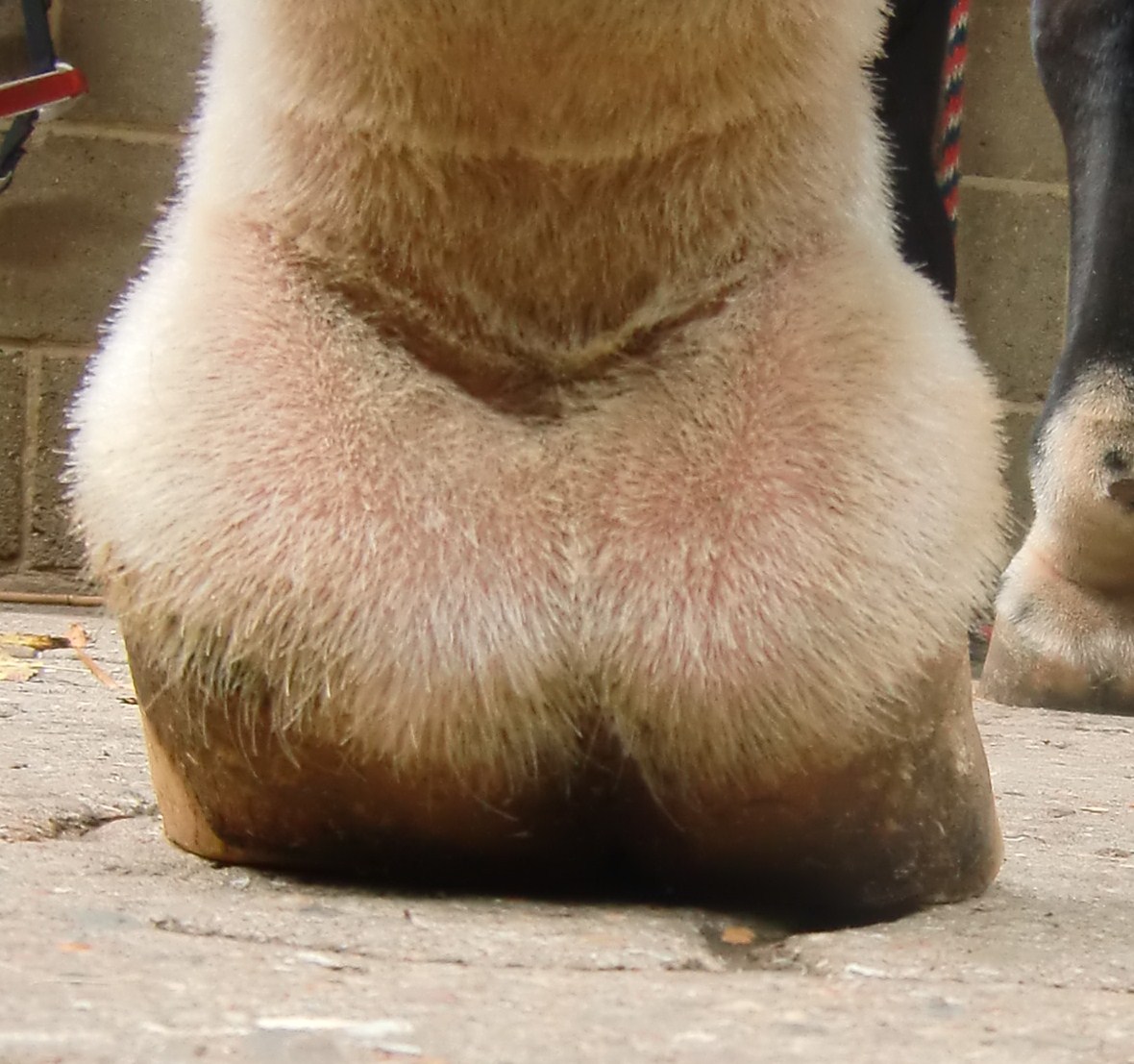 |
| Shifts lateral to medial |
 |
| Works hard, functions well |
 |
| Collapsed along medial wall - 12 05 10 |
 |
| Straighter - good example of event lines 01 09 10 |
I love deviated hooves, sorry, probably not the right thing to say, but I find them fascinating. Generally terribly easy to deal with, if you know what you are doing.
Sad then, that so many people are advised that they have to shoe a horse with a deviated hoof. I really don't know why, especially as I have seen the problems shoeing this type of foot causes; including for some, quite severe long term lameness.
A deviation is often, but not always a reflection of something going on higher up the horse. Maybe a conformation defect or some long term soreness. Other times the foot has just been inappropriately managed/trimmed.
The hoof in the top two photos belongs to a portly traditional hunting print type cob. Her original farrier said she would never be able to go barefoot because of the deviation - the outer hoof wall would wear to nothing. In fact she works very hard barefoot including lots of work on roads and stoney tracks and she still needs maintenance trimming. Far from the outside wall wearing too much, we find the medial side doesn't wear enough. Her carer has learnt how to deal with this in between formal trim sessions. Yes it grows that much!
The third and fourth photos belong to an endurance horse that has always been bare. We know she has had some upper body issues, plus she needed more regular trimming of the overly long wall which was tipping her foot over. The hoof is now straight - because it 'wants' to be straight, not because it has been forced to be. This is an example of a true performance barefooter just quietly getting on with it.
Wednesday, 2 March 2011
Shining a light on laminitis?
 |
| First trim 2 weeks deshod 25 11 10 |
 |
| 3rd trim 09 02 11 |
The horse attached to this hoof had been very lame with laminitis and had been on box rest for many months.
His 'Mum' had done everything as prescribed by vet and his award winning farrier except PTS. He had one last option, which was to take his shoes off and try the barefoot approach.
There are 11 weeks between the first and second photos; note how the sole has gone from flat (it was actually bulging) to the beginnings of concavity. The white line stretch is growing out and the heel buttresses are starting to bulk up and widen.
Just a few weeks post deshoeing and this little guy was leading the herd in a mad canter around a track system (aka Paddock Paradise).
 Now he is daily towing his Mum on hoof building walks out and about, every day for 20-30 minutes plus. He could easily do more.
It doesn't bear thinking about what would have happened to this horse if his owner didn't have the courage to defy the vet and farrier and try something else for him. Big hugs to them all.
And huge thank you's I know, from many who are thankful to these two for giving them hope and inspiration.
Tuesday, 1 March 2011
So who does this foot belong to?
So - somewhere in 2010 posts there are the 'originals' of this hoof. Do you know who it is? Comments are temporarily open for this one. One point for accurately identifying the hoof, two if you can identify the original post. Score 3+ if you can spot the differences.
 |
| Who do I belong to? |
Tuesday, 22 February 2011
Hoof cracks - update
 |
| 31 05 10 |
 |
| 06 02 11 |
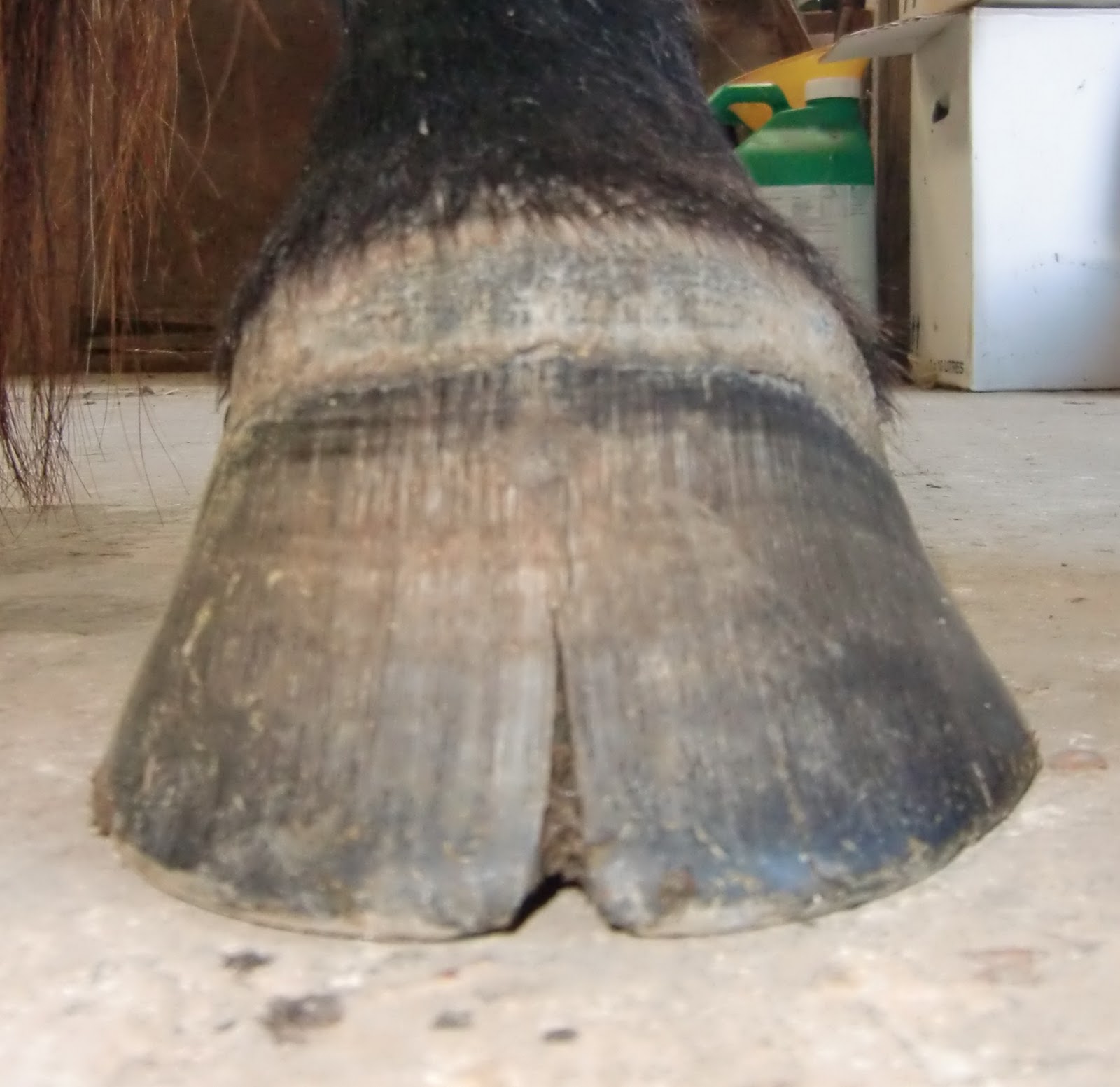
This horse is in their early 20's. Written off several years ago unsound. May 2010 unsound. Now sound, rather lively and being ridden and has been since last summer (not sure of precise date).
Regular rolling has allowed the crack on this hoof to grow out. Trim intervals were initially 4 weeks, these have now been extended to 5. Any longer and the crack starts to lever open. The horse lives out 24/7 on very wet ground.
Hoof cracks do not necessarily need to be a cause for major concern, or shoeing, filling or otherwise high octane intervention.
Thursday, 17 February 2011
They are my babies too..........
Client asked me the other day if I get attached to the horses I 'do'.
'Ooh' thought I 'Now there's a highly charged question!'
It's a fine line to tread - 100% putting out for the horse, their welfare, physically and mentally, but still staying removed enough so as not to tread on the carer's toes.
I am not so sure I do that very well. So apologies to all my clients for when my enthusiasm gets the better of me.
Because you see, I do get attached to the horses. All of them. Even the little darlings that kick me every time I so much as look at them. They are my babies too.
And the hardest part of the job is when you have to walk away. Because you can't trim a horse sound and healthy if there is something else going wrong in their life which can't/won't be fixed. From inappropriate diet, unnatural living and perhaps the hardest of all (to discuss with carer anyway) riding technique. And while I could keep pitching up and doing my 'thing'; in my heart and soul I just can't.
But there are huge compensations - I was just thinking back over just the last few months and you know what, without even trying I can think of half a dozen horses that were chronically lame, some written off, which are now sound and working. And that is in less than a year.
Most of them, with changes in lifestyle and diet come sound in just a couple of months. Some of them will need boots periodically. But you know, boots is better than dead.
Yes they are my babies too and I love them all, nearly as much as my own.
'Ooh' thought I 'Now there's a highly charged question!'
It's a fine line to tread - 100% putting out for the horse, their welfare, physically and mentally, but still staying removed enough so as not to tread on the carer's toes.
I am not so sure I do that very well. So apologies to all my clients for when my enthusiasm gets the better of me.
Because you see, I do get attached to the horses. All of them. Even the little darlings that kick me every time I so much as look at them. They are my babies too.
And the hardest part of the job is when you have to walk away. Because you can't trim a horse sound and healthy if there is something else going wrong in their life which can't/won't be fixed. From inappropriate diet, unnatural living and perhaps the hardest of all (to discuss with carer anyway) riding technique. And while I could keep pitching up and doing my 'thing'; in my heart and soul I just can't.
But there are huge compensations - I was just thinking back over just the last few months and you know what, without even trying I can think of half a dozen horses that were chronically lame, some written off, which are now sound and working. And that is in less than a year.
Most of them, with changes in lifestyle and diet come sound in just a couple of months. Some of them will need boots periodically. But you know, boots is better than dead.
Yes they are my babies too and I love them all, nearly as much as my own.
Wednesday, 16 February 2011
Best time of year to transition
I have come to the conclusion that there isn't really a 'best' time. It all depends on the horse, the carer and the circumstances.
If you have a 'metabolic' horse, when the shoes come off you may find a stretched white line, maybe a thin sole and a fair bit of thrush. If you were previously unaware of these issues it can be a bit of a shock and it takes time to absorb the information and then adjust to managing the consequences. It is easier to transition metabolic horses when there are the least amount of triggers around. High summer or mid winter maybe.
Thin soles can struggle over hard, rutted or stony ground until they are restored to greater health, thickness and function. But equally a horse prone to thrush is going to struggle with fetlock deep mud 24/7. Not that it wouldn't be a problem with shoes on, it would, but it is more noticeable when the shoes are off.
These are just two of the reasons that your trimmer might recommend boots for the transition period. So that you can keep a horse with compromised feet working, while you work on getting them better. And as movement helps a lot, then it helps to fit boots if necessary to keep the movement going. It is no good working a horse that is miserable. You want to work your horse within their comfort zone.
Then think about you too, when you do your first barefoot transition it helps if you are mentally and practically prepared. For some, the hostility encountered from well intentioned traditionalists is surprising and a bit hard to take. So do your research and make sure you have some support from somewhere. You will be taking your horse bare for good reasons which you have thought through carefully, so write your reasons down somewhere, so you can remind yourself if the going gets tough.
Probably not a good idea to embark on the transition process just before competition season though. Unless like me you gave up competing years ago (I so hate dressing up). Transitioning your horse doesn't mean you have to necessarily give up riding, but your horse may need boots and she may need her work programme tailored for hoof building purposes. Boots go down like lead balloons in competition, so get your horse transitioned well in advance of any competitive activities. Then you can proudly do your lap of honour 'naked' and not have to worry about losing a shoe the day before.
And remember, I tend to talk 'worst case' scenarios, some horses have their shoes off and barely notice. Some skip, buck and grin with joy. One got very 'fresh' - mistaking the foot care for foot fetish........ :-)
If you have a 'metabolic' horse, when the shoes come off you may find a stretched white line, maybe a thin sole and a fair bit of thrush. If you were previously unaware of these issues it can be a bit of a shock and it takes time to absorb the information and then adjust to managing the consequences. It is easier to transition metabolic horses when there are the least amount of triggers around. High summer or mid winter maybe.
Thin soles can struggle over hard, rutted or stony ground until they are restored to greater health, thickness and function. But equally a horse prone to thrush is going to struggle with fetlock deep mud 24/7. Not that it wouldn't be a problem with shoes on, it would, but it is more noticeable when the shoes are off.
These are just two of the reasons that your trimmer might recommend boots for the transition period. So that you can keep a horse with compromised feet working, while you work on getting them better. And as movement helps a lot, then it helps to fit boots if necessary to keep the movement going. It is no good working a horse that is miserable. You want to work your horse within their comfort zone.
Then think about you too, when you do your first barefoot transition it helps if you are mentally and practically prepared. For some, the hostility encountered from well intentioned traditionalists is surprising and a bit hard to take. So do your research and make sure you have some support from somewhere. You will be taking your horse bare for good reasons which you have thought through carefully, so write your reasons down somewhere, so you can remind yourself if the going gets tough.
Probably not a good idea to embark on the transition process just before competition season though. Unless like me you gave up competing years ago (I so hate dressing up). Transitioning your horse doesn't mean you have to necessarily give up riding, but your horse may need boots and she may need her work programme tailored for hoof building purposes. Boots go down like lead balloons in competition, so get your horse transitioned well in advance of any competitive activities. Then you can proudly do your lap of honour 'naked' and not have to worry about losing a shoe the day before.
And remember, I tend to talk 'worst case' scenarios, some horses have their shoes off and barely notice. Some skip, buck and grin with joy. One got very 'fresh' - mistaking the foot care for foot fetish........ :-)
Thursday, 20 January 2011
Movement
Often overlooked, frequently misunderstood; movement is very important to building good, sound hooves.* Ideally that movement should be as natural as possible, and when the hoof is healthy enough, as much as possible. Endless circles on the lunge or around the menage in isolation won't cut it.
Hooves have evolved to support a heavy animal; at speed, over long distances, and in the performance of a variety of balletic and/or warring manoeuvres, every day . It's a two way street, the movement builds the capability of the hooves and the hooves with healthy robustness, permit that movement to take place.
Lose one and you can lose the other; grow one with TLC and you will be rewarded by growing the other too.
In the good old days of Yore :-) the rule was always 6 weeks of road walking before anything else happened. This wouldn't be a bad place to start with a transitional hoof, but your horse may need to wear boots while her hooves get into gear growth wise, build sole and generally develop.
More importantly the carer/exerciser needs to learn to listen to, observe and respect the feedback they are getting from their horse. If she needs to go on softer ground, let her, if she says 'actually those stones are really ouchy' then use boots until she has the foot to cope without.
I can't give you a 'prescription' even though I know that is what many of us would love. Every horse and her hooves are individual and so require their own movement plan. What I can say is that consistency is pretty important. The hooves I see struggling are often short on consistency of movement.
Often there is a flurry of activity for a week or two and the hooves gear themselves up for more, only to be let down with a month or two of not very much, followed by another flurry. This, sadly is not helpful. Unless the horse is really really lucky, her hooves won't respond terribly well to this regime. They need to work, they need to have an idea of what work is coming so they can grow sufficient quality and quantity of horn to cope.
If you can't provide consistency, then make sure you provide boots, just in case.
I've gone over my books (other people watch telly, play with the kids, have a life, I look at hoof porn), and time after time, it is the hardest working hooves that survive and thrive.
In the UK we have an expression 'on your bike', well for barefoot maybe it should be 'get that hoof moving!'
* In conversation with farrier this week, we were on the same page with this; very interesting discussion.
Hooves have evolved to support a heavy animal; at speed, over long distances, and in the performance of a variety of balletic and/or warring manoeuvres, every day . It's a two way street, the movement builds the capability of the hooves and the hooves with healthy robustness, permit that movement to take place.
Lose one and you can lose the other; grow one with TLC and you will be rewarded by growing the other too.
In the good old days of Yore :-) the rule was always 6 weeks of road walking before anything else happened. This wouldn't be a bad place to start with a transitional hoof, but your horse may need to wear boots while her hooves get into gear growth wise, build sole and generally develop.
More importantly the carer/exerciser needs to learn to listen to, observe and respect the feedback they are getting from their horse. If she needs to go on softer ground, let her, if she says 'actually those stones are really ouchy' then use boots until she has the foot to cope without.
I can't give you a 'prescription' even though I know that is what many of us would love. Every horse and her hooves are individual and so require their own movement plan. What I can say is that consistency is pretty important. The hooves I see struggling are often short on consistency of movement.
Often there is a flurry of activity for a week or two and the hooves gear themselves up for more, only to be let down with a month or two of not very much, followed by another flurry. This, sadly is not helpful. Unless the horse is really really lucky, her hooves won't respond terribly well to this regime. They need to work, they need to have an idea of what work is coming so they can grow sufficient quality and quantity of horn to cope.
If you can't provide consistency, then make sure you provide boots, just in case.
I've gone over my books (other people watch telly, play with the kids, have a life, I look at hoof porn), and time after time, it is the hardest working hooves that survive and thrive.
In the UK we have an expression 'on your bike', well for barefoot maybe it should be 'get that hoof moving!'
* In conversation with farrier this week, we were on the same page with this; very interesting discussion.
Tuesday, 18 January 2011
Thin soles - where there is a will.......
Austen, hope you don't mind, but this one is inspired by you and is for everyone out there who is banging their heads in frustration when their horse has thin soles.
Just bear in mind that one of the horses in the sole thickness post had incredibly compromised hooves, but even without boots we had the horse ready for work in just one summer. It can be done. With a bit of patience and ear muffs (to ward off the mites.....).
Let's go back to DETECT.
Diet - every horse is an individual. There are some basic principles which will set you on the right road, but you will need to figure out some of the specific twists and turns of your own horse. Read the posts:
http://barefoothorseblog.blogspot.com/2010/10/managing-your-microbes-or-how-to.html
http://barefoothorseblog.blogspot.com/2010/11/hind-gut-acidosis-learn-to-love-your.html
Health food won't hurt your horse, so cut the sugar, molasses, alfalfa, haylage and the wheatfeed. Soak and rinse your hay if you have to. A thin sole is a warning. Ignore it at your horse's peril. Especially if it goes in tandem with a stretched white line.
Some view supplements as the work of the devil, I guess some are. I have to supplement because in the UK our grazing and forage is typically short of copper, zinc and magnesium to name but three. Not all supplements are equal and not all horses do well on the same one. Give it some time, read the labels.
Exercise - a hoof needs to move. Not just plonking about a pasture/paddock/dry lot/stall. But really move. Think about what it has evolved for - 20 miles a day plus all the gymnastics involved in horsey family life.
Many newly deshod hooves just can't cope with real movement to start with. They have been crippled. You know how a broken leg loses muscle tone in a cast? You get the idea. So start with a graduated programme. Boot for exercise if you need to.
Make use of any surfaces you have to test progress, but be respectful and if your horse says no, then no it is. I generally find that thin soled horses do well on very smooth tarmac (black top). Even 20 minutes walking 3 X week will help build sole. If you don't have access to this, then concrete can be substituted, but tends to be more challenging, so it will take more sessions of shorter, gentler walks. Don't trot until your horse can step on stones on the tarmac in walk without flinching.
Need to canter jump and let rip? By all means, if your horse can otherwise cope, but do your canter work in boots, or in the school. I am not convinced thin soled horses should be jumping and I am not convinced it is totally safe to jump in boots unless they are a good brand well fitted.
Time - to build a healthy hoof takes time. Some take longer than others. Footiness post dietary problems can be resolved within days/weeks. Thin soles take a bit more work to grow the material required and work it into a tough, dense structure. It also takes time to figure out the right diet for your horse. It takes time for the hoof to respond to the change in diet and work load. Give it that time. Take photos weekly, you will be surprised by the results, I can't promise they will always be happy surprises.
Environment - a hoof is responsive to the environment in which it lives. But that doesn't have to be a completely limiting factor. I used to keep my gang on a field which was very wet (complete with spring and marsh grass). But they got out most days to do road work and responded very well to this. I have clients whose horses are living in very 'unhelpful' environments, but again they thrive if they get to do the work. The ones that don't do so well usually have dietary issues. Diet and exercise count for more in my book, although a great environment is really really helpful, a not so good one doesn't have to be the end of the world.
Communication - a two way process. Unfortunately the BHS, parelli and others seem intent on making it one way. I have been very firmly taught by a succession of incredibly bright horses that I will get on much better if I listen to them (which includes observation) and respect what they are trying to tell me. It is not easy, I am a numpty, but my girls are patient and keep on trying so long as they feel I am trying. In my mind there is nothing so sad as the horse with the blank/far away look; they have given up because no one listens. A bit like the kid who doesn't bother crying any more.
Sometimes the communication is very subtle. Grace started off with just a tiny tiny lip wrinkle. Now we have a full range, but it took a while. Also observe posture, ears, hoof signs, etc etc, it all adds up. They can have some sort of pain from their guts without it being full blown colic and all you will see is a swishy tail maybe, or resistance to saddling or frequent wood chewing. Horses are co-operative by nature, if your horse isn't then find the reason why.
And if your horse is footy, find out why; check diet, but don't forget the obvious (like stones stuck in the foot).
Trim - boy are there some bad ones out there, but unless really dramatically awful, or regularly repeated, the damage can usually be grown out. The best trim in the world won't 'cure' a thin sole, at least not overnight. But a good trimmer can faciliate the hoof on its way to health and they should be able to advise you how you can help, without resorting to iron.
Just bear in mind that one of the horses in the sole thickness post had incredibly compromised hooves, but even without boots we had the horse ready for work in just one summer. It can be done. With a bit of patience and ear muffs (to ward off the mites.....).
Let's go back to DETECT.
Diet - every horse is an individual. There are some basic principles which will set you on the right road, but you will need to figure out some of the specific twists and turns of your own horse. Read the posts:
http://barefoothorseblog.blogspot.com/2010/10/managing-your-microbes-or-how-to.html
http://barefoothorseblog.blogspot.com/2010/11/hind-gut-acidosis-learn-to-love-your.html
Health food won't hurt your horse, so cut the sugar, molasses, alfalfa, haylage and the wheatfeed. Soak and rinse your hay if you have to. A thin sole is a warning. Ignore it at your horse's peril. Especially if it goes in tandem with a stretched white line.
Some view supplements as the work of the devil, I guess some are. I have to supplement because in the UK our grazing and forage is typically short of copper, zinc and magnesium to name but three. Not all supplements are equal and not all horses do well on the same one. Give it some time, read the labels.
Exercise - a hoof needs to move. Not just plonking about a pasture/paddock/dry lot/stall. But really move. Think about what it has evolved for - 20 miles a day plus all the gymnastics involved in horsey family life.
Many newly deshod hooves just can't cope with real movement to start with. They have been crippled. You know how a broken leg loses muscle tone in a cast? You get the idea. So start with a graduated programme. Boot for exercise if you need to.
Make use of any surfaces you have to test progress, but be respectful and if your horse says no, then no it is. I generally find that thin soled horses do well on very smooth tarmac (black top). Even 20 minutes walking 3 X week will help build sole. If you don't have access to this, then concrete can be substituted, but tends to be more challenging, so it will take more sessions of shorter, gentler walks. Don't trot until your horse can step on stones on the tarmac in walk without flinching.
Need to canter jump and let rip? By all means, if your horse can otherwise cope, but do your canter work in boots, or in the school. I am not convinced thin soled horses should be jumping and I am not convinced it is totally safe to jump in boots unless they are a good brand well fitted.
Time - to build a healthy hoof takes time. Some take longer than others. Footiness post dietary problems can be resolved within days/weeks. Thin soles take a bit more work to grow the material required and work it into a tough, dense structure. It also takes time to figure out the right diet for your horse. It takes time for the hoof to respond to the change in diet and work load. Give it that time. Take photos weekly, you will be surprised by the results, I can't promise they will always be happy surprises.
Environment - a hoof is responsive to the environment in which it lives. But that doesn't have to be a completely limiting factor. I used to keep my gang on a field which was very wet (complete with spring and marsh grass). But they got out most days to do road work and responded very well to this. I have clients whose horses are living in very 'unhelpful' environments, but again they thrive if they get to do the work. The ones that don't do so well usually have dietary issues. Diet and exercise count for more in my book, although a great environment is really really helpful, a not so good one doesn't have to be the end of the world.
Communication - a two way process. Unfortunately the BHS, parelli and others seem intent on making it one way. I have been very firmly taught by a succession of incredibly bright horses that I will get on much better if I listen to them (which includes observation) and respect what they are trying to tell me. It is not easy, I am a numpty, but my girls are patient and keep on trying so long as they feel I am trying. In my mind there is nothing so sad as the horse with the blank/far away look; they have given up because no one listens. A bit like the kid who doesn't bother crying any more.
Sometimes the communication is very subtle. Grace started off with just a tiny tiny lip wrinkle. Now we have a full range, but it took a while. Also observe posture, ears, hoof signs, etc etc, it all adds up. They can have some sort of pain from their guts without it being full blown colic and all you will see is a swishy tail maybe, or resistance to saddling or frequent wood chewing. Horses are co-operative by nature, if your horse isn't then find the reason why.
And if your horse is footy, find out why; check diet, but don't forget the obvious (like stones stuck in the foot).
Trim - boy are there some bad ones out there, but unless really dramatically awful, or regularly repeated, the damage can usually be grown out. The best trim in the world won't 'cure' a thin sole, at least not overnight. But a good trimmer can faciliate the hoof on its way to health and they should be able to advise you how you can help, without resorting to iron.
Whole hoof health, thin sole, contraction?
Ok, third post in 24 hours, can you tell I am supposed to be doing my tax return?
In response to query, how to spot contraction? I find this easier to show in pictures http://danceswithgrace.blogspot.com/2009/10/hooves-are-dynamic.html and Grace was and continues to be an excellent study.
Again remember hooves can go both ways. If I shod Grace or didn't manage her according to her needs they could go the other way just as easily.
Regarding thin soles; I hate to be boring, to sound like a nag or for anyone to feel exasperated/frustrated or worse, but it really is all about Diet and Exercise and a half way decent trim. Unfortunately shoes tend to exacerbate (and often cause) the problem. Partly from loss of circulation, partly from preventing the hoof mechanism working properly, sometimes because of how the farrier chooses which shoe to set and how it is set. And of course they mask a lot of problems without addressing cause. And any well trained, experienced hoof care professional will tell you the same.
Word of warning, because shoes mask problems and numb the feet a shod horse with a thin sole can be more at risk not less. I know it is then popular to pad, but this is literally swopping one problem with another and generating more expense, whilst doing nothing at all to fix the cause.
Thin soles can be nightmareish, especially for some people in some areas, but if you stick to the AANHCP guidelines, shut out the Ear Mites and take a deep breath they can be fixed really quite quickly. And if you are really struggling then boot, don't shoe. Because boots won't restrict the circulation and you can take them off and put them on as needed, which allows the hoof to develop and grow during 'off' time.
Diet wise thin soles can be a reflection of inflammation caused by diet and/or other toxic overload. And a hoof which is never worked and kept permanently on soft surfaces never gets the chance to build up a good solid, dense layer.
I can't show it pictorially, but density is important. As the (bare) hoof works over firmer surfaces the solar material compacts. I often think of felting as an analogy but then peeps tell me they don't know how that works. Others refer to 'callousing' but that doesn't really describe it either because that suggests hard places and soft places; whereas a properly worked hoof is hard and dense across the whole horny solar surface.
You could try thinking of hard plastic as opposed to bubble wrap?
This post http://barefoothorseblog.blogspot.com/2010/10/tripping.html shows a horse with a spectacularly contracted foot. In the solar view (with shoe) it is hard to tell just how thick the sole is (very with lots of chalk).
I am not sure this helps? Let me know
In response to query, how to spot contraction? I find this easier to show in pictures http://danceswithgrace.blogspot.com/2009/10/hooves-are-dynamic.html and Grace was and continues to be an excellent study.
Again remember hooves can go both ways. If I shod Grace or didn't manage her according to her needs they could go the other way just as easily.
Regarding thin soles; I hate to be boring, to sound like a nag or for anyone to feel exasperated/frustrated or worse, but it really is all about Diet and Exercise and a half way decent trim. Unfortunately shoes tend to exacerbate (and often cause) the problem. Partly from loss of circulation, partly from preventing the hoof mechanism working properly, sometimes because of how the farrier chooses which shoe to set and how it is set. And of course they mask a lot of problems without addressing cause. And any well trained, experienced hoof care professional will tell you the same.
Word of warning, because shoes mask problems and numb the feet a shod horse with a thin sole can be more at risk not less. I know it is then popular to pad, but this is literally swopping one problem with another and generating more expense, whilst doing nothing at all to fix the cause.
Thin soles can be nightmareish, especially for some people in some areas, but if you stick to the AANHCP guidelines, shut out the Ear Mites and take a deep breath they can be fixed really quite quickly. And if you are really struggling then boot, don't shoe. Because boots won't restrict the circulation and you can take them off and put them on as needed, which allows the hoof to develop and grow during 'off' time.
Diet wise thin soles can be a reflection of inflammation caused by diet and/or other toxic overload. And a hoof which is never worked and kept permanently on soft surfaces never gets the chance to build up a good solid, dense layer.
I can't show it pictorially, but density is important. As the (bare) hoof works over firmer surfaces the solar material compacts. I often think of felting as an analogy but then peeps tell me they don't know how that works. Others refer to 'callousing' but that doesn't really describe it either because that suggests hard places and soft places; whereas a properly worked hoof is hard and dense across the whole horny solar surface.
You could try thinking of hard plastic as opposed to bubble wrap?
This post http://barefoothorseblog.blogspot.com/2010/10/tripping.html shows a horse with a spectacularly contracted foot. In the solar view (with shoe) it is hard to tell just how thick the sole is (very with lots of chalk).
I am not sure this helps? Let me know
Subscribe to:
Posts (Atom)
Subscribe


 Posts
All Comments
Posts
All Comments