Custom Search
Shoes mask weaknesses, barefoot highlights strengths

Tuesday, 18 January 2011

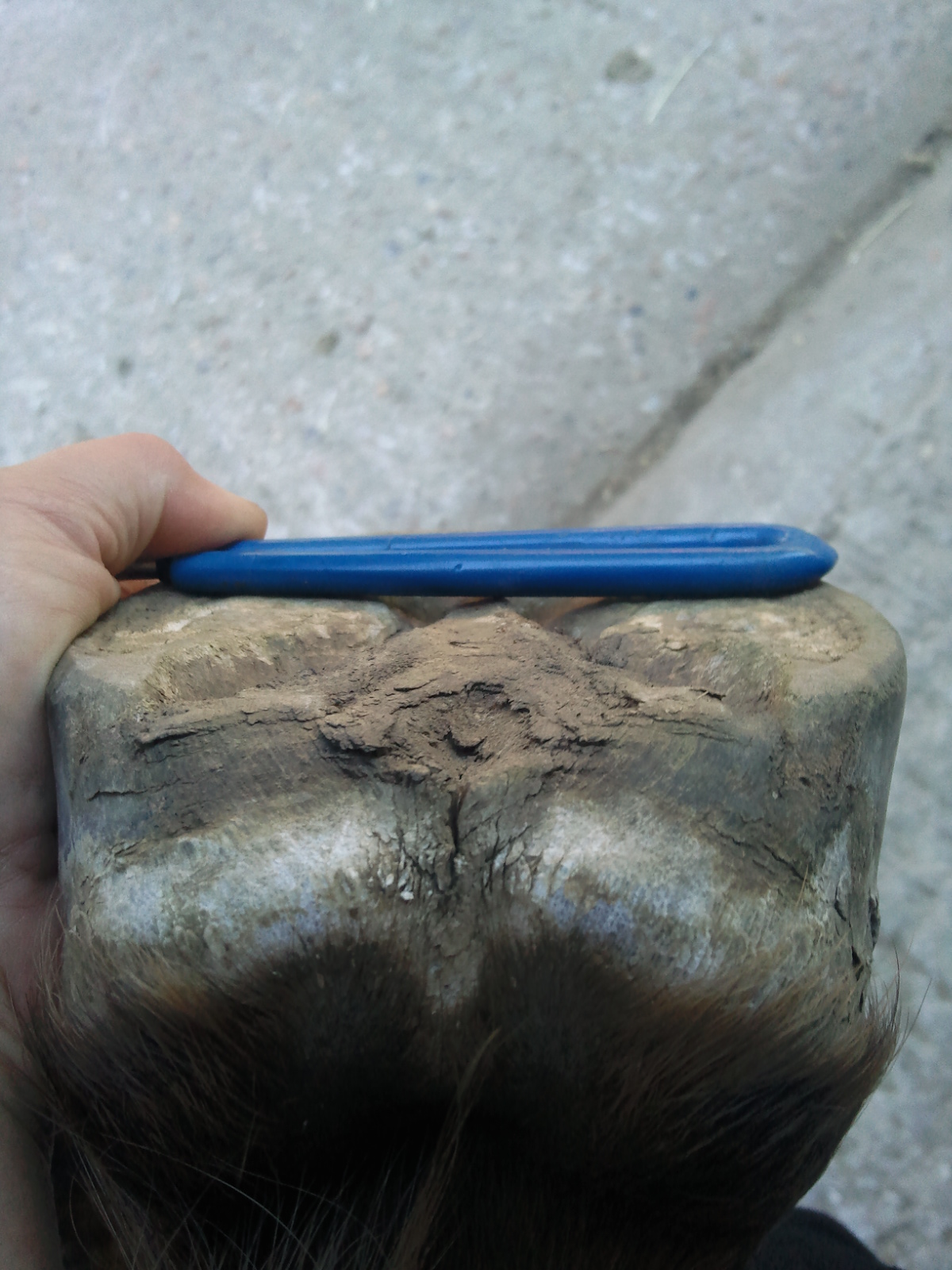
Thin sole, thick sole?

In response to a request.  How to judge solar depth?  Without the training it can be hard to gauge sole depth and it is jolly difficult to do by photo.  Trust me, there are some horse care professionals who can't do it even with hoof in hand.

And solar thickness in isolation is not 'the answer'.  The hoof health has to be taken as a whole.  That said a thin sole is problematic.  Here are a few of the hooves I have worked on at various stages in their journey.

A random selection with a host of issues.  I make no comment on white line stretch, bruising, abscesses etc.

Some of the hooves were declared 'genetically' flat/thin.  You might be pleased to learn these got just as thick as the 'genetically' better ones, once the diet, exercise and so forth were improved.

Thought you might find the pictures interesting.  All hooves featured have thickened up.  Please note that hooves can go in the other direction just as fast.  If you are not sure how to judge depth, get an AANHCP trimmer to help you.

1 Decontracting, sole thickening

2 Oblique view of previous

3 Getting depth, lacks concavity


4 Recent deshod, flat, almost convex, quite thin, contracted


5 Thin, flexes under pressure

6 Thin, flexes under pressure, infected

7 Thick enough, getting concavity, decontracting

8 Very thin, very flexible, newly deshod


9 Very thin, very flexible, newly deshod

10 As previous

11 Thin, no concavity

12 Getting thicker, building concavity

13 Previous v.thin/flexy getting thicker & concavity, decontracting

14 As previous

15 As previous

16 Hind from earlier, thicker, some concavity, infection/splits gone

17 Previous, alternate view


18 Don't let overall shape mislead, thick enough

19 Thick enough, watch for false sole


20 Previous pancake flat getting thicker & developing concavity

21 As previous


22 Earlier hoof, thickening, more concave, no more flexing

23 Oblique view previous

24 Heel view previous


25 Thick enough, getting ready to exfoliate

26 Previous - layers of sole clearly visible

27 Previous - another view

28 Previous, stripes from boot, sole flaking naturally


29 Thick enough, flat, works mostly on road


30 Previously thin, getting thicker


31 Heel view previous


32 Gaining concavity, thickness, frog torn in accident, new frog underneath

33 Getting there, still contracted

34 Heel view previous

35 Very thin, very flexible, deshod day before

36 As previous

37 Progress of previous, a way to go yet

38 Getting there

39 Classic, traditional 'looks ok' but is actually quite thin

40 Classic, traditional 'looks ok' but is actually quite thin,
 but thicker than it was

You are not a bad barefoot 'parent' and 'Ear Mites'

People who know me well, will realise I think Supernanny Jo Frost rocks.  So much of what she says applies very well in the horse world.

If you make a mistake this doesn't make you a bad 'parent' (horse carer).  Even if you make the same mistake twice.  Going barefoot is easy for some, not so much for others, it is not a straight or rock free path to follow.

Feel guilty if you don't learn from your mistakes, or if you blame the horse for them.  In time you will learn to read the map (your horse's hooves) and avoid the really big rocks (really bad advice from some people).

And learn to ignore the 'Ear Mites'.  Those well intentioned (or not) individuals who don't understand your choices, maybe feel threatened by them and/or completely disrespect your point of view and are at pains to make you feel bad for trying to do the best for your horse.

Or you could do what I do............

And point to all the previously PTS sentenced horses that are now sound and working.  And if you don't know of any personally then there are one or two featured on this blog.  But you know, Houston Mounted Police Force does it for me.  Anyone who can argue with that result - well, what can I say!  (it sure isn't printable!) :-)

Wednesday, 12 January 2011

The law of unintended consequences :-) which are the popular posts?

I have a habit of putting up titles for my posts that feel nice when said, or maybe are a reference to popular culture.

I also study my stats*. 

So guess my surprise at some of popular posts:-
  • Madam's feet
  • Madam goes jumpies
  • Great legs and gorgeous feet
And then it dawned on me (actually took a while).......  oh how disappointed some people must be.....  :-)


* Yes I know where some of my readers come from (more or less), you are not all completely anonymous! And you thought you only had to worry about Big Brother (BB) - well now you have to worry about the BT (Barefoot Trimmer) too :-)

Posting comments - professional standards

Regular readers of this blog will know that I tend only to comment on things I have experienced personally.  I am also do my best to be up front, (whilst respecting the privacy of my horse owners) and post warts and all.  I often don't post on the very worst cases, it is too painful for the owners (and me sometimes).

Now I have just had a comment from someone who wishes to remain anonymous, who is questioning whether shoes hurt horses.  I don't mind the question, but I reserve the right to not publish posts which may throw doubt on the professional standards of the poster, are offensive, are anon' and/ or possibly damaging to horse welfare. 

However to paraphase the (unpublished) post and respond.  Yes I do believe it is unacceptable to put shoes on horses in general, but particularly when the standard of workmanship is not up to scratch.  I don't understand the need to defend shoddy workmanship?

Do I believe poor farriery hurts horses?  Yes, but I also believe that poor trimming, poor horsemanship, poor nutrition also hurts horses.  I see the evidence almost every day, in lame horses that come sound when these issues are addressed.  It is not rocket science and there is little room for debate.  Sound or lame?  That is the question.

Thermography - Blood supply - shod v unshod

Somewhat shamedfaced I have half inched this image from a fellow AANHCP facebook page. Their text is spanish(?) or I would have just done a straight link. Mind you I think the pictures speak for themselves. Shod to the left, newly deshod to the right.

Monday, 10 January 2011

Speed of growth - how fast is fast enough, matching wear to growth

Rule of thumb, 1cm every four weeks.  Horses with compromised hooves may grow slower.  Some can grow a lot faster.

Photos below are six weeks apart.  Due to adverse weather horse has had virtually no exercise and limited turnout.

Note the event line on the side views and note the decontraction in the solar view.

Left hind 04 12 10

Left hind 09 01 11

Left hind 04 12 10

Left hind 09 01 11

Saturday, 8 January 2011

Update on Fred - 12 weeks post deshoeing


Right Fore Medial View - nail damage Oct 10


Left Hind Toe Oct 11

Left Hind Toe Jan 11

Left Hind Solar Oct 10


Left Hind Solar Jan 11


Fred was heading for 16hh thanks to his very tall feet and shoes. Now back down to somewhere nearer 15.2hh. No longer tripping and looking several years younger. Chronic thrush is slowing down his decontraction, but it is still happening.

Have a good look at the before and after photos and make your own mind up. I know which I would rather have.

Note: Previously shod by an award winning farrier; now barefoot trimmed according to AANHCP guidelines.

About Me

My photo
Southern England, United Kingdom