Custom Search
Shoes mask weaknesses, barefoot highlights strengths

Saturday, 28 May 2011

And my (old) vet said

LF April 10 - corn, sole thin at toe, weak heels,
spoon shaped
LH April 10
RF April 10
RH April 10 - apologies for poo!
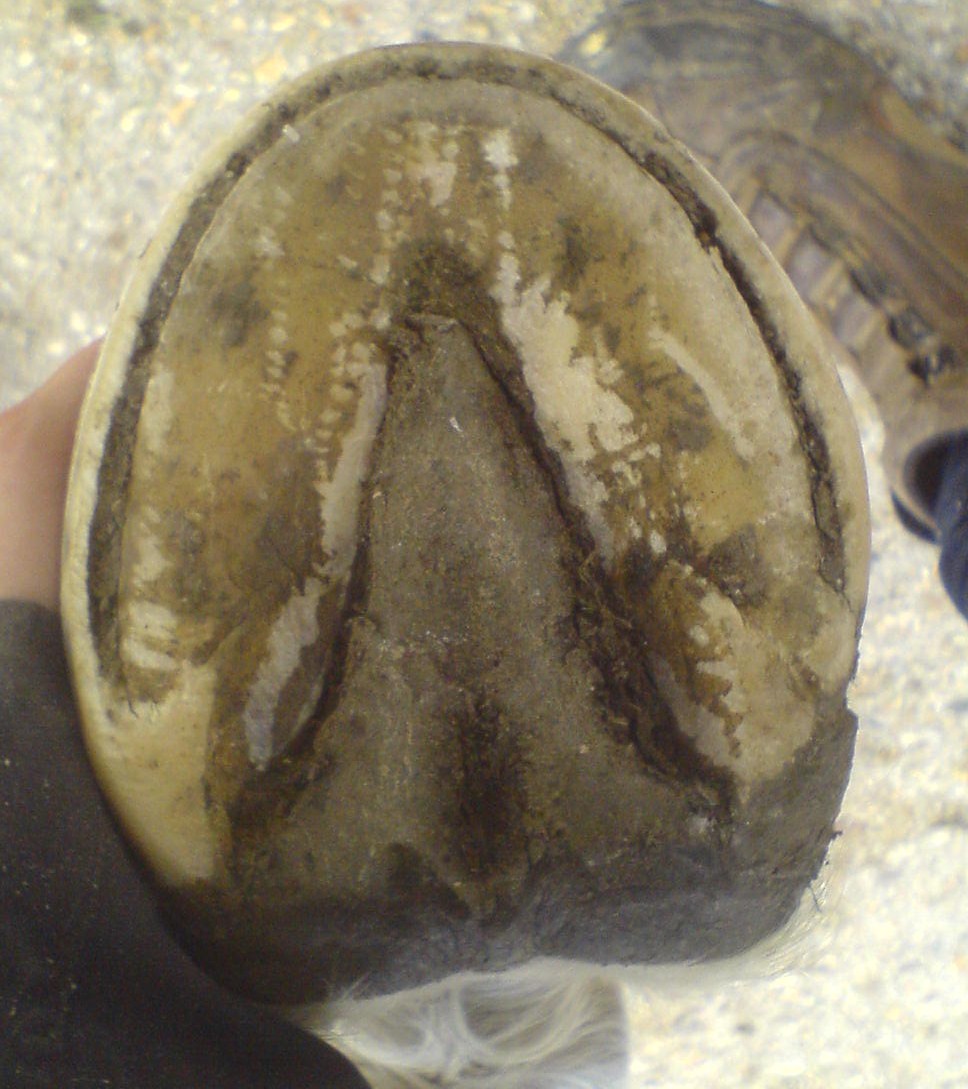
LF - May 11, 5 days post GH, more
concavity, sole thicker, heel bulbs
developed, wider at heel
LH - May 11 5 days post GH
RF - May 11 5 days post GH
RH - May 11, 5 days post GH


........... "Horses can do everything barefoot except Endurance."

The May 11 hooves are 5 days post the Golden Horseshoe.  80km in two days over a stoney moor*.  Although the owner reports it is not as stoney as their regular training ground.  Horse vetted sound with a Silver, missing Gold by one heart beat.  The icing on the cake was the compliments from the vet on the hooves! :-)

Maybe if my original vet were still practicing today he would change his mind?  He was pretty open minded and pragmatic so I like to think so.

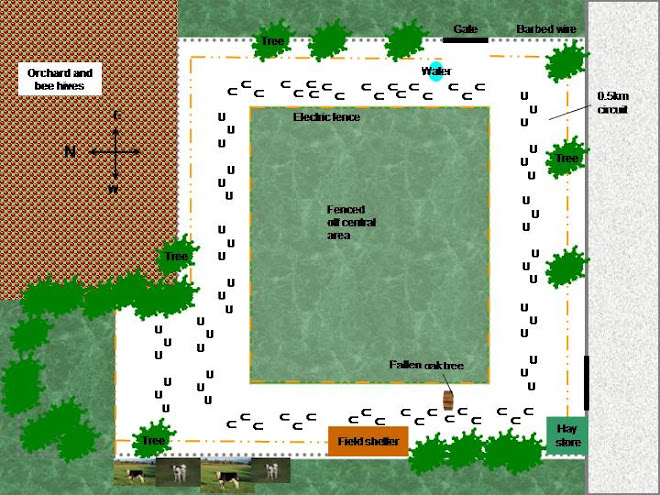
* I took this horse on as a client April 10.  Previously always ridden out in boots as always a bit footy.  Diet change and a few modifications to hoof care and what a difference a year makes.  Owner is incredibly dedicated and it wouldn't work without their ability to manage their horse.  Horse lives out 24/7, until recently in regular grass livery.  Now on a grass track.

Saturday, 21 May 2011

Flare

There seems to be a hell of a lot of confusion about flare.  Certainly conversations with my clients makes me realise it has become a dangerous term to use unless both parties are absolutely certain they are discussing the same thing.   So for the purpose of this post I am going to try to be more specific.

Many of the horses I deal with suffer from white line stretch.  This largely occurs because the lamellar bonds have been weakened, generally but not always from dietary disturbance.  I'll cover this in more detail in a future post.  For now stick with the idea that the lamellar bonds are compromised and a visual clue is that the white line is now wider than the edge of a credit card.

Other horses, in squaring off their toes create a hoof wall which has an uneven thickness.  The solar view may show a thicker hoof wall at '10am' and '2pm'.  For horses that don't move perfectly straight this might be '9am' and '1pm' or '11am' and '3pm' but you get the general idea.  The hoof wall in between has been worn thinner, creating 'corners' at either end of the thin section.

Much more rarely and I don't really see this in the South East, although I have seen it on my travels, the hoof wall grows at significantly variable thicknesses.

And then there is what looks like 'flare' from the outside but is actually nothing of the kind.  An update on this hoof is here.  Let's call this a 'deviation'.

On various occasions I have heard each of these scenarios described as 'flare'.  As each needs a different approach I think it is important to label/understand them more clearly to ensure the correct techniques are adopted.

Starting with the last scenario first - a deviated hoof.  More than one person has suggested that this foot should be tackled by rasping the outer hoof wall.  But check out the solar view - can you see what would happen if this were doneThe hoof wall would be substantially weakened, possibly badly compromised and the deviation would still be there.  Only with a weakened hoof wall the hoof would be less able to continue with the (fairly substantial) work load the horse currently enjoys - completely boot free over all sorts of surfaces.

Continuing my backwards theme.......  the uneven thickness of hoof wall (which I don't see much of these days).  If this is significant and likely to cause problems as it grows out then this can be dressed out, but extreme care needs to be taken as over enthusiasm can leave the hoof wall compromised.  Less is more.

Squared off toes.  I see this most often in horses that do a lot of straight line work on more abrasive surfaces and those that are seeking to bring their breakover back.  If the 'corners' are left they can break off leaving a ragged and unsightly edge.  Usually this causes the humans more problem than the horses.  Sometimes, especially if the horn quality is very plastic, a nasty tear can result.  If the hooves are very tough and the corners don't snap off then they can interfere with the horse's ability to move efficiently.  Corners are dealt with as part of the normal roll process.  The hoof should not need dressing higher up as there is no uneven wall thickness, just uneven wear.

White line stretch.  Now bear in mind you are dealing with a horse that has compromised feet.  Sometimes substantially compromised.  Along with the white line stretch there may be quite poor hoof quality, depending on how long the horse has been in distress.  I have seen some real shockers where the whole capsule reminds me of one of those chicken eggs with a weak shell.  Dealing with this by rasping the outer hoof wall is unhelpful at best.

There are but two things to do.  Remove the causal factor which is usually but not always diet related.  Grow down a tightly bonded hoof capsule (see posts on healing angle). And trim the hoof according to AANHCP guidelines, removing only what nature would have done given the chance.

Saturday, 14 May 2011

Help my horse has gone footy

Footiness is a mixed blessing.  Now don't get me wrong, we would all rather our horses never got footy.  But with the barefoot horse it's a really useful early indicator of something going wrong.  And this is something that I think a lot of people don't quite grasp. 

Footiness is a symptom of less than perfect health.  Sometimes only minor, sometimes something more.  But less than perfect health nevertheless. 

This is a quick list of things to consider:
  1. too much grass
  2. impact on grass of change in environment (rain after drought, several days of frost, fertilizer)
  3. too much sugary/starchy feed
  4. sugary hay (for cool season grasses)
  5. other non specific dietary upset
  6. course of antibiotics
  7. thrush
  8. bruise
  9. corn
  10. abscess brewing
  11. sole been thinned by inappropriate trimming
  12. foot overdue for trimming
Generally speaking if you can remove the causal factor the footiness will resolve within days, although some will take a couple of weeks.  If in doubt always consult with your vet.

But please don't be tempted to shoe until you know what the problem is - you may resolve the footy symptom, but you won't resolve the cause and without the footiness to guide you, you won't know if your horse has been restored to better health.

If you are determined to shoe (and of course I'd counsel against) then only shoe a sound horse.

Friday, 13 May 2011

Heels

Aug 10 - slightly contracted - note lack of substance and the
groove between bulbs

Aug 10 solar view of above - note weak butresses and
deep central sulcus

Oct 10 - heels decontracted - note how groove has disappeared


Oct 10 solar view of above - note changes to buttresses,
central sulcus, sole and frog generally

Note weight bearing section of heel is towards middle of foot
Note weak structure, poor horn quality, excessive wall rasping
Slowly weight bearing section moving back to where it should
be - toe still really long, quality improving a little
Heel in suspension, lami rings, excessive wall rasping
Contracted, infected, sore and weak
Few weeks later, decontracting, infection cleared, not sore
later still, note heel bulb position and shape


Of all the structures most abused in the horses hoof, my current bug bear is heels. Remember 'Fred'? Tall heels, contracted heels, infected heels and underrun heels.  None of these are normal or healthy and with appropriate care, diet and exercise they can all be improved.  A good heel is vital to a horse and sentiment aside, a horse with a well formed hoof is going to stay sound longer.

Oh and for those debating shoes/boots - if you need to put something on your horse's foot, boot everytime.  I have yet to deshoe a horse that had a good heel, but they can usually grow/build one pretty quick once that shoe gets taken off.

NB - building good heels doesn't happen by magic or overnight - a good diet and an appropriate management regime are important. And even horses living in less than ideal conditions can have a good foot/heel if they work hard enough

Tuesday, 12 April 2011

Sharing the love and my lunch

The former on purpose and willingly; the latter not so much.

Lesson learned - even on a really hot day don't leave your car window open - the YO dog will jump in, eat your lunch and an entire family packet of plain choclate digestives - leaving you with nothing but a seat full of crumbs and wrappers, an apple and a can of Fanta. Poor dog - I hope he wasn't too ill afterwards. 

It was a day full of blessings, starting with the gift of a sun hat and an ice lolly.  Finishing with meeting a truly wonderful family who have just taken on two young ponies.  Both total sweethearts.  Great feet.

I started at 4am - didn't get home til 9.30 pm - but arrived floating on cloud 9.  You know, I am the luckiest girl ever - my clients are brilliant! :-)

Friday, 8 April 2011

Who to trust?

Well your horse of course.

Sad but true, in these days of a market driven economy you have to be very careful.  We are all aware of various horse oriented products which don't quite live up to the big print on the front of the packet.

My own horse Grace was compromised big time when on the recommendation of another trimmer I tried a 'lami safe' feed.  Mmm - not for her nor for a few other horses I've heard about either.  Grace did react spectacularly badly - not only did she get very foot sore, but she also had extended EPSM issues and it made her really grumpy.

So listen to your horse, if something makes them footsore they are not faking it.  If they do well on a product celebrate - but don't expect it to work for the horse in the stall next door.

Even scientific research has to be questioned.  I was brought up to think 'scientifically' and I've had a job editing and publishing research - and I benefit from that experience probably every day.  Does make me a big time cynic though.

At present there is debate among the scientific community about the role of fructan as a causal factor of laminitis in horses.  While the process of debate is interesting, it can be unhelpful if it only serves to confuse or bemuse people struggling with managing their lami prone horse.

Most of us barefooters are more than aware that grass can be a big time problem and we don't need scientific research to tell us that - especially when different sources contradict each other.  What would be helpful is greater awareness of the impact of inappropriate diet on hooves beyond the barefoot community and more useful and reliable information on how we can manage our horses in a way which benefits them but also fits with our available resources.

Most regular readers of this blog will be aware of the Jamie Jackson material on feral horses and paddock paradise systems - and I am sure many of us long to be able to provide our horses with these types of facilities.

However in the meantime we have to find ways to make the best of what we have.  So how do you know that what you are doing is working?  Listen to your horse and trust what they are telling you. They don't have an agenda or a product to sell.

Listen to your horse, not to the feed rep, the barn owner or the man next door :-)  Sound or lame that is the question.

Thursday, 7 April 2011

Slightly gruesome - don't view if you are squeamish


Shod - hoof wall rasped 'moderately'


Note how foot is running forward, heels are collapsed
and are forward of the back of the foot which is in suspension
 

Shod solar view note overlaid bars,
position of shoe against frog


Deshod view of above


Cleaned up view of above


Detail of above


Reminder - 'ideal' nail placement -
oriented on water line


Nail on pair of above


Detail of above


Very thin sole


I don't know what killed this horse. I do know it had the most enormous abscess - pus was blowing out through the frog in huge quantities - so I have my suspicions.

I chose this foot for this post, because you see feet like it on every yard. Probably the majority of shod feet I see look something like this.

The hooves are running forward, the heels are collapsed and the sole is thin. In an attempt to reduce the duck bill impersonation the hoof wall gets rasped - further weakening the foot. This leaves little space for the farrier to place the nail and mistakes happen.

My question is - you can see the issues the foot has, you know how to fix them (diet, exercise, natural living as much as possible) - what contribution to foot health did the shoe make for this horse...

Never buy a shod horse

Based on recent (and past) experiences - of my own and my clients.

Too many people are buying problems in blissful ignorance.  Even with horses that have been vetted.

Shoes are being used to cover up a range of problems from footiness to twisted limbs. 

Don't set yourself up for heartache and a financial black hole.


If you want to buy a horse - buy a sound barefoot horse.

Thursday, 31 March 2011

Toe Cracks and an excess of Acronyms

Three things to investigate with toe cracks.

1) Is the crack in the outer wall only or does it include the white line?
2) Has the hoof wall been thinned or had any kind of oil/hoof dressing applied
3) Trimming

Five broad categories

Stretched white line - The bulk of toe cracks I deal with are an end symptom of a stretched white line which of course is a symptom of damaged laminae which is of course a symptom of hind gut issues of some sort.

When the white line is compromised opportunistic bacteria invade, (it's lovely and moist and bacteria friendly in there, especially under shoes.  They chomp away and eventually the whole lot becomes compromised sufficiently for the hoof to split.  This can be fixed. It takes time - because you have to grow the crack out and a bit of hard work, because you need to ensure the foot has the stimulation it needs to put out the growth and you may need to treat the bacterial infection.

Hoof wall length - LOTD (lack of trimming disease). The hooves have simply got too long and the cracking, splitting and chipping is the hoof trying to self trim.

Hoof dressings - CED - (I'll let you work that out), where OTC (over the counter) products available at any feed store have damaged the hoof wall - chemically or by disturbing the moisture balance, either over drying the wall or keeping it so moist that bacteria set up home and break down the keratin and it starts to crumble.

Trimming - Less than perfect mustang roll - if your horse tends to develop 'corners' and these are left too long (both in time and length of the 'pointy' section)  the leverage can create a stress crack - usually mid way between the two corners  Doesn't always happen.  These close up nicely when the stress is removed.

Or it could be that your hoof care provider is getting too handy with the rasp and has been thinning the hoof wall.  This damages it - ask them not to do it and if they insist find yourself another trimmer.  Usually this is done when the hoof is scooting forwards and the trimmer doesn't know how to deal with it any other way.

Horn quality - If you have a perpetual short crack in the toe which is hard to resolve, but doesn't seem to penetrate to the white line you may have an issue with horn quality.  Usually cutting right back on sugars/simple starches and checking mineral balances is enough.  The horse may also have long term low level undiagnosed hind gut issues.  Try probiotics such as Yea Sacc 1026 and/or charcoal*

*I am not a charcoal expert, but be careful of your source - there is some CED going on and poor quality charcoal is being sold to the unsuspecting.  You want a hardwood charcoal that has been properly treated.

For peeps in the UK check out Fine Fettle Feeds.  So far they haven't managed to make the UGP (Universal Guinea Pig) ill which is a start - I've only just started the test on Grace so I'll let you know how it goes in due course.

Sunday, 27 March 2011

Hoof Dressings

Hooves have evolved to manage their own moisture balance.  Feed the horse well, exercise appropriately, facilitate as natural a lifestyle as you can manage. 

Don't waste your money on hoof dressings.  Spend the cash saved on hoof boots if your horse needs them, or setting up your facilities so they can live more naturally.

In drier climates you might want to create a natural watering spot, so your horse can wet their feet as they drink, but don't dress hooves with oils, polishes or other products which can destroy the natural moisture balance in the hoof.  I have actually seen the outer hoof wall break down from these moisturising treatments.

If your horse gets thrush, then by all means treat it, but don't use anything which you wouldn't put on your own skin.  Another horror story - I've seen a horse with chemical burns from a thrush treatment. 

Keep your horse healthy, work them hard, let them live naturally, get the hooves trimmed regularly, avoid hoof dressings - you won't go far wrong and you will save a lot of money!

Saturday, 26 March 2011

With love from Grace - yummy herbs

Herbs on food before mixing

Grace's herb 'muesli'


Grace is EPSM and prone to laminitis.  So the poor love is on a very low sugar, low starch diet and it can get pretty bland at times. A long way from the 70+ species she has evolved to eat.

So we have a bit of fun with herbs - both for pure pleasure and also to add to her feed. 

Grace's current favourite is a blend that makes her dinner smell like lemon meringue pie.  I have to say I feel quite guilty when I feed her because as many humans as horses end up drooling at the smell and they don't get to have any!

Grace's herb list - we mix and match

Chamomile
Lemon Balm
Vervain
Scullcap
Lime Flowers
Poppy Petals
Roses
Rose leaves
Rose hips
Raspberry Leaves
Chamomile
Vervain
St John’s Wort
Chaste Tree Berries
Nettle
Rosehip
Garlic Granules
Celery Seed
Burdock Root
Dandelion Leaves
Devil's Claw Root
Comfrey Leaf
Aniseed
Coltsfoot
Hyssop
Bramble leaves
Hawthorn leaves
Burdock leaves
Cow Parsley
Willow
Hazel
Cinnamon

Remember this is Grace's own personal list and it may not be suitable for all horses.  I tend to offer her things, find out what she likes and then research each item carefully before deciding if it is safe to feed and what sort of quantity.  Some of these things can be gathered from the hedges in the UK, other bits I buy in dried.

Have fun!

Recently deshod and chipping

Photo 1
Photo 2

Photo 3

Photo 4

Photo 5

Photo 6


I was reviewing my photos and I found I do have some chipped hooves - but only ones that have recently been deshod.  So by photo number.

1  Hoof wall heavily rasped, (you can't see it but the heel is stacked too).  Standard farrier approach to a hoof that is scooting forward.  Weakened wall chips and breaks as nail holes grow out.

2-4 This is the hoof used in 'bull nose' (you might spot a trend developing here).  Again hoof wall has been heavily rasped (note that it's a hind so has bull nosed rather than flared from metabolic problem) and nail holes are breaking even while still shod.  In photo 4 you can see that nail free the hoof is just dandy but the horse has also been weaned off her pony nuts and put on a lower sugar diet.

5-6 Cardboard hoof - horse has metabolic issues big time.  Very sensible farrier refused to shoe any more because of poor quality (hurrah!).  In 6 you can see the hoof has grown out nicely and quality is restored.

I do have one horse that has some chips in it's bare feet - they have been left too long between trims and I am working on getting Grace to chip hers................

Friday, 25 March 2011

Hoof quality and treating

Some horses like some people can eat junk food and get away with it.  Others are ok for a while until it all catches up with them and some (like my Grace) have to watch what they eat 24/7/365.

It's not just about being overweight, there are at least two other common things to watch out for, before we even think about the heritable metabolic issues such as HYPP and EPSM.
  • Hind gut acidosis
  • Blood sugar/insulin spikes
If you over feed sugar and/or simple starches you risk your horse getting hind gut acidosis.  This is the first step to all sorts of other problems, one of which is laminitis.  Others are lack of performance, tiredness, lack of thrift and behavioural problems

As to treats, it is easy to assume that because the overall diet is low in sugar the odd carrot or mint doesn't matter.  And for some horses it doesn't.  But if you have a sensitive one then you could be causing the blood sugar to spike, which of course has a negative impact on the other side. And of course if the diet is already a bit high in sugar then too many carrots can tip a horse over the edge.

Plus sometimes I think it just isn't fair.  For example, my own Grace has to have a very low sugar/starch diet - sugary treats just set up the cravings all over again - it took me many weeks to wean her off sugar, why would I want to put us both through that again?

But I do use treats, but instead of sugary carrots and apples I feed herbs.  I try different things with her and she loves to get to choose.  Current favourite is lemon balm, but she likes a lot of things and it means she gets variety, low sugar and a positive contribution to her diet. 

Herbs are fun!

Thoroughbreds and barefoot

For successful barefoot performance does the breed of horse matter?  Yes and no.  Yes because there is so much prejudice about certain breeds that it can make it harder for the carer to get the support they need.  No, because any breed of horse can and does go bare successfully.

There are common issues no matter what the breed:
  • Inappropriate diet
  • Not enough movement
  • Stress (usually not noticed)
  • Inadequate/unhelpful hoof care
Unfortunately all of the above are especially prevalent among Thoroughbreds.  They are fed cr*p from a very young age, frequently confined, subject to far too much far too young and are shod as babies.

So in terms of hoof health, a lot of TB's start on the bottom or near bottom rung - which of course makes their barefoot transition that bit more challenging.  Doesn't mean it can't be done, does mean it takes more commitment, knowledge, patience and time to do it.

We do have some shining examples in the UK - Simon Earle manages all his racehorses barefoot and the Apsley End Polo Team are bare too.

But probably the best examples are the ones we never get to hear about - the private individuals who quietly just get on with it for the sake of their horse. And here is just one - the transition process has just started (about Jan 2011) after many false dawns and multiple set backs.  (Otherwise known as grass.... and an abscess.) This horse has a way to go, but as the video shows, he is sound on concrete! (bare not booted).

And big hugs and much appreciation to the owner of this lad and the supporting crew for allowing these photos and video to be published.  I know their journey has been a long and hard one and all credit to them for sticking with it despite all the negative 'ear mites' they have had to suffer.


Fore Aug 2010

Fore March 2011

Hind Aug 2010

Hind March 2011


Thursday, 24 March 2011

Hoof chipping

Sadly (I suppose in a good way) I don't have many photos of hoof chips.  I did try to get Grace to chip her hooves for me, but even though I marched her across some builders rubble she was having none of it!

But I see hooves chipping mostly for three reasons:-
  • Newly deshod hoof is growing out nail holes/damage and/or breakover is moving back
  • Poor horn quality
  • Neglect and/or poor trimming
Newly deshod cobs seem to chip the most, but that is just on my patch, it is not necessarily universal.  Cobs also seem to be shod in some of the most 'interesting' ways, considering how good their feet can be with very little effort.  The two things are often linked as the breakover is often very far forward of where it needs to be and the hoof wall has often been rasped extremely heavily.

Poor horn quality needs to be addressed by fixing the diet (KISS)* and introducing a carefully planned and well executed work programme to stimulate the foot into producing more high quality growth.  Any decent trimmer should be able to advise you on your particular.

Neglect :-( and poor trimming :-( are often cited as reasons why a horse can't go barefoot (the foot chips).  Sorry but these are inexcusable.  I can understand why people struggle with diet, the advice/general knowledge on offer is often a bit out of date, but neglect is never acceptable and there are some damn fine trimmers out there and the AANHCP network is growing daily.  I do understand that in some countries it can be hard to find a trimmer in the locality, but always try contacting the AANHCP because they are generally very helpful.  I've even known members to get on a plane to organise workshops in countries where there are no qualified local trimmers. 

Ok promo over!  If you are worried about hoof chips - usually you don't need to be - put the chip in context and if you are unsure contact your trimmer.

Put it this way the first horse in this post lost their quarter (old abscess hole growing out) - but was never a day lame and she works 6+ days a week and for hours at a time on all sorts of surfaces including roads and stones.

The second horse (same post) was never lame from the chunk missing from their hoof either (the laminitis was another matter!)

*My new version of this is Keep It Simple and Sugarfree!  Or you could go for Keep It Starch and Sugarfree.....

Wednesday, 23 March 2011

Sound isn't always pretty

This horse had been lame for many months and was deteriorating when the carer decided to have the shoes removed and try barefoot.  X-rays showed an eroded 'ski tip' pedal bone.  Laminitis had obviously been a problem for a considerable time, disguised by the shoes.  Despite veterinary intervention, no one had offered dietary advice other than that the horse needed to lose weight.  This was true, but for a classic fatty the question was how?

It took a while for the carers to make the emotional adjustments required (it was hard for them to stop feeding sugary treats) - but they really applied themselves and 8 weeks 6 days later, on a diet consistently mostly of soaked hay the horse came sound. 

The horse is now in full work and has beautiful movement.  The hooves?  well they have deteriorated a little this past February (it's caught a lot of people out) so the grazing muzzle is going back on.  The horse though is still sound.

Note, although the feet aren't as good as they could be, they are a major improvement on the recently deshod version.

Just deshod

March 2010

Monday, 21 March 2011

Concavity and footiness

Too many forums can be too much of a very unreliable information source.  It's easy to get hooked up on the latest hot topic.  And with forums you can't always know whether the poster is a newbie, keen to share what they are learning (and maybe not quite getting it yet), someone who is very experienced or a troll.

There are a couple of topics that raise their heads every spring in the UK, these are 'Concavity' and 'Footiness'. 

I am starting to realise that 'Concavity' has been raised to such lofty heights that some horses are expected to sport a replica of the inside of St Pauls Dome on the underside of their hooves. 

Bu you know not all horses sport inverted 'D cups' under their feet* - just as not all humans feet have exactly the same amount of arch.

If you are worried if your horse has 'enough' talk to your hoof care professional - if they are worth their salt they should be able to advise you.  If they can't - swop to someone who can.

Ditto footiness.  There is no doubt that the onset of spring grass causes many (maybe the majority) of cases of footiness - but not all.

One of the things I am aware of is that as horses are brought into work post winter blues and the rust gets dusted off, lameness which may not be noticeable in the paddock and stable suddenly gets lit in glowing neon the minute a hack across any harder/stonier surface happens.  A good proportion of the time it is because the horse has thrush, sometimes pretty severely.  It hurts.  Especially if the sensitive structures of the frog have been exposed because half of it has rotted away.

For new clients taken on in spring I find all sorts - from brewing abscesses, badly contracted heels, poor trim jobs, corns - all of which contribute to lameness.

Some be fixed with my nippers (but none with shoes, which mask symptoms but fail to cure the cause).  What is usually needed is a programme of appropriate exercise, a decent diet and maybe for a spell, boots.

*A foot that has a modest amount of concavity can still be very sound over stones etc, but just like all hooves, you need a decent amount of quality sole and no inflammation of the solar corium.  Grace has 'A cup' soles but as she proved this evening - can be very sound over rubble and stones, so long as I look after her properly.

Saturday, 19 March 2011

Hard working feet can still get better

RF Mid May 10
RF Mid March 11
LF Mid May 10
LF Mid March 11


I first met this horse May 2010. Never shod, but largely ridden out in boots because of footiness. It was clear that the horse had some degree of LGL because of the soup sinking event lines on her hooves. There were a few structural issues too, massive corn and feet that were spoon shaped in front (narrow, contracted heel and flaring toe).

Now 10 months later the hooves (finally!) are decontracting, they are shorter, with just as much depth to the sole.  These hooves also remind us that they respond to the going they are familiar with - a sudden 1000% fold increase in road work has worn the March 11 hooves a bit too much. But the carer/rider is aware that if they are consistent with the road work they will be fine.

Friday, 18 March 2011

And the mystery foot belonged to .....

Fred! 

Fred mid Oct 10

Fred end Feb 11


This horse has gone from strength to strength.  No more tripping and he looks years younger.

Tuesday, 8 March 2011

Bull nosed hooves


Relatively subtle bull nose

Lovely example, note HA, pair to next photo

Pair to previous
Hoof from 3rd photo note bull has dropped out.  Very clear HA
Getting there


What is a bull nosed hoof? Most (but not all) bull nosed hooves are found on the hinds. They are how the hind feet express deficiencies in diet and trimming that are normally (but not always) seen as flaring in the fronts.

The first photo shows a distinct but subtle bull nose. The remaining photos show the journey from a recently deshod (and pretty sick) hoof to a straighter healthier hoof. There is still a way to go, but I think you will agree, the difference is noticeable.

About Me

My photo
Southern England, United Kingdom