and while I think about it .........
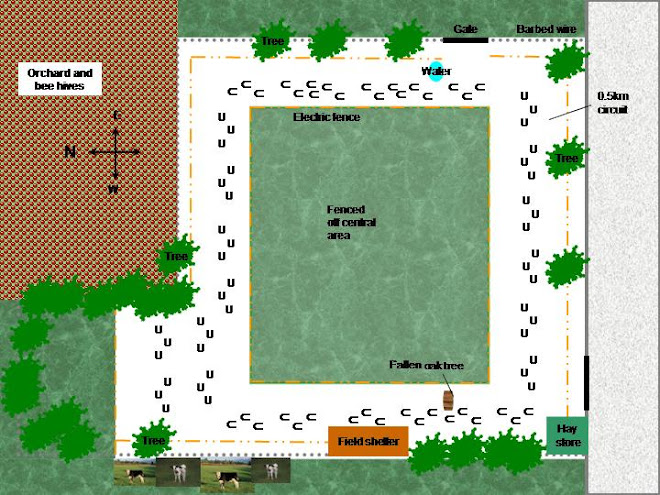
More bouncing is required for the carer (you know who you are), who in the past few months has deshod three horses all at the same time, moved yards and then built the horses a track of their very own.
Recently trotted up for vets post a weighing session all three horses were reported as being 'very sound' and were also the closest to their ideal weight of any horses the vets have weighed.
The herd includes a warmblood, a TB and a pony. Congrats to the carer! :-)
Tuesday, 1 November 2011


Time for a little bounce......
Of pure joy.
The latest 'navicular' is hacking out bootless, sound on grass and is improving over hard ground. And has stopped biting their carer. Main lifestyle changes? Yes - treated like a lami and moved yards.
Very lami shetland - had literally gone through the bottom of his feet is apparently doing some bouncing of his own during his regular 'parades'. Main lifestyle changes? Yes - dirt paddock and daily heart beat raising walks. Although the carer reports that the term 'walk' is misleading because he is prancing about and tows her along and has turned into a 'naughty little ********' but I think they are quite happy about that :-) And he comes to call which is really nice because he must be enjoying his jaunts.
Both are on DIY livery.
Sunday, 30 October 2011
Does your overweight horse have hooves that are 'starving'?
 |
| Lower half free access to grazing and overweight, upper half same grazing but muzzled and correct weight |
 |
| Hard to see, but hoof has 'dessicated' texture, horse overweight |
 |
| Dessicated hoof has split (outer hoof wall only). New growth - horse correct weight is coming in much healthier |
 |
| Solar view of split hoof above, pre trim, you can see crack is outer hoof only |
I freely admit some uses of the English language freak me out a little. One of which is 'you need to get after him' - more of which in a future post, and another is: 'I don't feed any supplements in the summer, he is out on the grass.' This latter phrase, in tandem with the to my mind somewhat romantic notion that horses (in the UK) can get what they need from their environment can lead to problems.
The hooves above are attached to horses belonging to the very best type of carers. Dedicated to the welfare of their companions and prepared to research and investigate how to optimise their health. Both horses are 'metabolically challenged' - so are more difficult than the average horse to look after. So all credit to the carers for putting in the extra effort it takes to look after them.
Unfortunately both horses got a bit on the round side. It happens. Most of the time the results are no more than a bit of porkiness and a shortness of breath. But with horses there are times when the outcome is a bit more unfortunate.
As you know long term overweight in a horse can lead to Insulin Resistance and Laminitis (2/3 lami cases are linked to obesity). But what doesn't seem to be recorded in any data I have found is any material on the fat but 'starving' horse.
There is growing awareness, but it is still low, that in the UK our forage tends to be short of copper, zinc and magnesium. So if your porker is reliant on forage alone they may well be short of these vital minerals.
The hooves above have succumbed to fungal infections which have damaged the outer hoof walls. This happened when they were overweight and reliant on grazing alone. Put on a diet and given a modest amount of supplementation and you can see the hooves are improving.
It's early days for one of the hooves, but although it will take a few months for the cracks to grow out, the quality of the new horn is good.
So keep an eye on the texture of your horse's hooves. Dry and crumbly or dessicated coconut hooves don't really need hoof dressings*, but they probably do need 'feeding', with a correct mineral balance not more sugar.
*Which unless carefully chosen can make the type of fungal infections seen in these hooves worse
Tuesday, 25 October 2011
Thoroughbreds, barefoot, concrete and dressage
 |
| So pretty :-) |
You've met this chap before see here - well his hooves at least. He now happily hacks on concrete, no boots required. (His old boots have been helping another horse to rehabilitate and will shortly be moving onto their third customer).
But just to show his brain is as good as his feet he has been strutting his stuff in dressage. And to my mind he is looking just great. :-)
Big hugs to his people for doing such a good job :-)
Saturday, 22 October 2011
Teaching a horse to wear a grazing muzzle
This protocol is not entirely mine, I've adapted it from one I found on a nutrition site, but it seems quite sensible. So if any of you are contemplating using a muzzle to restrict your horse's grazing you might want to try this and let me know how you get on.
Allow yourself and your horse plenty of time for this - several days or a week or more
- Start with the muzzle and put some food into the bottom
- Allow your horse to put her head into the muzzle themselves, don't force it on. Give her time to figure out that if she puts her head into the muzzle she will get some food.
- When your horse has sussed this bit put the muzzle on and put some food through the hole at the bottom.
- Then at the next session you can take your horse to the grass area and place the muzzle on the horse. Pick some grass and put it up into the hole at the bottom a few times.
- Then begin to ask your horse to follow this down to the grass but still put some grass into the hole for her. Do this a couple of days.
- Your horse should start to to put her head down to get the grass you are putting through the bottom.
- If the above has gone well she should then start to try to get her own grass as you let her search for what you have been putting up into the muzzle.
Tuesday, 18 October 2011
Happy tails............. 5 weeks barefoot diet and now comfy on stones
I am sure last night's phone caller won't mind me sharing the anonymised and paraphrased content of our conversation and some of the relevant background. Just to give everyone a bit of inspiration and some food for thought maybe.
Caller started the 'barefoot diet' just five weeks ago and to her complete joy (and much excitement) her horse can now manage a tricky concrete and stones track that he has always had trouble negotiating before he started the diet.
The background is this:- Met caller some five weeks ago. Horse had been shod for some five years. First shoeing was on vet recommendation because the horse had gone footy in the late spring/early summer. (Yes I know what you are thinking!)
Owner not terribly chuffed as had been determined to keep horse barefoot, but was persuaded that this was the best and only option. No mention of diet or low grade lamintis was made.
So five years on and some unfortunately damaged hooves and the horse is still not comfortable over stones. Just five weeks on the 'barefoot diet' and he is transformed.
Go figure.
The good news is that now the owner knows what is needed and can manage her horse accordingly. It only took five weeks to transform this horse, but it might take a little longer for the frustration of the 'wasted years' ( owners words not mine), to ebb away.
Big hugs to them both.
Oh and to misquote Dr Kellon, 'Halfway measures lead to halfway results." This owner has followed instructions to the letter, including instituting an exercise programme to help manage the horse's weight.
Tuesday, 4 October 2011
Thought for the day
I think I am going to stop using the word 'transition' when discussing how to transform a sickly shod foot to a high performance barefooter; I've come to the conclusion that it creates false impressions and expectations in a lot of people's minds.
Almost as though the process is no more challenging than moving from train station to airport lounge, when actually there is usually the need for a tremendous amount of hoof structure development which takes a lot of time and application. Often many months of daily grind.
Which leads me to success factors.
What really counts? Time and consistent delivery of the things a healthy hoof needs; decent diet and appropriate exercise. Not money or lots of facilities. Just quiet determination and the ability to read your horse and act accordingly.
The very best hooves on my books are attached to horses that frequently live out 24/7, often in less than ideal environments, one particularly so, but they are fed properly and work their butts off.
Note: they work their butts off - a hoof needs to work, one that doesn't will lose function and performance even if it is outwardly 'pretty' and tough.
Those on full livery seem to do the least well. And it's not because the owner lacks dedication or makes no effort. But 'things' have a way of happening that throw a proper spanner in the works. From unhelpful turnout situations/timings; to equally unhelpful feeding practices and time/cost pressures on livery staff.
More than one horse on my books has had it's health transformed by moving from human 'ideal' livery to something far less luxurious. Not sure the same can be said for their carers though.......... (only kidding - the carers seem to cope just fine!)
I personally found the same with previous horses. Moved them from very nice stables etc etc to a muddy field with a track, no rugs, no electricity or school. They did just great, so did my bank balance.
And oddly I ended up doing much more riding - with no yard to sweep or stables to muck out I had more time. And the feet working so much harder were so much fitter - and so was I :-)
Monday, 3 October 2011
Home grown...
 |
| Just deshod |
 |
| 11 weeks later |
Very 'metabolic' horse, to the extent that a couple of handfuls of the wrong sort of hay will have a negative impact on legs, feet and behaviour (swelling, footiness and grumpy). Not an easy one for anyone; so hats off everyone to the owner of this horse for doing such a grand job in very difficult circumstances.
Note:
Overall shape change
Bulking up of frog
Reduction in thrush
Development of heel buttresses
Thickening and toughening of sole
Decontraction
Extra bulk in heel bulbs
Thursday, 22 September 2011
Hoof Reading 3
 |
| 1 |
 |
| 2 |
 |
| 3 |
 |
| 4 |
 |
| 5 |
Because the shod horse doesn't feel it's feet so well, in the UK we have become conditioned to seeing severe cases of thrush and thinking of them as normal and of little consequence. And if a thrushy, shod horse trips over a stone or goes a bit hoppy on a limestone track we blame the stones rather than our hoof care.
But it's not the stones at fault. Evolution (or God if you prefer) has given the horse feet that are capable of negotiating some of the toughest terrain on earth. When they are healthy. If your horse struggles with stones the very painful truth is that your horse is not in optimal health.
So apart from soreness over stones and the disgusting smell, why does thrush matter?
In very simple terms; a horse in pain from thrush won't use the back of their foot properly. The suspensory/concussion absorption mechanisms come out of use and the horse will become more prone to injury. The heel will start to contract and if this goes on long enough the horse may well get a diagnosis of 'navicular' in any one of it's many flavours.
Thrush is serious and it must be effectively treated.
The hooves in this blog
Hooves 1-3 as you can see have severe thrush, no. 4 isn't too clever but it's not as bad.
The hooves have been freshly trimmed (not by me) and the owner is concerned that the hooves may not be properly balanced. Although photos can be misleading, I have to agree that there are areas of concern.
Q What do you think of the hooves in these pictures?
Monday, 19 September 2011
Soaking hay - does it make that much difference?
Just briefly because it is 23.38 and I have to be up tomorrow at 05.00 .....
Grace has her hay soaked for a minimum of 12 hours and more usually 24, and post soak the hay is thoroughly rinsed under running water.
A kindly soul looked into her big brown eyes, was totally hypnotised and lobbed some unsoaked hay over her door. And yes Grace did go lame and yes she also tied up. (Grace has EPSM).
Yet Grace can go out overnight into a huge field and come in just fine. Our unsoaked hay is more detrimental to her than nightime turnout. - Note she goes out at dusk and comes in at dawn.
This wouldn't necessarily be true with different hay and turnout in a different field or the same conditions but different horse. So it is important to really know your horse and their hooves. One 'size' does not fit all.
Thursday, 15 September 2011
You are what you eat......
'House' reckons 'everybody lies'. Me I think that is a little harsh, most of the people I meet are decent, honest folk doing their very best. Sometimes in very difficult circumstances.
But sometimes people tell you what they think you want to hear. And sometimes they think that a little white lie won't hurt. Only with horses and their food, it often does.
Most, if not all of the horses I have been kicked, bitten or otherwise bashed by have been having 'dietary issues'. Usually sugar - once you have unpicked all the things going on - that is what it boils down to.
Take for example the horse that recently bit my head. Yes my whole head, crocodile style. The carer assured me the horse was on a low sugar diet. I accepted that, but I should have trusted the hooves which were not doing very well, and the behaviour which showed clear symptoms of dietary issues.
More about behaviour and sugar in a future post
.
Monday, 12 September 2011
Deadly white powder, often cut with other substances
Some will swear it is ok in moderation, many can eat a fair bit and be absolutely fine, for others even a small amount is not so good.
Yes folks, today's post is about sugar :-)
The chemical formula for almost all sugars is CnH2nOn (n is between 3 and 7). The last time I checked this holds true for organic sugar too.......... and yes organic sugar has the same number of calories and the same potential to rot your teeth and in excess upset the balance of your horse's hind gut.
As you know, horses have evolved to eat lots of low sugar, high fibre forage. They are so good at it that they can survive in areas too harsh for cows and sheep. Yes, get that, horses are tougher than cows or sheep.
In future posts I may get into more of the biology of why too much sugar is bad for our horses, but for now can I urge you to read the small print of what you are feeding your treasured friends.
As an example; - a feed shop near me is selling grass seed advertised as 'Suitable for low sugar pony paddocks.' Well I read the label, it is over 70% Rye grass (seed) and when I checked out the varieties of Rye included (yes I am a geek), they average over 18% sugar in the growing season. Now bearing in mind we are aiming for less than 10% - how the ? is that low sugar? It certainly isn't suitable for horses or ponies.
Ditto various products marketed as safe for laminitics or 'low sugar'. Don't read the marketing guff on the side of the bag (in the UK) look for the white label that should be stitched on (it often falls off). This will detail how much sugar is in the bag, as well as listing the ingredients. And don't be fooled; many molasses free products aren't, instead they contain a modified form of molasses which has had a tiny bit of the sugar taken out. But it is still sweet and sugary!
Some will argue that a bit of sugar never did any harm. Well the owners of the horses with behavioural problems; that on a low sugar diet have transformed into paragons of good behaviour, but when slipped the odd carrot or bit of grass and turn into 'monsters' will argue otherwise :-) Guys you know who you are! :-)
And let's not forget the LGL's sound on well soaked hay, but footy when not.
Tuesday, 6 September 2011
Hoof Reading 2

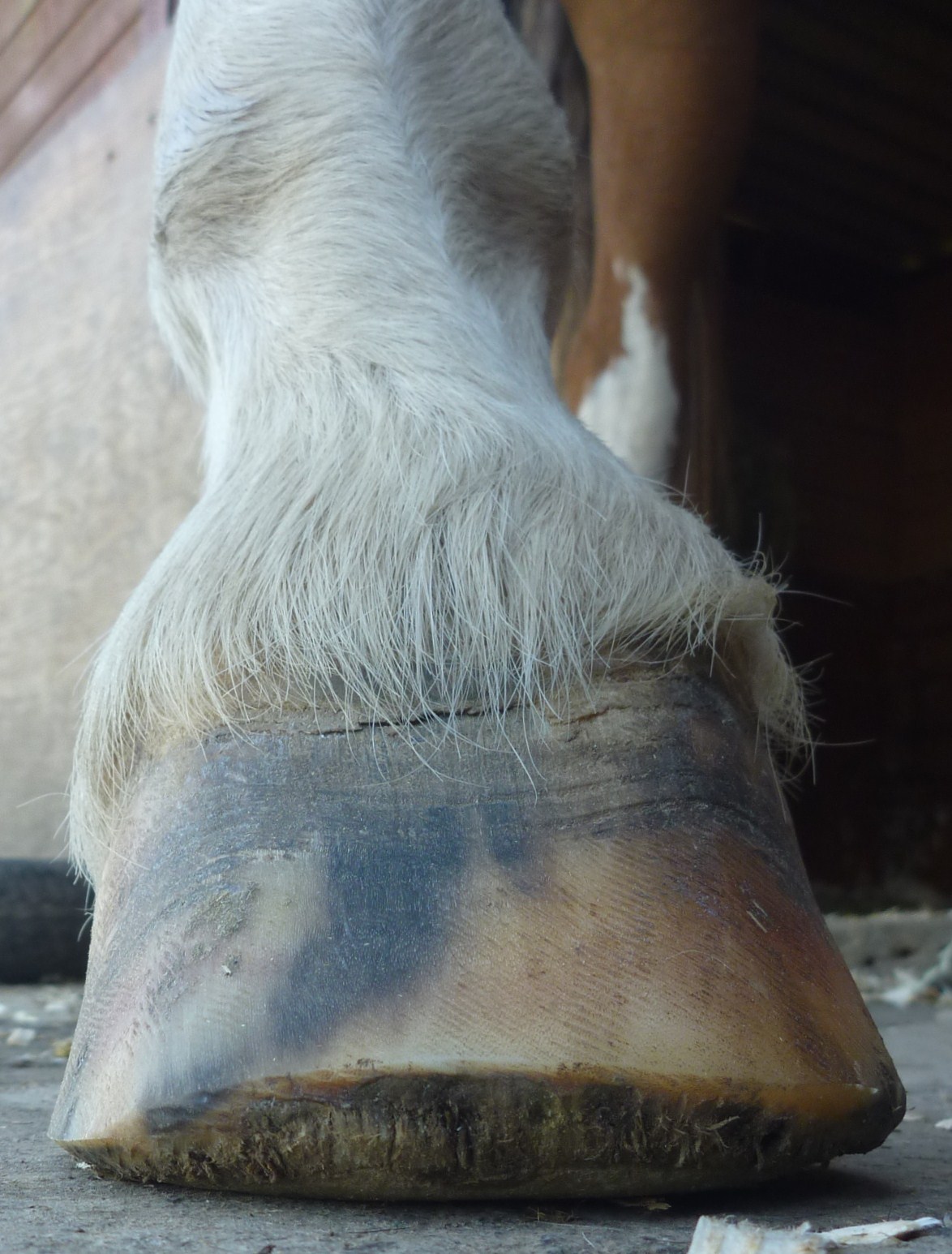


The owner of this horse told me that they were reassured when the attending farrier told them that the horse did not have laminitis.
Only a vet is allowed to diagnose, but like you, I think the horse is a strongly laminitic case, particularly as part of the back story is that it has presented in founder stance.
Only vets are allowed to diagnose though and when a farrier says 'no laminitis' who can blame a less experienced owner for believing them?
Certainly not me, I spent years believing all sorts of things I now realise were completely and utterly wrong and worse.
Sadly I don't know what is going to happen to this horse, I just hope and pray he will get the help he needs.
On a separate note, I haven't commented on the individual photos, but there are some interesting points. Anyone care to have a stab?
Wednesday, 31 August 2011
Hoof reading
I'm giving you just one photo. Tell me what you see. There is a huge amount of background to this with more photos, but first I want your views. So if you want more photos of this case you need to work a little for it! :-)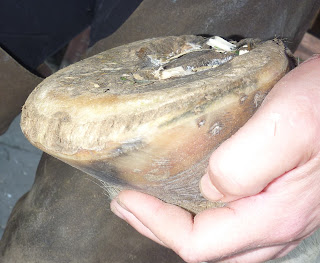

Saturday, 20 August 2011
Sweet dreams - who said WBs can't go barefoot?
 |
| Wow! look at them go :-) |
 |
| Tracks don't have to be over complicated |
Someone (the local 'expert') confidently told me that warmbloods can't go barefoot. Fortunately these guys don't suffer ear mites.
Three warmbloods (only two shown) all barefoot, all confident over a variety of surfaces and having a blast now they can hack out without slipping. Their carer has been brilliant, an example to us all of how to do it. Lots of observation, an open mind and the horses' health always a priority.
And what a great track! Lucky lucky them, but for those without this blessing - these guys got good barefoot before they got the track. It can be done and you know what - I tend to find WB's make excellent barefooters. But just don't feed them 'junk' - it messes with their heads as well as their feet.
Friday, 19 August 2011
Hoof shape and shoes
Same hoof as previous; but solar view. Note how the widest part of the foot is moving towards the heel. You might find it hard to see, but the sole is increasing (slowly) in thickness and concavity. Also note how the frog has quickly widened and how it was somewhat cramped by the shoe.
 |
| 30 05 11 |
 |
| 24 07 11 |
 |
| 11 08 11 |
Navicular and 'metabolic' - 10 weeks 3 days
By kind and generous permission of the carer.
Vets have given a 'Navicular' diagnosis. Horse on presentation has very thin soles, fronts are running forward, heels are collapsed, bulbs pointy rather than full, toe wall has been rasped out in places, frog is squishy (but not rotten, just unused), digital cushion is undeveloped (on palpation) and there is some red in the white line.
Subsequent trial and error shows the horse is sensitive to grass, probably oats and haylage. Does better on night time turnout with soaked hay in the day. Horse is on/off footy depending on circumstances but is generally improving. Progress would probably be faster if 24/7 turnout on a grass free track could be provided. But this carer has chosen to learn how to manage a tricky case, at livery, because long term they want to know how to provide for this horse. Even so, and even with some set backs they are making progress.
In the photo array the first picture (top left) was taken 30/05/11, the last (bottom right) 11/08/11. Can you see the differences?

Monday, 18 July 2011
No miracles here
Regular readers probably know that I write this blog (more accurately, sweat, bleed and salt the air - seeing as how I am not that IT literate) to provide some inspiration for people with more challenging horses and barefoot newbies. Yeah and there is a bit of personal satisfaction too, let's not forget that. I am only human and a pretty flawed one.
But I don't do it to parade 'miracles'. All the horses on this blog are cared for either in livery or at home, with the exception of the odd rehab I had before I ever went pro.
And that is the point really, because it is the care that they receive that transforms these horses. Not my trimming, not some super special feed or supplement, but a general holistic, horse centric care approach.
True, the tall horses need the length adjusted etc, but without proper care all I could achieve would be some pretty basic adjustments. Some horses need a long period of rehabiliation and the carer may need advice on how to rehabiliate a hoof, but they should take the credit for any success because they are the ones who have delivered the care.
And yes, sometimes progress is a little slower than it could be because the owner is learning, but you know equally it is sometimes really really fast. And previous horse experience is not really any kind of guide. What does count is putting the horse first and learning to 'read' them and respond appropriately.
So what I am trying to say is, when trawling the net and this blog in particular, as you peruse the before and after photos, just remember the only miracle at play is the miracle of mother nature.
Friday, 15 July 2011
More tall walls
Another day, another horse, another set of overly tall feet.
This one came as a perpetual tripper. I have never seen such an enormous jumpers bump (not pictured) on a medium heavy cob (and no he doesn't do any jumping). Also camped under. I suspect that this guy, being 20, is going to have more problems with reeducating his muscles than he will have with his new feet.
That's not to say the 'new' feet won't be noticed. His heels will widen, the frog will come into use, breakover will come back, the proportions will change, the walls will get denser as will the sole. How could all these changes not have an impact and not be felt? Sometimes I wish the horses could talk to us - other times I am quite glad they can't.
 |
| Frog is tiny and not touching ground, heels are very tall |
 |
| Heel is contracted, bars bent inwards, foot is 50/50 rather than 2/3 and 1/3 |
 |
| Wall much taller at quarters than toe |
 |
| Height on opposite quarter |
Comparison between shod and unshod height
This hoof has just been deshod. Although there has been a significant shortening of the whole hoof capsule, over time it will get shorter still - and all to the good.
There are two ways in the above photos of comparing the differences between the before and after shots. The horizontal amber lines give an overall comparison of the height of the hoof before and after.
The pairs of coloured lines show more detail. Each colour pair is the same length and angle in both the before and after shots. So the red line which marks the toe length, by being the same length and angle shows the difference in the hoof toe before and after. The green line shows the change in height of the heel. The blue line joins the red to the green, showing their relationship to each other is the same in each photo.
And where did the extra height on the shod horse come from?
Not just the shoe but a lot of untrimmed hoof wall too.
 |
| Before and after deshoeing, same day, same hoof |
There are two ways in the above photos of comparing the differences between the before and after shots. The horizontal amber lines give an overall comparison of the height of the hoof before and after.
The pairs of coloured lines show more detail. Each colour pair is the same length and angle in both the before and after shots. So the red line which marks the toe length, by being the same length and angle shows the difference in the hoof toe before and after. The green line shows the change in height of the heel. The blue line joins the red to the green, showing their relationship to each other is the same in each photo.
And where did the extra height on the shod horse come from?
Not just the shoe but a lot of untrimmed hoof wall too.
 |
| Hoof wall is longer in toe than heel, tipping foot backwards |
Subscribe to:
Posts (Atom)
Subscribe


 Posts
All Comments