Custom Search
Shoes mask weaknesses, barefoot highlights strengths

Friday, 10 May 2013

Asymmetry/deviation and balance

Brief intro - previously shod cob.  Hooves were 'pretty' when shod, but the horse used to trip. I don't think they qualify as 'pretty' anymore, but horse doesn't trip either. I know which I prefer, for the horse's health and the safety of the rider.
LFT - balanced?


Know the difference between flare and asymmetry/deviation? Not everyone does and confusion between the two often leads to unnecessary heartache and drama. It is important to understand why they are different and how each arises. Although if the HCP is practising NHC not too much can go wrong.

We have reviewed deviation before; basically all the structures are synchronised, but the solar area of the hoof has shifted. This might be en masse to the lateral or medial sides or there maybe a bit of a wibble going on see here. So long as the horse is sound and the pedal bone is in balance I don't worry too much.

In an 'ideal' world we might see deviation as an abberation, it does tend to reflect a compensation for another issue maybe higher up. Sometimes if the issue is resolvable the deviation will disappear over time, see here. Sometimes the issue has become fixed, it might be wonky legs or an old injury.

Regardless by applying NHC and with the owners/carers playing their part, the horses I have dealt with have all kept sound and done well.

Flare is another matter and by flare I mean the flare you see when the white line is stretched. See here where the toe is stretched - seen most clearly in the second to last photo of the series (in the linked post, not this one). The hoof in the second photo below has flare, from a stretched white line which you can see extends all round.

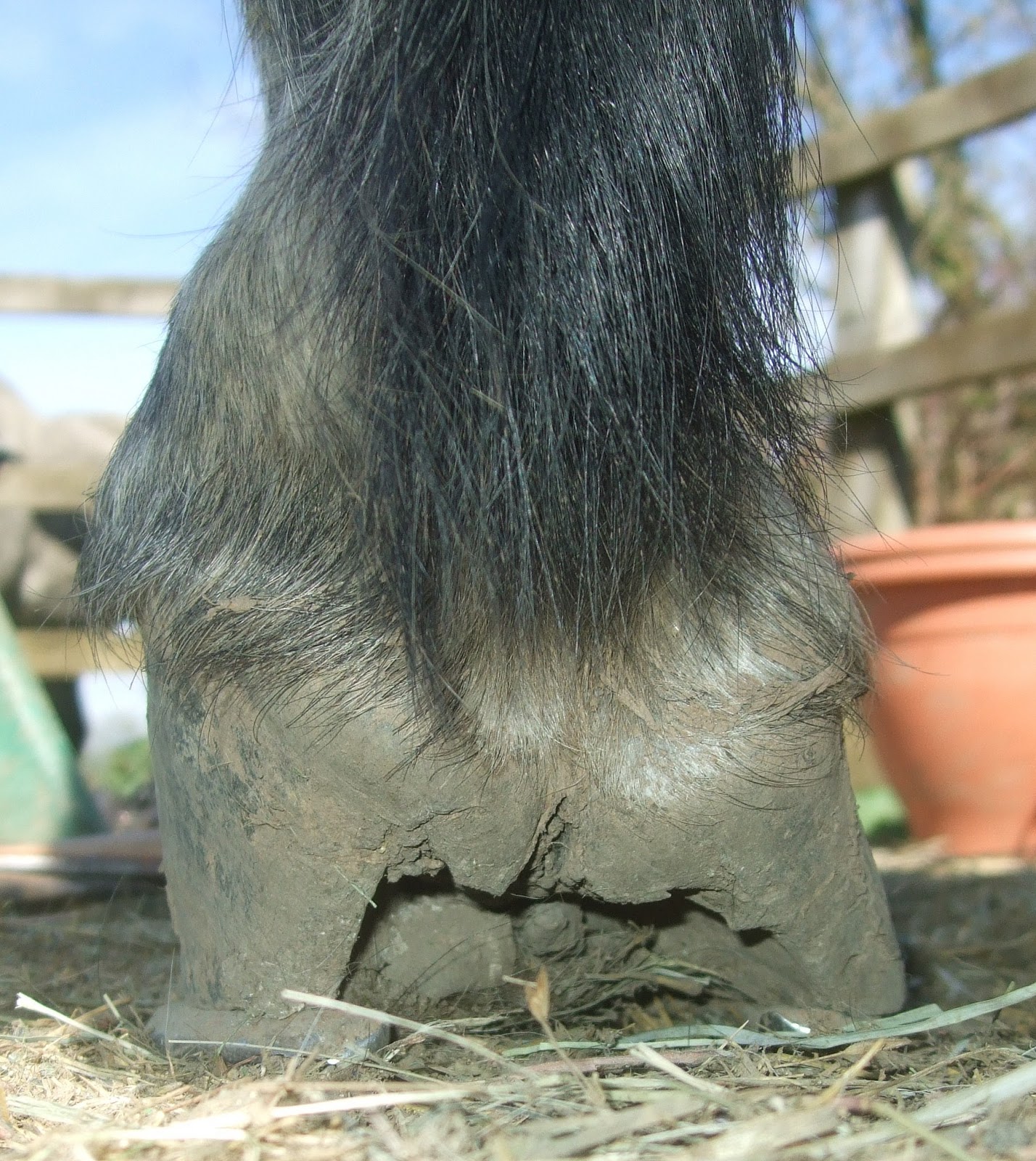
It was suggested to the owner of this horse that the hoof was out of balance and that this should be addressed before dire things happened.  As you can see from the photos below the hoof is actually asymmetric or deviated from the outside, but perfectly balanced from the solar view.  If an attempt were made to dress out the asymmetry/deviation you can easily imagine what might happen. 

Asymmetry


Stretched white line, foot in balance

Tuesday, 7 May 2013

Credit where it's due

I've been asked on more than one occasion to promote products and/or companies in the body of this blog.  For money.  I won't do it.  This blog is meant to be an educational and discussion tool.  It isn't a front for selling.

But today, I break my rule, but not for money and not because I've been asked.

Round of applause goes to Priors Farm Equine Vets.  Once again Ben has risen to the challenge presented by Grace.  No drama, no second mortgage required, just sensible, horse centered pragmatism. 

Saturday, 4 May 2013

Would you be interested?


Student Opportunity

Due to demand for our services outstripping supply, Barefoot South is offering two student places. Students will qualify to become a Barefoot South employee when training is successfully completed.

If you are interested in applying please email hoof@barefoot-south.com by no later than 11th May 2013.

Applicants will need to meet the following criteria to qualify for interview.

·         Demonstrate some practical experience of barefoot, performance horses, this could be owning a working barefoot horse, or looking after working barefoot horses

·         Be able to discuss the pros and cons of barefoot management techniques

·         Hold a full, clean, current UK driving license

·         Have own transport

·         Be capable and competent in handling horses of all sizes

·         Computer literate

·         Have use of a mobile phone

·         Be a quick learner

·         Capable of taking direction

·         Excellent communication skills, written and verbal

·         Possess strong basic maths skills

For further details or any other queries or if you are not sure if you meet the criteria, but are interested in becoming a student please contact Lucy on the above email address.

UK applicants only, all physical aspects of training to take place within one hour of any part of the M25, at Barefoot South’s discretion.

Friday, 3 May 2013

Sweeties and Spavins

The biggest challenge with this horse (for me) was getting her shoes off without hurting her.  I was pretty sure she was nail bound, quite possibly pricked and being on the older side, somewhat stiff and she has spavins. Shoeing had always left her sore, and her owner had to bute her before being shod.

The owner has an ongoing task which is bigger still.  Keeping this young lady away from the sugary consumables she loves.

A recent incident involved breaking out of her stable and into the cattle feed shed where she was found stuffing her face with Liquorice Allsorts.  Apparently that is one of the ingredients of cattle feed these days, and if you check out Dairy One you can get the analysis for 'Candy Byproduct'.

Despite these challenges, the usual livery/grass problems and the dire warnings from the usual suspects about how a spavined horse can't go barefoot, this partnership has done very well.  You can see them below on a sponsored ride, completely barefoot, no problems with slipping.  Quite a few problems with brakes so I'm told.  Oh and her hinds aren't nearly so stiff these days.


Rocket fuel not required, a forage based diet provides this horse with plenty of energy - picture taken by Mark Dalton

One of the fab four... hooves that is

Wednesday, 24 April 2013

Weebles wobble but they don't fall down

Experience of hoof rehab highlights how much an apparently solid and well defined part of a horse's anatomy, ie the hoof can change, both for the good and the not so much.

And of that outwardly solid structure there is one section which can cause enormous heartache and pain, whilst being largely ignored and when noticed frequently misunderstood.  Yet this section is also capable of impressive transformations which often go unnoticed.  What am I referring to?  Heel bulbs of course.

Hence the title
"Weebles wobble but they don't fall down."
Which means to me at least, that the heel bulbs can be in terrible shape, but the poor horse attached to them will still struggle on. Until they reach the point of catastrophic failure anyway.

When you know what to look for the signs are obvious.

Personally I like heel bulbs to be substantial, plump, full bodied, balanced. These qualities hint at well developed lateral cartilages which are a vital part of properly functioning hoof.  I also tend to find them attached to hard working, high performance hooves.  Soggy, squishy, underdeveloped, pointy heel bulbs are generally attached to hooves which are in poor shape one way or another.
Can you see the 'wobble' - horse unsound

Bulbs bulked up - wobble gone - horse sound

Major wobble


If your hoof anatomy is a little shaky, there is a diagram below. (I never said I could draw...) If you want to you might like to try to apply that drawing to the photos. Then compare the anatomy drawing with my rough sketch of a hoof I saw recently (below). Can you see what is happening? The horse was not comfortable. There was other 'stuff' going on, but leaving the foot out of balance wasn't helping. It will take time to address the balance for that hoof (it's not just a matter of lopping a bit off the bottom), but early signs are good.


Friday, 19 April 2013

18 days

RFS - Day One

RFS - Day 18
Compare white stripe in hoof wall with RFS Day One
LFS - Day One


LFS - Day 18
Compare lateral cartilage and heel bulb with
LFS Day One


We first met these hooves here. The horse is currently competent over tarmac, concrete and grass, somewhat footy over stones. Flight of forelimbs significantly improved post trim yesterday. (Improved breakover) Horse looked softer, more relaxed and behaved impeccably despite very windy conditions and rattling sheds. Exercise is designed to rehabilitate hoof and body and is focused on comfortable footsteps... lots of them.

If you have time to exercise your horse then rehab at home is very doable and you get to learn what will and what won't work for your horse. 

This horse lives at a conventional UK livery yard, no special facilicities, equipment and all the usual challenges.  And still we have significant change and improvement in a short space of time.

The owner is fabulous, and that is what makes the difference - the diet and exercise regimes are being followed through.  It's a team effort and the most important member of the team is the main carer/owner.

Wednesday, 10 April 2013

Educational trends and Sugar Beet

For those of you that don't know me - I'm pretty ancient. Not pre war, I just feel like it, but older than the current UK Prime Minister and that is just plain wrong........

In my day (insert much tooth sucking and huffing and puffing), all kids had a reasonable grounding in science, math and general logical thinking at least until the age of 13.  I don't know how it goes now, but 'general science' doesn't seem to cut the mustard in the same way as studying the sciences separately.

Well the proof is in the pudding perhaps, and it is sad to see a general trend for folks not to question published material, digital or print.  But we should and we must apply a healthy dose of scepticism and logic to everything we read.

Take for example sugar beet.  An innocent enough vegetable, but one that can be very devisive. Maybe not as devisive as Maggie Thatcher, God rest, but I loved her for her honesty and I love sugar beet too.  So my cards are on the table, I am pro sugar beet.  But don't let my opinions sway you.  Be logical, look at the data.  Don't be swayed by hysteria either, and there is a shed load of that on the internet these days.

In examining sugar beet you need to separate your data by country, as each has their own regulation regarding how food stuffs are grown and handled.  And this is where the first set of errors creeps in.  For example in the US much if not all sugar beet is GM. In the UK the percentage of GM sugar beet is 0.  That is right, nada, none, zero, because GM sugar beet is not accepted by the sugar processing industry in the UK. It is a very tightly controlled industry, I was actually slightly horrified because it is pretty much a closed shop.  A bit like the unions dear Maggie wasn't so keen on.

So in the UK we realise we have to look at UK data not US.  If you can be bothered, and once, when I was a bit younger I was, you will phone up producers, suppliers, nutritionists, scientists and so forth.  You will get hold of EU legislation and information on pesticides etc.  Having done all this you may find there are two factors at work that make the idea that beet pulp is 'laden with toxins' an 'interesting' idea.

The two factors are science and money.  And never underestimate the power of money (sad but true).  I've often found the way to influence an apparently intractable person was to point out the bottom line benefits.  So for the science, the noxious chemicals and yes I accept that chemicals are noxious, are so low that they are pretty much beyond detection in beet pulp.  I say 'pretty much'  because no doubt there is batch out there where they found some.  For the money, these noxious chemicals are so expensive that farmers, mindful of the bottom line, work extremely hard to minimise their use.  Which makes a nonsense of the idea that these things are liberally sloshed around like so much pond water with neither due care nor consideration.  I don't doubt that some farmers are careless, but the sugar industry tests each batch of beets and won't accept anything which is going to interfere with production or the end product.

But don't get drawn into the rhetoric, hype or hysteria.  If you are worried by the products you feed your horse, do the work.  Understand how your horse's digestive system functions, appreciate the beauty of hind gut fermentation and what is required to keep it afloat.  Call your suppliers, get the data.  And observe your horse.

For what is one man's meat is anothers poison.  I do respect Kellon and the work she has done.  I don't know of anyone else that has the sheer volume of data to support the thinking and findings.  And volume counts.  There are too many ill thought out studies based on handfuls of horses.*  They don't stand up to scrutiny and should be discounted.  Equally I accept that some foodstuffs which are well tolerated by the majority of the equine population won't be tolerated by all.  So if unmolassed beet, or alfalfa or straw etc doesn't work for your horse that is a good finding, but don't use it to assume they don't work across the board.

*And this is often about status and sometimes money too.  Scientists gain standing from the numbers of papers they publish.  They don't necessarily have to be any good.

This is an american blog, but elaborates on the material you may find if you do the work.

http://enduranceridestuff.com/blog/2010/10/beet-pulp-toxicity-dont-fall-for-this/

If someone wants the UK data it is there you just have to work for it.  If you want me to find it for you I will, but you'll have to pay me!

To start your journey and I don't say this guy is right, but it is a starter.

http://www.biotech-info.net/deadly_chemicals.html


Monday, 8 April 2013

Bit of a bind

I first met this charming big black beastie (BBB) on 13th May last year.  His owner had contacted me for help as she didn’t want to lose him.

Prior to our meeting BBB had been referred to a leading referral centre (LRC) with 4/10 lameness in the left fore.
Using MRI scanning the diagnosis was remodelling of the Navicular bone and some damage to the DDFT in both front feet, but primarily the left fore.  But when the owner discussed the diagnosis the waters got muddied somewhat, but ultimately the LRC recommended a year in a field and maybe he would be suitable for the odd hack if he was shod with wedge shoes.  The vets said enjoy that for as long as you can but his prognosis isn't a good one and ultimately will result in Euthanasia. 

And so our journey as Team BBB began.


Recently deshod. Outer hoof wall previously
rasped out. Signs of nail bind present


Roughly two weeks later


Now, notice flared quarters. Not perfect, but
 funcional and sound


Hind post deshoeing


Hind now


To be honest there was nothing exceptional in the outward appearance of the recently deshod hooves.  Thinning of hoof walls and nail bind are surprisingly common in the UK.  What was more unusual was the condition of the hind feet, but these weren’t the focus of the lameness issues.
Today all the hooves are still a work in progress, and I can’t comment on the condition of either the Navicular bones or DDFTs - but what is form without function?  And I am happy to report that BBB is sound and moving beautifully.
How has the owner achieved this remarkable outcome?  Well lots of hard work it’s true, a successful barefoot horse needs a lot of exercise, but diet change was important and allowing the hooves to function naturally without the impediment of a rigid shoe.

What BBB’s owner has to say

"Prior to having a horse with 'caudal foot pain' exacerbated by shoeing I would not have even considered barefoot. I am embarrassed to admit that the one person who kept her horse barefoot at one of the competition yards I was at was someone I avoided as I thought she was slightly strange and a 'parelli type' hacking with horse trainers and never wanting traditional shoes. I didn't for a second think that by keeping her horse barefoot she was looking out for the wellbeing of her horse’s soundness and longevity.
I started my barefoot journey truthfully and honestly because I felt I had little other choice or at least not a very hopeful other choice! I am amazed at how Lucy has guided me, sometimes through gritted teeth (especially with reference to the dietary changes!) with patience and honesty. I was told from the start that it is not always an easy journey and that he may well be sore initially and have peaks and troughs in his transition phase. I was very lucky in that it went very smoothly with an overall improvement that was seen very quickly.
BBB is now one year barefoot and has grown his first new hoof capsule (apparently the second will be even better!) He is completely sound and competing successfully at BD level dressage. I owe this phenomenon to nature which is truly a rather wonderful thing, BBB for 'talking' to me and guiding Lucy's expert DEET principle and to Lucy for being there every step of the way (it helps that you do not go to bed until late!). I look forward to seeing BBB's feet this time next year :)"

Saturday, 6 April 2013

Thoroughbreds can't go barefoot they have genetically bad feet ;-)

Early May 2011

Mid August 2011


Except time and again TB's are proving this common misconception just isn't true. 

This TB had 'typical TB hooves'. Just check out the bull nose in the May photo. By mid August same year the bull nose is halfway grown out. At this stage because the owner was otherwise occupied the horse was a pasture ornament, all that was changed was the diet (shoes had been removed shortly before May photo). If the horse had been exercising I'm pretty sure the bull nose would have grown out faster. The horse is now a competent barefooter, declared very sound by vets and turns his hoof to dressage, jumping and eventing.  Oh he hacks out on roads too...........

Wednesday, 3 April 2013

Sometimes it hurts like hell, but it's worth it

Ok, to protect the innocent and cut a tangled history to size.

Older horse, been through the mill, current fix is heart bars in front, vet says nothing more can be done and if they don't work then call it a day.

I'm asked to peek over stable door - horse definitely not happy.  Owner not happy. So a date was fixed.  To pull the shoes that is.
Heartbar shoe in situ

Note filler on inside of right fore

Immediately post deshoe

I always ask owners and carers for updates and this is what I got today:

"Well like a 2 year old to lead and a greyhound when turned out! He's never been like this before think I might have shoes put back on! Only joking his stride length in front has lengthened a lot, his walking perfectly on road and on stones path, slightly footy when turning. His frogs look even better than yesterday it's absolutely amazing, I've even showed YM the pics!!"

Not bad for 3 days deshod.

And the pain? Well that's nearly all mine - my arms are killing me! :-)

Tuesday, 2 April 2013

Out with a whimper in with a bang

Apologies for no posts since November.  Had a minor diversion.

Now I have a question for you guys.

How long between these two photos.  Same hoof, promise!


Tuesday, 20 November 2012

Stanley - the first horse to officially join Movember to raise money

This is Stanley; barefoot of course, but more importantly a recruit for, and the first official horse to raise money for Movember. (Scroll to the bottom for photo of the Mo.)


Please support him in his efforts to beat the humans at their own game. Stanley's MOment of whiskery fame is to be found at http://mobro.co/stanleythecob, he's already been mentioned on the Queen Mary 2's breakfast tv show, and on his local radio station Wave 105!  

Stanley is a member of a team at the college where his owner works and is currently standing 2nd in the team ratings, but  of course we would  all love him to get to first place and maybe stay there.

When he is not concentrating on growing his Mo, Stanley can be found participating in a variety of horsey sports.  Or eating.  Every horse knows the importance of a healthy appetite when it comes to growing a healthy Mo. :-)

Stanley with his 'Mo'


Friday, 7 September 2012

Should I shoe my laminitic?

Way way back I deshod a laminitic that was due to be PTS that week. Shod by an award winning farrier there was apparently nothing more that could be done. The horse was lame and fed up having suffered conventional therapy and been box rested for months. The owner was naturally distraught.

It wasn't long before he was sound and even with a few dietary hiccups he has been sound since and is currently in work.

I want to walk you through a few pictures - some are gross so finish your dinner before you read any further.

This first picture shows 'Henry', one of my freeze dried legs.  You can see the lamellar wedge, imminent solar penetration and how the poor thing is forced to bear weight on the tip of his pedal bone.
'Henry' NB wedge, angle of the pedal bone & heel height
 
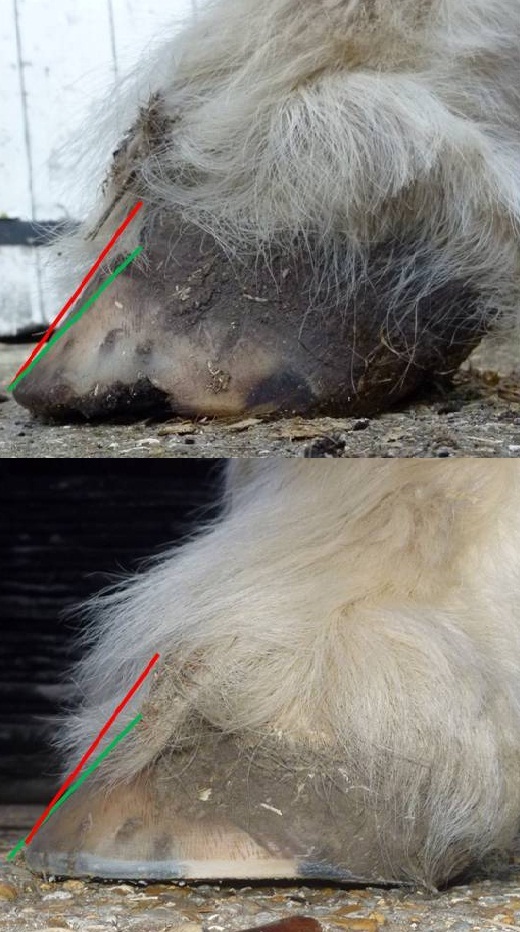
 These photos tell their own story.  I understand that some HCP are taught to maintain the toe wall between 45 and 55 degrees. 
 
Initially this is done by rasping out the outer hoof wall, then when this option is exhausted (no outer wall left), the heel is raised. 
 
This of course will invert the hoof capsule so the horse has to bear progressively more weight on the tip of the pedal bone.  This is both painful and injurous to the horse.


Red is pre trim angle, green post
NB heel height - pre trim, sole has been dechalked
With no more heel raising, but a complete diet change and lots of movement, the healing angle (HA) can grow down.
 
You can see the difference betwee the angle the horse was forced to maintain when he had shoes on, compared with the angle the hoof is meant to grow at. 
NB Wedge, red line denotes HA when fully grown in
You can see the history of trials and tribulations the horse went through during his rehab - dietary misadventures mostly.  But the last bit of wedge is nearly grown out.  Horse was sound throughout.
A few months later, not without hiccups and the wedge has
all but grown out.  Hoof in background has yet to be trimmed.

Wednesday, 5 September 2012

Navicular rehab at home...........

Is perfectly possible although perhaps harder if you are short on facilities. But so long as any pathology has not progressed too far* and you are sufficiently determined you may suprise yourself.

I quote extracts from a text received today:

The vet came today to look at [horse] so we could book another MRI..... He was impressed with his feet and said they look much better.... Vet said whatever we were doing it was clearly working!

This horse is out 24/7 in a less than ideal environment and is owned by someone who works full time. I've coached from the sidelines (and trimmed when needed) but the owner has done all the hard work herself.

*Some people sadly leave it far too late

Thursday, 5 July 2012

What a difference five weeks makes

First I've been off sick for about 3.5 weeks so am now so far behind I almost don't know where to start and it's a bit daunting.  I never was that hot for the admin side of any job and now I have a ton of stuff to do.

Second - it brings to the fore another, hidden benefit of barefoot.  Most hooves can, if necessary, on occasion, go that extra week or two in between trims.  They may get considerably more tatty than their carers prefer, a few may get a little wonky, but the earth continues to turn and the hooves continue to be able to function.  It's only with the rehabs that I really start to worry.  And this is one of those.

Immediately post deshoe, just started to clean up

Five weeks later, to the day, note how toe wall
has grown in, the proportions have improved,
with a wider heel, buttresses coming back,
and frog bulking up


There is still a long way to go, but the horse was considerably more comfortable after the trim and is positively bouncing in boots and pads.  Not bad for five weeks.  And yes there have been some modest dietary modifications and an exercise programme put in place.  A few socks may have bitten the dirt too..........

A traditional viewpoint is that shoes 'protect' hooves. The hooves in these photos are actually stronger and more capable without metal nailed to them. It is going to take time to grow out the damage and in the interim boots and pads are invaluable.

Monday, 18 June 2012

Chunky Monkey defies the modern myths

Functional and pretty!


This foot is attached to one of those gentle giants that aren't supposed to be able to go barefoot - apparently they are too heavy for their feet etc etc I did mention him while waiting for the AA but I thought you'd like a picture and a bit more info.

Originally shod Cytek and to be honest, style of shoe aside, the shoeing job was definitely one of the better ones. Horse is tubby, LGL prone and probably IR.

The carers who look after him worked really hard to clear thrush, help him lose weight and make his rehab as comfortable as possible. And it really didn't take that long.

Now they are reaping the benefits:
  • 'Lazy kick-along' has transformed into dynamic powerhouse
  • Previously painfully slow walk is now so powerful it makes their hips hurt when they ride him
  • No more slipping on the road
  • Loves to trot
  • Cheaper feed bills
  • Happier horse
  • and last and least important - cheaper foot care bills

Sunday, 17 June 2012

Cruel Practical Jokes and other stupidities

You know the really dumb stuff that lads of about 12-15 start doing as their hormones surge and pimples start popping?

The tap on the opposite shoulder so when you look round noone is there.  Putting a foot on a scale to make someone appear heavier.  Drawing pins on chairs and gluing pennies to the pavement.

I used to think these were just dumb practical jokes, but I saw a reworking of the foot on the scale thing recently and it wasn't at all funny.

Mind you I doubt it was done on purpose, but the alternative isn't much better.

Have to keep this beyond anon, so sorry no photos, so let's draw a mental picture for you instead.  I've had to alter a few details but nothing substantive.

Scenario
Hooves being x-rayed for lameness work up.

The experienced among you will know the drill.  Hooves are raised on blocks, sometimes very simply, other times much more complex, but remember the hoof on block bit.

One of the things x-rays are used for is to help vets determine side/side and front/back balance of the hoof and the pedal bone within it.

So I'm looking at this x-ray, you can clearly see the block under the hoof.

Except you can't; there is no block under the caudal hoof at all and the heel has been allowed to dip below the level of the rest of the hoof by a significant amount because it is falling off the block.

The horse gets diagnosed with negative palmar angle. (Simply put the pedal bone is too low at the back.)

Thought
I am a generally miserable old bag with a naturally inquisitive nature, so I feel pretty comfortable with questioning stuff and have a vet who is good enough to bear it in good humour (bless him).

But many horse owners are not like this.  They are nicer and don't want to upset people or ask 'dumb' questions.

To these nice people I put forward this - so long as you phrase your questions politely and with the best of intent no good vet is going to mind you asking about stuff.  If they do object then maybe you should find one that will let you learn. Because that is what it is all about - learning together so we can better take care of our horses to whom we owe so much.

Laminitis and Fructans

I was going to post this in 2010 - never quite got round to it.......

Did you know that if you ingested enough water it could kill you?  And I don't mean by drowning. There was a case in the UK not so long ago.  Yet few of us would declare water to be a bad thing, except maybe cats and the odd spotty youth.  Many materials, if eaten in sufficient quantity can have harmful effects.  For some substances; Yew Tree Seeds, Laburnanum Seeds, Deadly Nightshade (I think the clue is in the name......... ) it doesn't take very much.  So the question then is how much is too much?

The reason I mention this is because grass fructans have been getting a lot of bad press largely because of a study published by Dr. Pollitt in 2006.  Now don't get me wrong, this isn't out to demonise Pollitt, he is a fine researcher who no doubt seeks to help horses where he can.  But so far as I can tell, this particular study broke a few rules (basic stuff we were taught in 'O' level when I was a lass and yes that is practically pre history for those cheeky folk who know me).

Problem One
The fructans used didn't come from grass and they didn't even resemble grass fructans.  And here on earth not all fructans are created equal.  The fructans in the experiment were from chickory and these have a simple, mostly linear structure.  Grass fructans are more complex and have branching side chains.

It is unlikely that these different structures will be fermented in the same way, with the same speed and the same quick reduction in hind gut pH.  I am unaware of any study where the same results have been found with grass fructans.

Problem Two
A very high dose; 3.75kg of the pure chickory fructan was delivered by stomach tube, and unlike the lager louts of Europe, few horses would naturally ingest anything this way. It would take c.43kg of fresh grass to deliver that much fructan (and remember even then it would be a different type of fructan).  Grace is a a hoover, and eats far beyond her theoretical capacity but even at her greediest at c.500kg she struggles to put away more than 16kg.  Yes I am that sad that I measure everything.

Problem Three
The peak season for pasture associated laminitis is spring, when fructan levels are low.

Conclusion
So from my simple 'O' level point of view, the findings of this research are that if you hook a horse up to a stomach tube, force feed it an unnaturally and ridiculously large amount of the wrong sort of fructan you are going to disrupt hind gut fermentation and give a horse laminitis.

NB - but why would you?

Thursday, 14 June 2012

Haven't posted about Grace for a while

Especially not on her blog.  Sorry.

I'll have had her for 3 years in July and she is an example of how horses/hooves can have a roller coaster ride, but still generally improve over time. And many changes, both good and bad can be reversed.

Slightly gobsmacked that she is doing pretty well hoof wise despite laminitis rearing its head all around and despite a lack of work.  Although of course she could tip over the edge tomorrow.  Spring last year she didn't do so well.  This year the Spring grass is worse and going on for much longer, but she is foot wise suffering less.

Guts though are terrible with the sheer quantity of long, very wet, low fibre, high sugar,  low mineral grass.  Edible charcoal and Yea Sacc are helping me out.  I keep her in for the occasional whole day too, just to dry her tummy up.  Ideally I'd like her brought in at noon and for a while this worked really well, but there are 'technical' issues so this is what we are doing for now.
I'd like better concavity but not too bad. Nov 2011 and
below

Slightly longer toe than I'd like but okish for a pasture pet


Grace reinforces the notion that a lot of hoof troubles start in the hind gut.  I work my butt off/spend a fair bit to try and help her out with this and so far it seems to be paying off.  Still cheaper than shoes.  But of course this is not why she is barefoot which is entirely for her sake.

I can better identify any onset of laminitis and take remedial action.  Grace can develop and use her caudal hoof, essential for protecting her limbs from concussion (oh boy do I hate riding shod horses after years of bare).  Also an essential element of preventing navicular syndrome. 

While barefoot doesn't entirely prevent thrush (far from it) it is easier to treat and bare horses that are mineral balanced, healthy and in work seem to suffer much less.

Grip on roads is great and with correct conditioning, again especially of the caudal foot, they slip over most surfaces much less. 

Some bare horses seem to slip more on short wet grass, some less.  I can't judge that one as the feedback from clients is mixed.  I do think that unbalanced riders can bring a bare horse down more easily on wet grass. 

But the shod horse is staying upright at the expense of long term joint/ligament health - so if you are not balanced my advice is 'Don't jump short wet grass - period'. 

I know at the time it is hard, yes I was once a teenager, despite my Mum saying I was born aged 40.......  but there are more important things in life than ribbons.

Common Sense

Couldn't help but notice a horse with extraordinarily oval feet.  Extensive lamellar wedge (stretched white line) poking out over the toe of each shoe.  No outer hoof wall at distal point of hoof.  My big ears overheard the BHS Instructor who is the horse's owner commenting:

"The farrier says he's laminitic, but his feet have always been like that."

Well that's all right then.......................................  (not).

Contrasted with carer for this horse who was being reassured that all was ok - but who despite being a novice decided to to their own thinking and research.

RF Eggbar prescribed for heel shear.
NB contraction, prolapsed frog which
doesn't reach the floor.   Uneven heel
heights.

Tall foot had eggbar, other foot shod plain. Horse tripped
badly to point of falling

NB front leg stance.


Qualifications count for nought if they fly in the face of common sense.

About Me

My photo
Southern England, United Kingdom